Summary
Editor's rating
Value for money: pays off if you care about the data, not the looks
Design: functional, a bit plain, and slightly dated
Battery life: decent, but the 7 days claim is optimistic
Comfort: easy to forget on the wrist… most of the time
Materials and build: light, plasticky, but not fragile
Tracking performance: solid health data with a few quirks
What the Vivosmart 5 actually is (and isn’t)
Pros
- Very comfortable and light for 24/7 wear, including sleep
- Strong health tracking (stress, body battery, sleep score) with a detailed free app
- Reliable notifications and stable phone connection without constant glitches
Cons
- Screen is small and monochrome, feels dated next to newer trackers
- Real-world battery life is closer to 3–5 days than the advertised 7 with all features on
- Lacks some basic quality-of-life features like an on-band timer and more watch face options

Specifications
View full product page →| Brand | Garmin |
A simple tracker for people who just want the numbers
I’ve been using the Garmin Vivosmart 5 (white, S/M) for a couple of weeks, mainly as a daily health tracker and to keep an eye on stress and sleep. I came from cheaper Chinese bands and a basic Fitbit-style tracker, so I wasn’t expecting miracles, just something more reliable with better data. The short version: it’s a solid, data-focused band, but it does feel a bit behind on smart features and the screen is on the small side.
What pushed me to try this one was Garmin’s reputation for solid tracking and the free Garmin Connect app. I didn’t want to pay for subscriptions or deal with brands that kill their apps after two years. The Vivosmart 5 plugs into that ecosystem pretty smoothly: setup with my phone took about 10–15 minutes including account creation, pairing, and first sync. Nothing fancy, but it worked on the first try, which is already better than some competitors I’ve tried.
From day one, the focus is clearly on health metrics: body battery, stress, heart rate, sleep score, Pulse Ox, steps, intensity minutes. If you want flashy watch faces, contactless payment, or music control on your wrist, this is not it. This is more like a health dashboard strapped to your arm. I ended up checking the app way more than the band itself, and that’s basically how this product is meant to be used.
It’s not perfect. The battery doesn’t hit the official 7 days if you leave everything on, the screen is a bit cramped, and it feels a bit old-school next to newer trackers. But in daily life it’s reliable, fairly accurate, and low drama. If you care more about good data than fancy looks, it’s worth a serious look. If you want a mini smartwatch, you’ll probably be underwhelmed.
Value for money: pays off if you care about the data, not the looks
In terms of price vs what you get, the Vivosmart 5 sits in an awkward but still acceptable spot. It’s more expensive than a lot of basic Chinese trackers and some entry-level Fitbits, but cheaper than full-blown smartwatches. For the money, you’re mainly paying for the Garmin ecosystem and the quality of the health data and app, not for fancy hardware. The band itself feels fairly basic, so if you judge only the physical product, it might feel a bit overpriced.
Where it starts to make sense is if you actually use the Garmin Connect app properly: long-term trends, sleep and stress history, body battery, detailed activity breakdowns, and no subscription fees on top. If you’ve dealt with brands that lock key metrics behind paywalls or kill their apps after a few years, Garmin’s approach feels more long-term. That’s a big part of the value: you’re not just buying plastic and a sensor, you’re buying into a platform that’s been around for a while.
On the flip side, for around the same price, you can sometimes find smartwatches with color screens, better customization, and more smart features (like timers, more watch faces, music controls, etc.). The Vivosmart 5 lacks a simple on-band timer, has a small monochrome screen, and generally feels a bit behind on user experience. If you want something that looks modern and has more smartwatch-like features, this might feel underwhelming.
So, value-wise: if your priority is reliable health tracking, a strong app, and a small, comfy form factor, the price is reasonable. If you mainly want style, big screen, and smart features, you’ll find better deals elsewhere. I’d call it good value for data nerds and health-focused users, and just “okay” value for everyone else.
Design: functional, a bit plain, and slightly dated
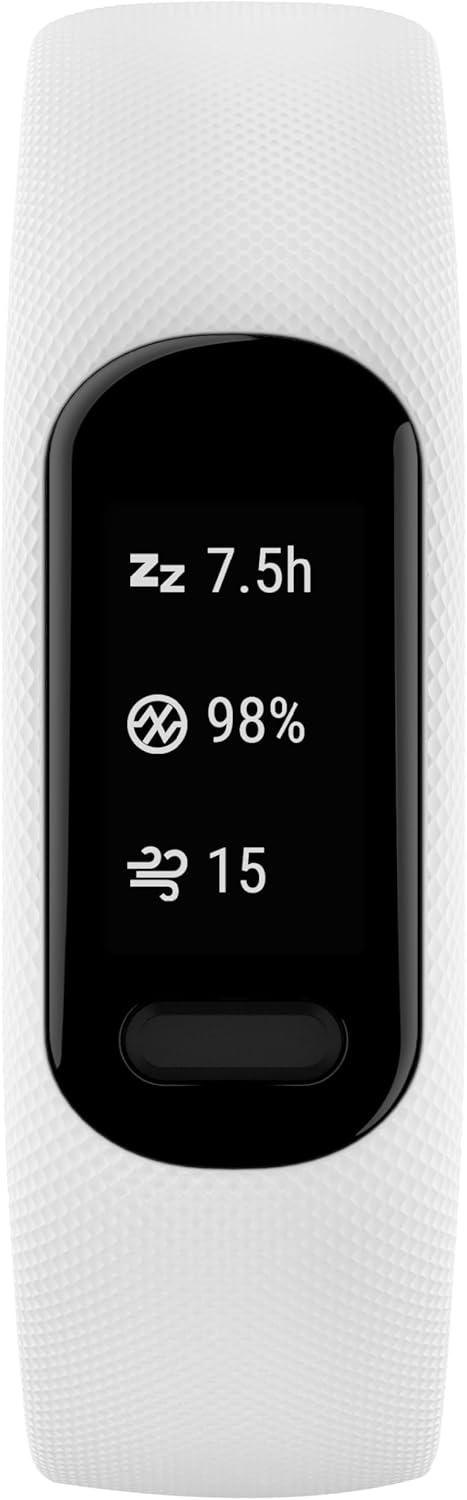
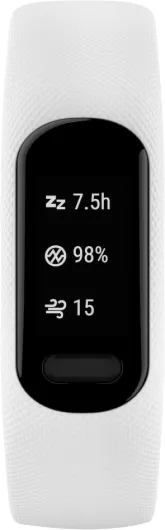
Design-wise, the Vivosmart 5 is very low profile. The white S/M version I used is narrow and light, so it doesn’t scream “gadget” on your wrist. If you’re not into big chunky watches, you’ll probably like that. The band is just a simple silicone strap with a small rectangular module in the middle. No metal bezel, no fancy patterns, just straight-up plastic and silicone. It looks fine, but don’t expect it to impress anyone visually.
The screen is where you feel the age a bit. It’s a 0.84-inch monochrome OLED-style display. It’s brighter and bigger than the Vivosmart 4, but compared to newer bands with color screens and higher resolution, it looks basic. Text is readable, but if you have bad eyesight, you might find it a little small, especially for longer notifications. Outdoors in daylight, it’s legible as long as brightness is up, but again, not impressive—just usable.
One thing I liked is the physical button under the screen. On many cheap bands, everything is touch-only and can be annoying with sweaty or wet fingers. Here, the button makes navigation a bit easier and more predictable. Still, the UI is a bit old-school: swipe up/down through widgets, tap to enter, long press for menus. It works, but it feels like an interface from a few years ago, not something super current.
Overall, the design is purely functional: it’s discreet, light, and doesn’t get in the way. But if you’re into stylish wearables or want something that looks like jewelry or a real watch, this will feel like a plastic band, because that’s basically what it is. For the price, I think Garmin could have done slightly better with the screen and maybe offered a bit more personality in the watch faces, but it’s fine if you prioritize function over looks.
Battery life: decent, but the 7 days claim is optimistic
Garmin advertises up to 7 days of battery life, and like always, that’s the best-case scenario with some features toned down. In real life, with heart rate monitoring always on, notifications enabled, and Pulse Ox only at night, I was getting around 4–5 days per charge. If you go all-in with constant Pulse Ox and a lot of workouts, you’re more in the 3–4 day range. So yeah, the 7 days is technically possible if you strip things down, but most people won’t see that.
The good bit is that battery drain is predictable. You don’t suddenly lose 30% in a day unless you do a long session with GPS connected. You can easily see in the app what’s using power and tweak settings: turn off all-day Pulse Ox, reduce screen brightness, cut down on notifications, or disable wrist-raise. With a few tweaks, 5 days is realistic without making the device useless.
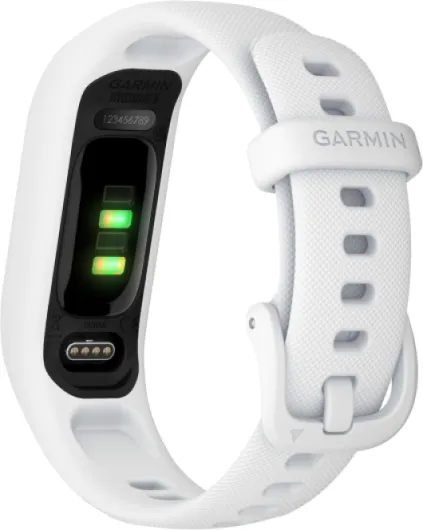
Charging is where it feels a bit dated. The cable is a proprietary clip-style USB cable that plugs into a port on the back of the tracker. It’s not a magnetic cradle; you have to line it up properly. It’s not hard, but it’s less convenient than modern magnetic chargers. Charging from around 20% to full took me roughly an hour and a half plugged into a standard USB charger, which is acceptable.
Overall, the battery is good but not mind-blowing. It easily beats full smartwatches that need daily charging, but some modern bands can do 10+ days. If you’re fine throwing it on the charger twice a week, you’ll be happy. If you’re expecting to forget the charger on a 10-day trip, you might be pushing it unless you disable half the features.
Comfort: easy to forget on the wrist… most of the time
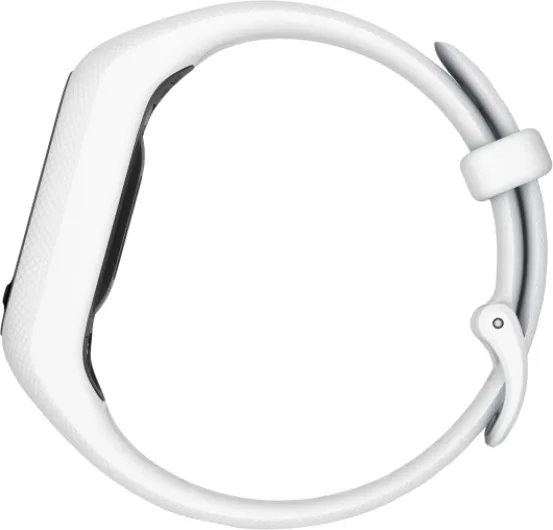
Comfort is probably one of the Vivosmart 5’s strongest points. Because it’s so light and slim, I could wear it 24/7 without it bothering me much. After a couple of days, I barely noticed it was there, even while typing on a laptop or sleeping. Compared to chunkier smartwatches, this is a big plus if you hate feeling like you have a brick on your wrist. The narrow band also makes it easier to wear next to long sleeves or jackets without getting caught.
The silicone strap is flexible and easy to adjust. There are enough holes to get a decent fit, whether you like it a bit looser during the day or tighter for workouts. For heart rate accuracy, you do need to keep it reasonably snug, but not cutting off circulation. I had it slightly tighter during runs and looser at night, and it stayed in place without leaving marks most of the time. When sweat builds up under the band (especially in hot weather or after a workout), it can feel a bit sticky, but that’s pretty standard for silicone.
I did notice that if I left it on for long stretches without taking it off to dry, I’d sometimes get a little skin irritation, mostly from trapped moisture, not the material itself. A quick rinse and drying both the band and my wrist solved it. If you have sensitive skin, plan to take it off once a day for a few minutes. The band doesn’t feel harsh or abrasive; it’s just that constant contact plus sweat and soap can cause mild irritation over time.
Sleeping with it was fine. It’s small enough that it doesn’t dig into your wrist or get caught in the sheets. The only minor annoyance is the screen lighting up if you move your arm and wrist-raise is enabled. You can turn that off to avoid a mini flashlight in your face at 3 a.m. Overall, on comfort: very good for long-term wear, with the usual silicone-band caveats.
Materials and build: light, plasticky, but not fragile
The Vivosmart 5 is mostly resin and silicone, and you can feel that right away. It’s very light (around 24.5 g), which is good for comfort, but it does give off a bit of a cheap vibe at first touch. The strap feels like standard silicone: slightly rubbery, flexible, and easy to clean. It’s not luxurious, but for a fitness tracker that you’ll sweat in, that’s probably the right call. You don’t really want leather or metal here.
The good point is that the strap is replaceable, unlike the Vivosmart 4 where the strap was more integrated and could be a pain when it broke. On this model, the strap can be swapped, so if it wears out or you get irritation, you can change it. That’s a practical upgrade. The buckle is standard and secure; I had no issues with it coming loose during runs or swimming.
The main module (the part with the screen and sensors) feels reasonably solid. It’s not premium, but it doesn’t feel like it will fall apart if you bump it into a door frame. I wore it in the shower, in the pool, and while washing dishes; no water issues so far. The charging port is a physical connector on the back—no magnetic puck. This is a bit old-fashioned and means you have to align the clip-style cable just right. It works, but it’s not as convenient as modern magnetic chargers.
Overall, the materials are practical and sweat-friendly, but if you’re sensitive about plastics or concerned about long-term skin contact with silicone, you might want to keep an eye on irritation and maybe take it off regularly to dry the skin. It’s clearly built more for function than for premium feel, and at this price point, I think it’s acceptable, but not impressive.
Tracking performance: solid health data with a few quirks
On the activity tracking side, the Vivosmart 5 does a pretty solid job, but it’s not perfect. Step counting is in the same ballpark as other brands: sometimes a bit generous, sometimes a bit conservative, but close enough for daily goals. It counts some arm movements as steps (like most trackers), but not to a ridiculous degree. For walks and runs, when connected to your phone’s GPS, distance and pace were consistent with what my phone and another watch reported, so no big surprises there.
The health metrics are where Garmin leans in. Heart rate readings matched fairly well with a chest strap during steady activities (like walking or easy runs). During high-intensity intervals, it lagged a bit, which is pretty common for optical sensors on the wrist. Stress and body battery are more interpretive metrics, but I found them reasonably aligned with how I felt: higher stress spikes during busy work calls, body battery dropping after short nights, etc. It’s not medical-grade, but it gives you a decent picture of your overall load.
Sleep tracking is detailed: you get sleep stages, total time, sleep score, and some tips in the app. It usually detected my sleep and wake times correctly, with maybe a 10–15 minute margin. Short awakenings in the middle of the night were sometimes missed, but that’s normal for wrist-based tracking. The sleep score felt fair: nights where I tossed and turned or went to bed too late got lower scores, and I felt that the next day. If you’re into optimizing your sleep, this gives you enough data to see patterns over weeks.
Sports modes are pretty basic but cover the essentials: walking, running, cardio, yoga, and pool swimming. Swimming worked, but length counting was a bit off sometimes, especially if I stopped at the wall or changed pace. You can see the data in the app and mentally correct it if needed. For casual tracking, it’s fine; if you’re a serious swimmer, you’ll probably want something more specialized. Overall, performance is reliable enough for everyday health tracking, with the usual limitations of wrist sensors.
What the Vivosmart 5 actually is (and isn’t)
On paper, the Vivosmart 5 is a slim fitness band with a tiny 0.84-inch monochrome touchscreen, a physical button, and a bunch of sensors (optical heart rate, Pulse Ox, etc.). It tracks steps, calories, sleep, stress, heart rate, basic sports (walking, running, yoga, cardio, pool swim, and a few more), and syncs everything to the Garmin Connect app on your phone. There’s no built-in GPS, no speaker, no microphone, and no fancy color screen. Think of it as a smart pedometer with health extras.
In practice, the way I used it was pretty simple: I wore it 24/7, let it auto-track my steps and sleep, and manually started activities like walking or pool swimming. Notifications from my phone came through reliably: calls, texts, and app alerts. You can read full text messages on the band, which is handy when your phone’s in your bag. But you can’t really interact much—no replies, no big customizations, it’s just for glancing.
The Garmin Connect app is where the watch really makes sense. Daily dashboards show body battery, stress levels over the day, sleep stages, and heart rate graphs. If you like data, you’ll be happy. If you just want a simple step count and that’s it, it might be overkill. Some users complain about the new app layout, and I kind of get it: it’s packed with info and not always super intuitive at first. But after a few days, I knew where everything was and it became part of my routine.
So, to be clear: this is not a smartwatch. It’s a health and activity tracker first. Compared to something like an Apple Watch or Galaxy Watch, it feels very basic. Compared to cheap bands, it feels more reliable and better structured, especially on the app side. If you go in with that mindset, you’ll judge it more fairly.
Pros
- Very comfortable and light for 24/7 wear, including sleep
- Strong health tracking (stress, body battery, sleep score) with a detailed free app
- Reliable notifications and stable phone connection without constant glitches
Cons
- Screen is small and monochrome, feels dated next to newer trackers
- Real-world battery life is closer to 3–5 days than the advertised 7 with all features on
- Lacks some basic quality-of-life features like an on-band timer and more watch face options
Conclusion
Editor's rating
The Garmin Vivosmart 5 is a no-frills health tracker that focuses on delivering solid data rather than impressing you with fancy design or smart features. It’s comfortable, light, and easy to wear 24/7, and the combination of heart rate, stress, body battery, and sleep tracking gives you a pretty clear picture of how your body is doing over the week. Paired with the Garmin Connect app, it becomes a useful tool to manage energy levels, stress, and basic fitness, without monthly fees or complicated setup.
On the downside, the hardware feels a bit dated: small monochrome screen, proprietary clip charger, no built-in timer, and limited customization. Battery life is decent but doesn’t hit the advertised 7 days unless you dial back features. If you’re expecting a stylish smartwatch with a bright color display and tons of smart functions, you’ll probably be disappointed. But if what you want is a reliable, low-profile band that quietly tracks your health and doesn’t nag you with subscriptions, it does the job well.
I’d recommend it to people who: want a serious health tracker in a small form factor, already like (or are ready to learn) the Garmin app, and don’t care much about flashy screens. I’d skip it if you’re mainly after looks, big screen, or rich smartwatch features—in that case, something like a budget smartwatch or a more modern band will suit you better for the same money.