Summary
Editor's rating
Value for money: strong if you hate subscriptions
Design: looks like a normal ring, not a gadget
Battery life: close to the promise, but depends how you use it
Comfort and sizing: great once dialed in, annoying process to get there
Durability and waterproofing: handles daily life without fuss
Tracking performance: good enough for daily use, not lab-grade
What this ring actually does (and doesn’t do)
Pros
- Very light and comfortable to wear 24/7 once you get the size right
- No subscription fees and full access to data and insights in the app
- Battery realistically lasts about a week or more, with quick 90-minute charging
Cons
- Sizing process can be annoying and the sizing kit doesn’t always match perfectly
- Activity and workout tracking are basic with no GPS and limited sports features

Specifications
View full product page →| Brand | RingConn |
A smart ring that doesn't feel like tech strapped to your hand
I’ve been testing the RingConn Gen 2 Air in Galaxy Silver, size 9, for a bit now, basically wearing it 24/7 except for charging. I’ve used smartwatches and fitness bands before (Garmin and Fitbit), so I’m not new to tracking stuff, but this is my first real try with a smart ring. I wanted something that could handle sleep tracking without a chunky watch digging into my wrist at night, and ideally without yet another monthly subscription.
Right away, the thing that stood out is how light it feels. You read the 2.5 g spec and think “okay, whatever”, but in practice it really does feel like a normal ring. After a day or two I just forgot it was there unless I knocked it on a table. That’s basically what I was hoping for: something that tracks heart rate, sleep, stress, etc., but doesn’t scream “wearable tech” all the time.
I used it mainly for three things: sleep tracking, general daily heart-rate and stress tracking, and as a quiet way to keep an eye on my recovery without having to wear a watch in meetings or while sleeping. I also tested the waterproof claim in showers and a couple of longer swims, and played a bit with the AI insights in the app to see if it was just buzzwords or actually useful.
Overall, it’s not perfect, but it’s pretty solid for what it is. The data looks decent, battery life is close to what they claim (but not always), and the big plus for me: no subscription. There are some annoyances though, mainly around sizing, tiny battery differences vs the marketing, and a few quirks in activity tracking. If you’re expecting medical-grade accuracy or smartwatch-level workout features, you’ll probably be a bit underwhelmed. If you just want a low-profile health tracker that mostly gets out of the way, it does the job.
Value for money: strong if you hate subscriptions
On the value side, the big selling point is simple: no subscription. With Oura and some other brands, the hardware price is just the start, and then you get hit with a monthly fee if you want full access to your data and insights. With RingConn, you pay once for the ring and that’s it. The app is fully usable without paying extra, and the insights aren’t locked behind a paywall. Over a couple of years, that cost difference adds up fast.
For what you pay, you get: a light and comfortable ring, decent health tracking, long battery life, and a reasonably polished app that syncs with Apple Health and Google Fit. The downsides are mostly around the sizing hassle, slightly optimistic battery claims, and the fact that it’s not a high-end sports device. If you go in expecting a small health tracker that focuses on sleep, heart rate, stress, and general wellness, it feels like good value for money. If you expect full smartwatch features, detailed workout metrics, or medical-grade accuracy, you’ll feel it’s missing things.
Compared to wearing a smartwatch, this ring is for people who want something more discreet and more comfortable at night. I’d still keep a watch for serious workouts, but for everyday health tracking, this ring covers most of what I care about: sleep patterns, resting HR, stress trends. And again, the fact you’re not locked into a subscription is a big plus in my book. You can stop using it any time without feeling like you’re wasting an ongoing fee.
So, is it the cheapest thing out there? No. But looking at the build quality, the features, the battery, and especially the subscription-free model, I’d say it’s fairly priced. There’s better stuff out there if you’re a hardcore athlete, and there are cheaper basic trackers if you just want steps. But as a balanced smart ring for everyday health tracking, it sits in a pretty reasonable spot.
Design: looks like a normal ring, not a gadget
Visually, the Galaxy Silver version looks like a simple, minimalist band. No flashy logos, no weird shapes. From a distance, it just looks like a plain metal ring. That’s something I liked a lot, especially compared to some smartwatches and bands that scream “fitness tracker”. If you wear it to work or out to dinner, nobody is going to stare at it. It blends in fine with normal jewelry.
The big selling point design-wise is that it’s ultra-thin (around 2 mm profile) and only 2.5 g. In real life, that means it doesn’t feel like a chunky ring that gets caught on everything. I’ve tried other tech rings before that felt like I was wearing a metal nut from a toolbox. This one sits much flatter, and it doesn’t snag on pockets or gloves much. You’ll still feel it if you grip something hard, but it’s manageable.
Inside the ring, you’ve got the sensors and charging contacts. You don’t see them from the outside, but you do feel a very slight difference on the inner surface compared to a regular ring. It’s not sharp or anything, just not completely smooth like a pure jewelry ring. After a couple of days, my finger just got used to it. The edges are rounded enough that they don’t dig into the skin, even when sleeping.
Style-wise, I’d call it clean and low-key. It’s not going to win any design awards, but it doesn’t look cheap either. The silver finish on mine held up well so far: no big scratches, just the usual tiny marks you’d expect if you tap it on a desk or gym equipment. Compared to the Oura ring, I actually prefer this look — it’s a bit less bulky and a bit more discreet. If you’re into flashy jewelry, this might feel too plain, but for a health tracker I think that’s a plus.
Battery life: close to the promise, but depends how you use it
Battery life is one of the main reasons to get something like this instead of a smartwatch, and the RingConn Gen 2 Air does pretty well here. The official claim is up to 10 days on a single charge, with a full charge taking about 90 minutes. In my actual use, I was getting between 7 and 10 days depending on how much I fiddled with the app and real-time measurements.
On weeks where I just wore the ring, checked the app a couple of times a day, and didn’t spam live heart-rate checks, I got pretty close to the 10-day mark — around 9 days before it dropped under 10% battery. On weeks where I kept opening the app, syncing more often, and playing with settings, it was more like 6–7 days. That matches one of the Amazon reviews where someone only got around a week and was a bit annoyed because the marketing says 10–12. I get the frustration — if you’re expecting a hard 10 days every time, you might be a bit disappointed.
The charging dock is simple: a small base with magnetic contacts and a USB-C cable. You just drop the ring on it and it snaps into place. No charging case like some other models, but honestly, with this kind of battery life, I don’t really need to charge on the go. I mostly just plug it in while I’m at my desk once a week or so. A full charge from almost empty took roughly what they say, around 1–1.5 hours, which is fine.
Overall, I’d say the battery is pretty solid. Not magic, not unlimited, but way better than having to plug in a smartwatch every other day. Just keep in mind that the 10 days is more of a “best case” scenario. If you’re the type who constantly checks stats and keeps all options maxed out, expect closer to a week. Still, for a device this small, that’s decent and doesn’t really get in the way once you build the habit of topping it up before it hits zero.
Comfort and sizing: great once dialed in, annoying process to get there
Comfort is where this ring does pretty well, as long as you get the size right. The ring is light and thin enough that after a couple of days I honestly forgot I had it on most of the time. Sleeping with it was much nicer than wearing a watch. No strap mark on the wrist, nothing pressing on the side of the hand when I lay on it. For sleep tracking alone, a ring like this makes more sense to me than a smartwatch.
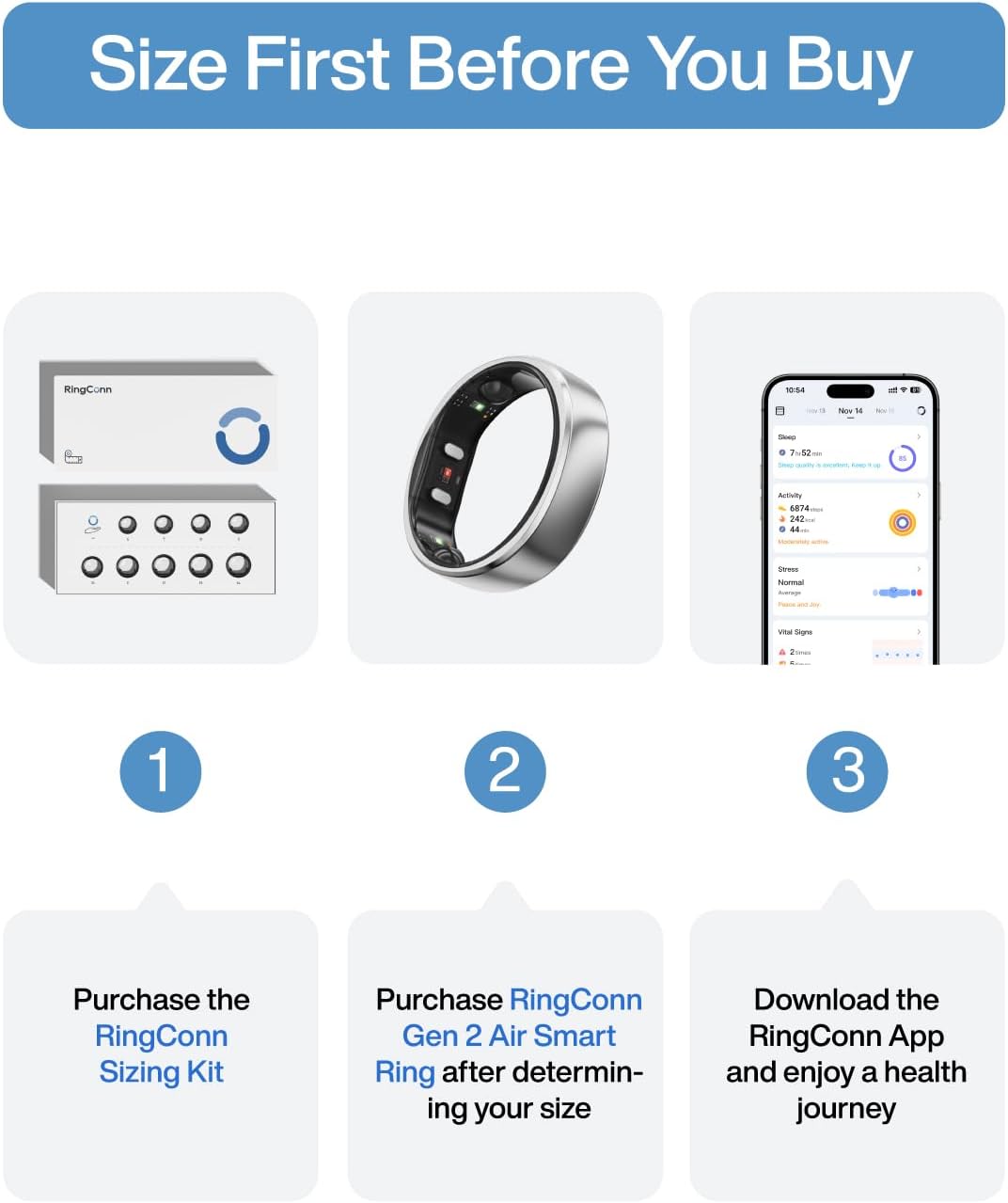
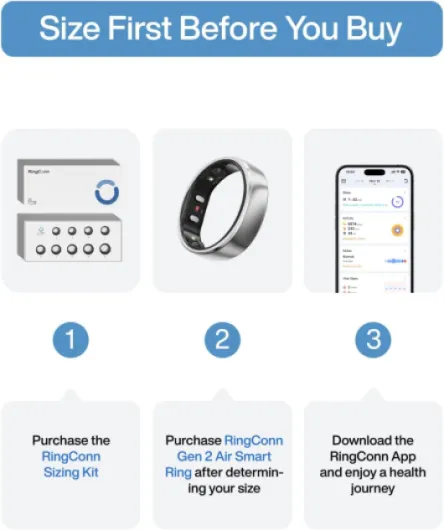
The catch is the sizing. RingConn uses its own sizing standard, so your usual jewelry size doesn’t always match. They push you to order or use a sizing kit first: a set of plastic dummy rings you wear for at least 24 hours. And that’s actually good advice. Your fingers really do change size between day and night, when it’s hot, after salty food, etc. I tried a size that felt fine in the morning, and by the evening it felt a bit tight. After a couple of days of trying, I settled on the size that felt snug but not squeezing at night.
Once you hit the right size, comfort is solid. It stays in place when moving, but I could still twist it slightly if I wanted. It doesn’t dig into the skin when typing or holding a phone. At the gym, I only really noticed it when gripping heavier weights or a pull-up bar, but that’s true of any ring. For everyday stuff like cooking, showering, walking, or working at a desk, it just disappears into the background.
One thing to watch out for: if you go too loose, the sensors might not stay perfectly aligned on the underside of your finger, and that can mess with readings (especially heart rate and SpO2). Too tight, and your finger feels swollen and you’ll end up taking it off anyway. So yeah, the sizing process is a bit of a hassle, and some reviewers complained about mismatches between the kit and final ring. But if you’re willing to spend a couple of days testing the plastic ring and being honest about how it feels at night, you’ll probably end up with a comfortable fit that you can wear all day and night.
Durability and waterproofing: handles daily life without fuss
Durability-wise, the RingConn Gen 2 Air held up fine in normal daily abuse. I wore it in the shower, washing dishes, and in the pool, and I didn’t see any problems. The IP68 rating and 100 m water resistance are clearly overkill for most people, but it’s reassuring. I didn’t take it diving, but for swimming and general water contact it behaved like a normal metal ring — no fogging, no weird behaviour, no disconnects.
The outer surface resisted scratches pretty well for me. After a couple of weeks, I could see tiny hairline marks if I looked very closely under light, but nothing that stood out from a normal metal ring you wear all day. I did accidentally bang it on a metal door handle once, and it left a very small mark, but again, same story as regular jewelry. If you’re super picky about cosmetic perfection, you’ll probably baby it anyway, but for average use it feels tough enough.
Inside, the sensors stayed clean. I just rinsed the ring with water and dried it with a soft cloth now and then. No corrosion, no loose contacts. The connection to the charging dock stayed solid; the magnets still snap it in place properly. I didn’t notice any signs of the coating peeling or fading on the Galaxy Silver model. Obviously, long-term durability over a year or two is hard to judge after a short test, but nothing in my use raised red flags.
One thing to remember: because it’s so light and small, it’s actually easy to forget where you put it when you take it off. I nearly left it on a sink once after a shower. That’s not really a build-quality issue, more just something to keep in mind. From a toughness standpoint, I’d say it’s good value for money: it handles water, sweat, and normal knocks without drama. I wouldn’t wear it for heavy manual labour with tools all day, but for office, gym, and casual outdoor use, it’s holding up well.
Tracking performance: good enough for daily use, not lab-grade
In terms of tracking accuracy, I’d say the RingConn Gen 2 Air is good enough for normal people who just want trends and general guidance, but it’s not something I’d use as a medical reference. I compared it loosely with a Garmin watch and a basic pulse oximeter at home. For heart rate, it was usually in the same ballpark, maybe off by 2–5 bpm here and there, which is fine for casual use. Resting heart rate at night was very close to what my watch showed.
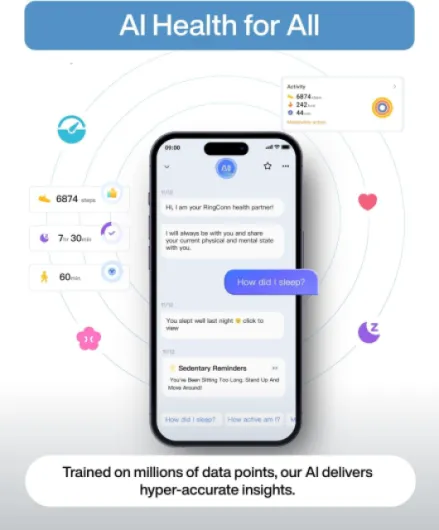
For sleep tracking, it did a decent job of capturing when I fell asleep and when I woke up. The total sleep duration matched pretty well with my actual nights. The breakdown into light, deep, and REM sleep is always a bit of a guess with these devices (they’re not EEGs), but the patterns made sense: on nights where I slept badly, the ring showed more interruptions and lower sleep scores. The sleep insights in the app are actually useful: you get clear summaries like “went to bed later than usual” or “lower deep sleep than your 7-day average”, which helped me see some habits, like scrolling on my phone too late.
The stress tracking is based on heart rate variability (HRV) and general patterns. It flagged some busy workdays as higher stress and calmer weekends as lower, which lined up with how I felt. I wouldn’t use it to diagnose anything, but it’s decent as a nudge to maybe slow down a bit when you see the trend going up. SpO2 readings at night mostly hovered around the same numbers as my finger pulse oximeter, but I didn’t test this super thoroughly, more like spot checks.
For activity and fitness, this is where it’s a bit weaker. There’s no GPS, so you don’t get routes or pace like you would with a watch. Steps and general activity level seem okay, but if you’re a runner or cyclist who cares about split times and VO2max, this ring won’t replace a proper sports watch. I see it more as a background health monitor than a sports training tool. Overall, the performance is decent but nothing more: it gets the job done for everyday health tracking, but if you’re very data-obsessed or a serious athlete, you’ll probably keep your existing watch and use this mainly for sleep and general wellness.
What this ring actually does (and doesn’t do)
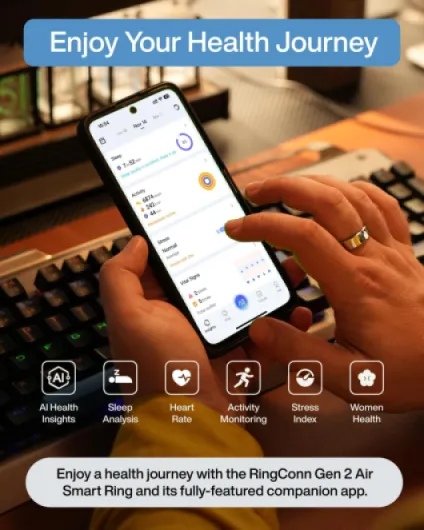
On paper, the RingConn Gen 2 Air is a smart ring focused on health tracking: sleep, heart rate, stress, blood oxygen, and general activity. There’s no screen, no GPS, and no notification buzzes like some smartwatches. Everything goes through the RingConn app on your phone (Android or iOS). The ring itself just sits on your finger and quietly collects data using its internal sensors.
They claim up to 10 days of battery life from a 22 mAh battery, with a full charge in about 90 minutes. In practice, I was usually landing between 7 and 10 days depending on how much I played with the app and live measurements. That lines up with some other user reviews: some people hit the full 10 days, others sit more around a week. Either way, it’s still much better than charging a smartwatch every 1–3 days.
The ring tracks:
- Sleep: duration, stages (light/deep/REM), interruptions, and an overall score
- Heart rate: resting heart rate, HR trends, and sometimes HRV-based stress estimation
- Stress and recovery: through HRV and patterns across the day
- SpO2 (blood oxygen): mainly during sleep
- Activity: steps, basic calories, and rough activity level (but no GPS routes)
- Menstrual cycles: tracking and prediction in the app (I didn’t test that personally, just checked the interface)
The ring is IP68 waterproof and rated up to 100 m water resistance, which is more than enough for showers, pools, and casual swimming. I wore it in the shower daily and for pool sessions without any issues. It syncs with Apple Health and Google Fit, which is nice if you already have other devices feeding into those. No subscription is a big part of the pitch: you pay once for the ring and that’s it. Compared to Oura, that’s a real cost difference over time.
One important bit: RingConn uses its own sizing system, so they really push the idea of using a sizing kit first. That’s not just marketing — if you guess your size like a normal ring, there’s a good chance you’ll be off, and that can mess with both comfort and accuracy. A couple of reviewers mention some hassle between the sizing kit and the final ring matching, so don’t expect this step to be instant. But if you’re patient and wear the plastic ring a day or two, you’ll probably land on the right size.
Pros
- Very light and comfortable to wear 24/7 once you get the size right
- No subscription fees and full access to data and insights in the app
- Battery realistically lasts about a week or more, with quick 90-minute charging
Cons
- Sizing process can be annoying and the sizing kit doesn’t always match perfectly
- Activity and workout tracking are basic with no GPS and limited sports features
Conclusion
Editor's rating
Overall, the RingConn Gen 2 Air is a solid smart ring for everyday health tracking, especially if you’re sick of subscriptions and don’t want a chunky watch on your wrist all the time. It’s light, low-profile, and comfortable enough to wear 24/7 once you sort out the sizing. Sleep tracking, resting heart rate, and stress trends are handled well enough for normal users, and the app gives clear, practical insights instead of just dumping raw graphs on you. Battery life is good: realistically 7–10 days depending on your habits, which is still far better than most smartwatches.
On the flip side, it’s not perfect. The sizing process is a bit of a pain, and you really should use the sizing kit properly or you’ll risk a fit that’s either uncomfortable or less accurate. The 10-day battery claim is a best-case scenario, not a guarantee. And if you’re a serious athlete looking for detailed workout metrics, GPS, or advanced training tools, this ring won’t replace a dedicated sports watch. It’s more of a quiet background health monitor than a performance tracker.
Who is it for? People who want to track sleep, heart rate, stress, and general wellness without wearing a watch all the time, and who like the idea of a one-time purchase with no monthly fee. Who should skip it? Hardcore runners/cyclists who live inside their training stats, or anyone expecting medical-grade accuracy. If you’re okay with those limits, the RingConn Gen 2 Air is a pretty solid choice that gets the job done without making a big fuss about it.