Summary
Editor's rating
Value for money: good deal if you care more about fitness than fancy features
Design and screen: light, plastic, but the AMOLED saves it
Battery life: where this thing really stands out
Comfort: easy to forget you’re wearing it (in a good way)
GPS, tracking and smart features: fitness first, smart stuff second
What the vívoactive 5 actually is (and isn’t)
Health and sleep tracking: useful, but not perfect
Pros
- Genuinely strong battery life (about a week in real use with workouts and sleep tracking)
- Good fitness and health tracking with lots of sport modes and clear stats
- Light and comfortable enough to wear all day and night, with a bright AMOLED screen
Cons
- Feels more plastic than premium and the interface isn’t as smooth as Apple or Wear OS
- Health metrics like sleep and stress can be hit-or-miss if you look too closely at the details

Specifications
View full product page →| Brand | Garmin |
A smartwatch that actually lasts more than a day
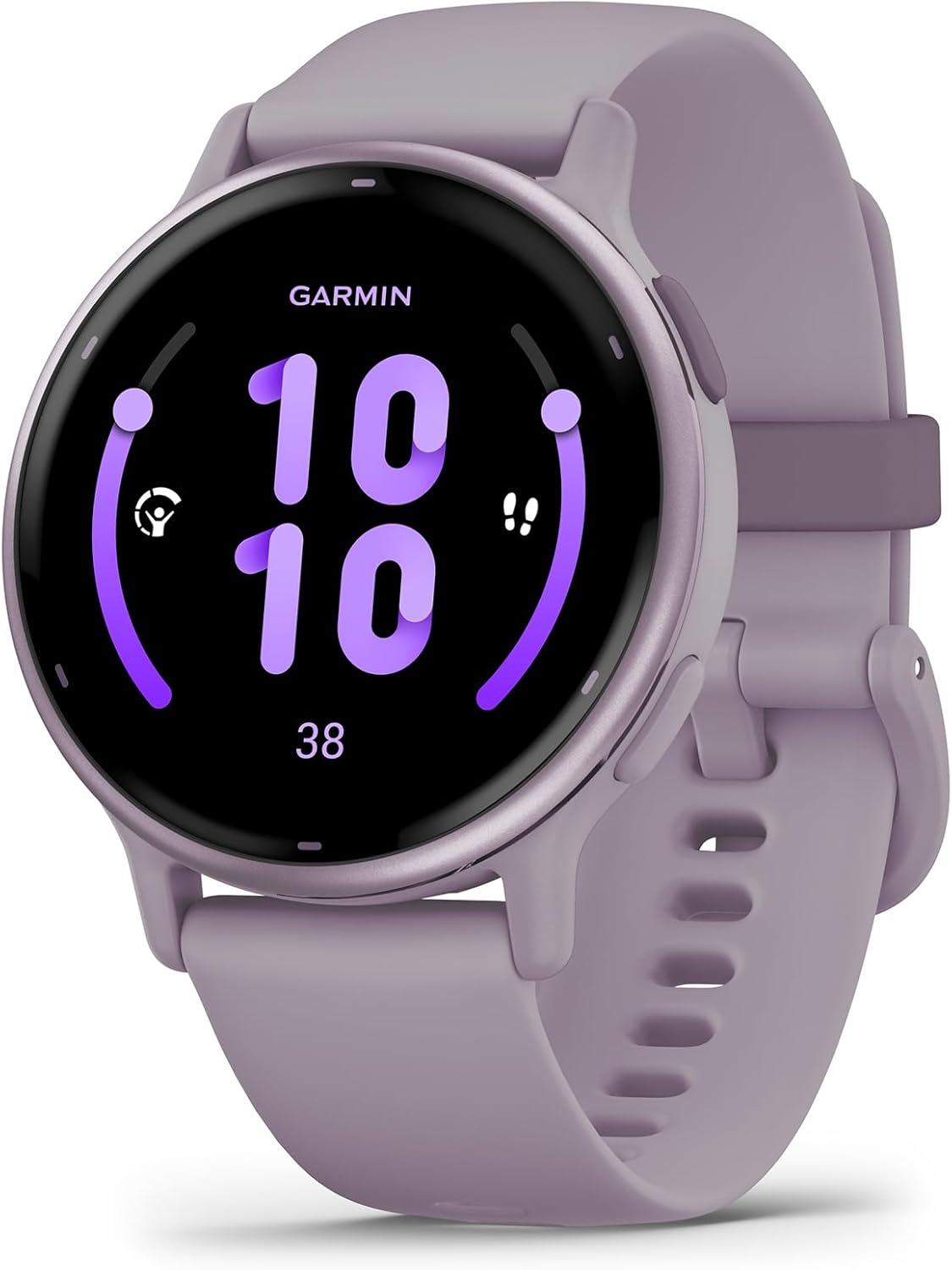
I’ve been using the Garmin vívoactive 5 (Orchid color) for a few weeks, coming from an Apple Watch and briefly a Pixel Watch 2. In simple terms: this is the first smartwatch where I don’t feel like I’m babysitting the battery all the time. It’s not the smartest watch in the world, but as a daily fitness and health tracker, it’s pretty solid.
The first thing that hit me was how relaxed I felt about charging. With my Apple Watch, I was always thinking: “When do I charge this so I don’t kill sleep tracking or my workout?” With the vívoactive 5, I just throw it on the charger roughly once a week, usually when I’m at my desk. No special planning, no stress. That alone changes how you use the thing day to day.
I mainly care about tracking walks, light runs, strength sessions, sleep, and getting notifications on my wrist. I’m not training for a marathon, I’m just trying not to sit all day and keep an eye on my health. From that angle, the vívoactive 5 hits most of the right notes: decent accuracy, lots of sports profiles, and health stats that are “good enough” to see patterns, even if they’re not medical-grade.
It’s not perfect though. The interface feels a bit clunky compared to Apple, the watch feels more plastic than premium, and some metrics like sleep and stress are sometimes off. But if you’re like me and you care more about battery life and fitness than fancy apps and voice assistants, this watch gets the job done without making you charge it every night.
Value for money: good deal if you care more about fitness than fancy features
Price-wise, the vívoactive 5 usually sits around the mid-range of smartwatches. People have grabbed it on sale around $200, and at that price it’s honestly a pretty good package: bright AMOLED screen, solid battery, GPS, offline music, and a big pile of health and fitness features. If you compare it to an Apple Watch or Pixel Watch that costs more and needs daily charging, it starts to look like a sensible buy.
Where the value shows is in the long-term use. You’re not paying for a huge app store or deep integration with a single phone ecosystem. You’re paying for reliable tracking and battery that doesn’t annoy you. Garmin’s software and the Garmin Connect app are not the prettiest, but they’re detailed and fairly stable. And you’re not locked into one phone brand since it works with both Android and iOS, which is nice if you think you might switch phones later.
On the other hand, if you really care about smartwatch features — voice assistant, calls from the wrist, advanced apps, super slick animations — then the vívoactive 5 might feel a bit basic for the money. In that case, you might be happier paying more for something like an Apple Watch, a high-end Garmin, or a Wear OS watch, and just accepting the weaker battery.
For someone like me who mainly wants: good fitness tracking, solid sleep data, all-week battery, and basic notifications, the vívoactive 5 offers good value for money. It’s not the cheapest tracker, but it hits a nice balance between price, features, and battery. If you only need simple step counting and notifications, it might be overkill. But if you want to take your health tracking a bit more seriously without going into full pro-athlete gear, the price feels fair.
Design and screen: light, plastic, but the AMOLED saves it
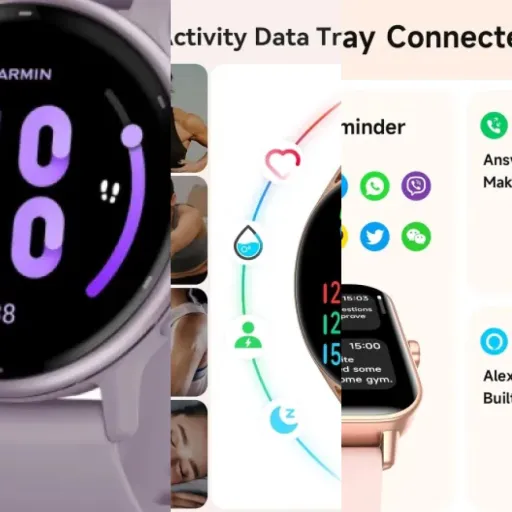
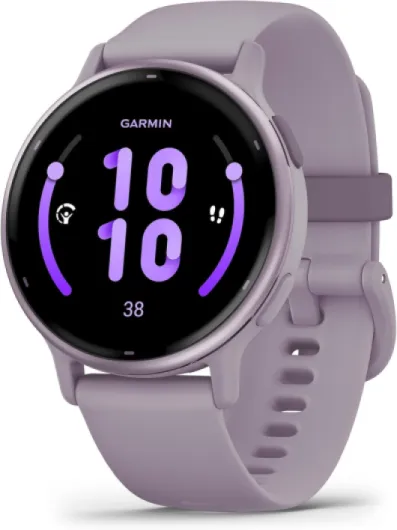
Design-wise, the vívoactive 5 is pretty simple: round case, one main button plus a back button, and a touchscreen. The Orchid color is basically a soft purple that looks more casual than sporty. It’s not a luxury look, it’s more like “decent plastic fitness watch.” If you’re used to brushed metal and heavy cases, this will feel a bit toy-like at first, but you quickly forget about it because it’s so light.
The AMOLED screen (390x390) is the part that actually makes the watch feel modern. It’s bright, colors pop, and text is clear. Outdoors in the sun, I could read it fine after bumping the brightness a bit. Indoors, I actually had to lower brightness and use warmer colors on the watch face at night so it didn’t blast my eyes in bed. The always-on display option is nice, but if you leave it on all the time, battery life obviously drops a bit. I ended up using raise-to-wake and it worked well enough, with the occasional missed wrist turn.
The bezel is pretty minimal, but you can still see a small black border around watch faces. It doesn’t bother me, but if you’re picky about "edge-to-edge" looks, this isn’t that. The watch is also fairly compact: 1.7 x 1.7 x 0.43 inches and about 1.3 ounces, so it sits nicely on smaller wrists and doesn’t feel like a brick when you sleep or work out. That’s a big plus compared to chunkier Garmins and some Wear OS watches.
In short, it looks fine, not premium. The screen is the star, the body is just functional plastic. If you want a watch that looks like jewelry or a fancy mechanical piece, this isn’t it. But if you just want something light and practical that doesn’t scream “I’m training for an Ironman,” the vívoactive 5 design gets the job done.
Battery life: where this thing really stands out
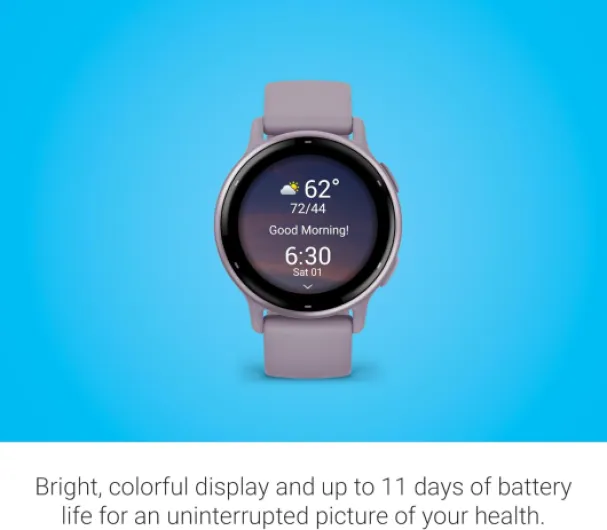
Battery is honestly the main reason I’d pick the vívoactive 5 over an Apple Watch or Pixel Watch again. Garmin says up to 11 days in smartwatch mode. In real life, with always-on display off, notifications on, some GPS workouts, sleep tracking every night, and occasional music playback, I was consistently getting 7–9 days before feeling like I needed to charge. That’s still miles ahead of the 1–2 days I was getting on other watches.
The difference this makes in daily life is big. I don’t have to schedule charging around sleep or workouts. I just plug it in maybe once a week when I’m at my laptop, let it charge while I work, and then forget about it again. On a 3–4 day trip, I didn’t even pack the charger and came back with battery left. That’s the kind of thing that sounds small, but once you get used to it, going back to daily charging feels annoying.
If you crank everything up — always-on display, lots of GPS activities, bright screen, music from the watch — you’ll obviously burn through the battery faster. In that scenario, you’re more in the 4–5 day range from what I saw. Still, that’s better than many other smartwatches under heavy use. Charging itself is via Garmin’s usual proprietary cable. It’s not super fast like some phones, but from low battery to full in about an hour and a bit felt fine to me.
So, in battery terms: this is the watch for people who are tired of charging every night. It’s not magic, but it’s reliable. If you’re used to Apple or Wear OS, you’ll probably feel a bit of relief the first time you realize you haven’t charged it in days and it’s still sitting at 40–50%.
Comfort: easy to forget you’re wearing it (in a good way)
Comfort is one of the spots where the vívoactive 5 does really well. The watch is very light, and you feel that right away. Compared to my old Apple Watch and a bulkier Garmin I tried before, this one pretty much disappears on the wrist after an hour. I’ve worn it all day, then through the night for sleep tracking, and it never felt like I needed to rip it off.
The silicone band is basic but fine. It’s soft enough, doesn’t rub on the skin when you’re sweating, and the buckle system is standard. During runs and strength workouts, it stayed in place without me having to cinch it down super tight. No weird chafing or red marks on my skin after long days, which I’ve had with stiffer bands before. You can swap the strap easily if you want something nicer, but out of the box it’s okay.
For sleep, comfort is a big deal. With some heavier watches, I always ended up taking them off in the middle of the night. With the vívoactive 5, I could keep it on all week with no problem. I did tweak a few things: I turned down screen brightness, shortened the backlight timeout, and disabled always-on display at night. That way, if I rolled over and the screen lit up, it didn’t blast my face. Once that was set, I barely noticed it in bed.
On the downside, because it’s so light and plastic, it doesn’t give that “solid watch” feeling on the wrist. It feels more like a fitness band with a big screen than a traditional watch. That’s not a big issue for me, but if you want something that feels heavy and substantial, you might find it a bit too toy-like. From a pure comfort and wearability angle though, for long days and nights, it’s very easy to live with.
GPS, tracking and smart features: fitness first, smart stuff second
On the performance side, the vívoactive 5 is clearly tuned for fitness and health tracking more than clever smart features. For workouts, GPS locks in reasonably fast, usually within a few seconds outside. Distance tracking on runs and walks has been close enough to my phone and to my partner’s vívoactive 5. On shorter distances, we sometimes saw small differences (0.9 vs 1.0 mile), but on longer runs it usually evened out. For everyday use, that’s acceptable.
Heart rate during workouts seems consistent. During intervals and HIIT, it sometimes lags a bit when my heart rate jumps quickly, which is pretty standard for wrist sensors. For steady runs, walks, and cycling, it’s fine. You also get more than 30 sport profiles: walking, running, cycling, HIIT, strength, yoga, Pilates, swimming, golf, and even wheelchair-specific modes that track pushes instead of steps. I don’t use wheelchair mode personally, but it’s a good sign that Garmin thought about more than just runners.
Smart features are where you feel the difference vs Apple or Google. You get notifications (texts, calls, app alerts), calendar, weather, music controls, and the ability to download music offline from Spotify/Amazon/Deezer if you’re on Android. There’s no speaker or mic, so no voice assistant and no taking calls on the watch. The interface is usable but not slick. Swiping through widgets and menus is okay, but it’s not as smooth as an Apple Watch. Still, once you learn where things are, it works.
Overall, if you want a watch that nails health and fitness tracking and gives you basic smart features, this performs well. If you want deep app ecosystems, voice commands, and super polished animations, this will feel a bit basic. For my use — tracking workouts, sleep, and getting notifications — it does the job reliably, just not in a flashy way.
What the vívoactive 5 actually is (and isn’t)
The vívoactive 5 is basically Garmin’s “everyday” fitness smartwatch: AMOLED screen, built-in GPS, music storage, contactless pay, and a ton of health metrics. It sits below the more expensive Venu and Forerunner lines, but above the basic activity bands. In practice, it feels like a watch made for people who want serious tracking without going full ultra-runner nerd.
On paper, you get: up to 11 days of battery in smartwatch mode, more than 30 sport modes, sleep tracking with sleep score, Body Battery, stress tracking, HRV, nap detection, menstrual tracking, wheelchair mode, and the usual steps/calories/heart rate. It also does phone notifications, music from Spotify/Amazon/Deezer (offline), and Garmin Pay. Storage is 4 GB, which is enough for a few playlists and watch faces, but not a massive library.
What it is not: it’s not a mini smartphone on your wrist. No speaker, no microphone, no voice assistant, no big app store like Apple or Wear OS. The apps you get are mostly sport-related and a few tweaks from Garmin’s Connect IQ store. If you’re used to talking to Siri or Google Assistant from your wrist, you’ll feel a bit naked here. Personally, after a few days, I stopped missing it, but it depends how you use your watch.
So overall, I’d describe it like this: fitness tracker first, smartwatch second. If you go in with that mindset, it makes sense. If you expect Apple Watch-level “smart” features, you’ll probably be a bit underwhelmed. But if your priority is to track your day and your workouts without your watch dying before bedtime, the vívoactive 5 fits that role pretty well.
Health and sleep tracking: useful, but not perfect
The vívoactive 5 tries to do a lot on the health side: sleep score, HRV, Body Battery, stress, naps, menstrual tracking, meditation, and more. The big question is: does it actually feel useful or is it just graphs? Overall, I’d say it’s useful for trends and habits, but you shouldn’t obsess over every number.
Sleep tracking is one of the better parts, but still not flawless. Most nights it correctly detected when I fell asleep and woke up, and the sleep score + coaching is nice to glance at in the morning. It gives you a short summary like “you slept less than usual, maybe go a bit easier today,” which lines up with how I feel most of the time. That said, there were nights where it said I had “light sleep” or was “awake” when I was pretty sure I was sleeping fine. So I treat it as “rough guide,” not hard truth.
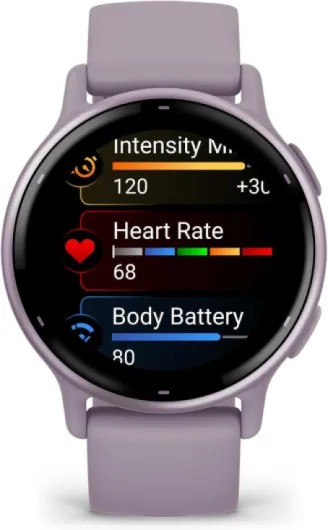
The Body Battery feature is actually more helpful than I expected. It combines sleep, stress, activity, and naps into a single “energy” number. On days after bad sleep or heavy training, it usually shows a lower starting score, and you can see it drain faster if you’re stressed or moving a lot. I’ve used it a few times to justify taking a lighter workout or going to bed earlier. Again, it’s not magic, but it nudges you to think about recovery, not just steps.
Stress and HRV are interesting but sometimes feel a bit random. Sitting at my desk, it sometimes tells me I’m stressed when I’m actually pretty calm, probably reacting to small heart rate changes. On the flip side, it sometimes misses obvious stressful moments. So I look at the daily trends, not the minute-to-minute values. In short: effective as a general health compass, but not something I’d use to make serious medical decisions or obsess over tiny changes.
Pros
- Genuinely strong battery life (about a week in real use with workouts and sleep tracking)
- Good fitness and health tracking with lots of sport modes and clear stats
- Light and comfortable enough to wear all day and night, with a bright AMOLED screen
Cons
- Feels more plastic than premium and the interface isn’t as smooth as Apple or Wear OS
- Health metrics like sleep and stress can be hit-or-miss if you look too closely at the details
Conclusion
Editor's rating
After using the Garmin vívoactive 5 for a while, I’d sum it up like this: it’s a very solid fitness-focused smartwatch with battery life that actually matches real life, not just spec sheets. The design is light and a bit plasticky, but the AMOLED screen looks good, it’s comfortable enough to wear 24/7, and the health features are detailed enough to be useful without turning you into a lab rat. It’s not perfect — the interface can feel clunky, and some health metrics (especially sleep and stress) are sometimes off — but for everyday tracking it does the job well.
Who is it for? People who want to track workouts, sleep, and general health, and who are tired of charging their watch every night. If you’re coming from an Apple Watch or Pixel Watch and you’re okay giving up voice assistants and fancy apps in exchange for a week-long battery and better fitness focus, you’ll probably be happy with this. Who should skip it? Anyone who wants their watch to act like a mini smartphone with calls, voice commands, and a huge app ecosystem. Also, if you care a lot about premium materials and a metal body, the vívoactive 5 will feel a bit too plastic.