Summary
Editor's rating
Value: strong tool, painful price
Big, rugged, and not exactly subtle
Battery and solar: long-lasting, but don’t expect magic from the sun
Comfort: fine for all-day, noticeable for sleep
Titanium, sapphire, and built to be abused
Built to be knocked around, and it feels like it
GPS, tracking, and training tools: this is where it earns its price
What you actually get with the Fenix 7X Sapphire Solar
Pros
- Excellent GPS accuracy, training metrics, and onboard maps for serious outdoor and fitness use
- Very long battery life with solar extending it further, so charging is rare
- Durable build with titanium and sapphire that handles knocks, sweat, and weather without worry
Cons
- High price, especially for the Sapphire Solar version, and overkill for casual users
- Large and thick on the wrist; not ideal for small wrists or people who want a discreet watch
- Smartwatch features and phone integration are basic compared to Apple/Google ecosystems

Specifications
View full product page →| Brand | Garmin |
A tank on the wrist, but in a good way
I’ve been using the Garmin Fenix 7X Sapphire Solar as my main watch for a few weeks now. I bought it because I was tired of charging watches every day and I wanted something that could handle long trail runs, mountain bike rides, and hikes without babying it. I came from a more basic smartwatch and a cheaper fitness band, so this is definitely a step up in terms of what it can track and how rugged it feels.
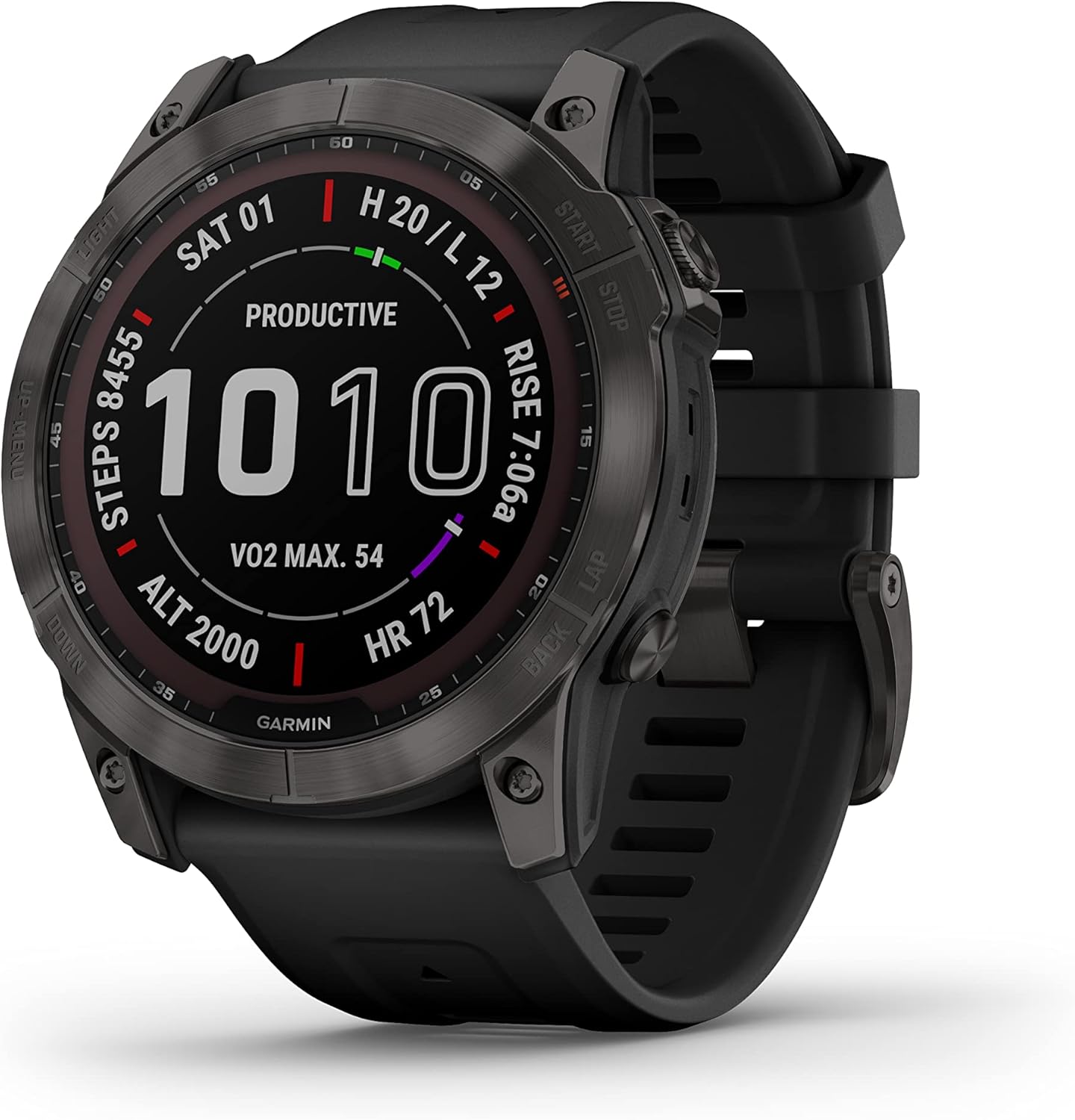
First thing to know: this thing is big. On the wrist it feels like a serious tool, not a fashion watch. If you’re used to slim Apple Watches or Fitbits, the 7X is going to look huge at first. After about three days, I stopped noticing the size, but I still bump it into door frames more than my older, smaller watch. The upside is the big screen is easy to read outdoors, even in bright sun, and the buttons are easy to hit with sweaty hands or gloves.
What pushed me toward the Sapphire Solar version specifically was the combo of titanium case, sapphire glass, and solar extension. I wanted something I wouldn’t scratch on rocks and that I wouldn’t need to charge constantly. The solar doesn’t magically replace a charger, but it does stretch the battery in a noticeable way if you’re outside a lot. I also cared more about GPS accuracy and training data than fancy apps or voice assistants, so Garmin made more sense than a Pixel or Apple Watch for me.
Overall, my first impression is that the Fenix 7X Sapphire Solar is clearly made for people who actually go out and train, not just count steps. It’s not perfect: the smart features are behind what you get from Google or Apple, and the price hurts. But if your priority is battery, durability, and training metrics, it hits those points pretty hard. The rest of this review is basically where it shines and where it annoyed me in day-to-day use.
Value: strong tool, painful price
Let’s be blunt: the price is high, especially for the Sapphire Solar version. You’re paying for premium materials, long battery life, and deep training features, not for flashy smart features or fashion. If you mainly want notifications, simple step counting, and music control, you can get cheaper watches that do that just fine. This one only makes sense if you’ll actually use the GPS, maps, training metrics, and durability on a regular basis.
Compared to a mid-range smartwatch, you’re spending a lot more, but you’re also charging way less often and getting much better sports and navigation tools. Compared to other Garmin models, you’re paying extra for titanium, sapphire, and the bigger battery/flashlight of the 7X. If you don’t need maps on the wrist, multi-band GPS, or the tougher materials, something like an Instinct or a lower Fenix model might give you better value.
Where the value starts to look better is over time. This is not a watch you replace every year. The hardware feels like it will easily last several years, and Garmin tends to keep adding features and updates through firmware. There’s also no required subscription for the main features, which matters when you compare it to ecosystems that lock some metrics behind monthly fees.
Overall, I’d say the value is good if you’re an active user, and just average if you’re more casual. If you’re the type who trains several times a week, goes outdoors often, and keeps gear for years, the price is easier to swallow. If you mostly sit at a desk, do a short jog twice a week, and care more about smart features than battery and durability, you’re probably overspending here and should look at something cheaper or more phone-focused.
Big, rugged, and not exactly subtle
The design of the Fenix 7X Sapphire Solar is clearly aimed at outdoor people, not office fashion. The Carbon Gray DLC titanium case looks serious and fairly neutral, so it doesn’t scream bright sports watch, but the sheer size means it still stands out. The 1.4" always-on display is large and easy to read, with decent resolution (280x280). It’s not an OLED, so you don’t get deep blacks or flashy colors, but in direct sunlight it’s actually easier to read than most OLED watches I’ve used.
What I really liked is the mix of buttons and touchscreen. For workouts, I mostly use the five buttons because they work with sweat, rain, and gloves, and you’re not accidentally pausing your run by brushing the screen. The touchscreen is handy for scrolling through maps, widgets, and settings when you’re not in the middle of an interval. I ended up turning off touch during activities and keeping it on for everything else, which seems like the best compromise.
One thing that stood out is the built-in LED flashlight on the 7X. I honestly thought it was a gimmick before buying it, but I’ve used it way more than expected: finding stuff in the car, walking the dog at night, quick campsite tasks. It’s not as bright as a real headlamp, obviously, but for short bursts it’s genuinely useful. It also has red modes if you care about night vision on trails or in tents.
On the downside, the watch is thick and wide, and on smaller wrists it will look oversized, no way around it. Under tighter sleeves it can be annoying, and I’ve definitely clipped it on door handles and walls a few times. If you want something that disappears on your wrist, this isn’t it. But if you want something that looks and feels like a piece of gear, the design lines up with that. I’d call the design practical and tough, not stylish, and I’m fine with that for this type of watch.
Battery and solar: long-lasting, but don’t expect magic from the sun
Battery life is one of the main reasons I went for this watch, and it’s very solid. In my use (always-on display, all-day heart rate, Pulse Ox during sleep only, a few GPS activities per week, notifications on), I’m getting around 16–20 days per charge without trying to save power. That’s already far better than any general smartwatch I’ve used. When I had a week with more GPS activities (several long rides and runs), it dropped closer to 12–14 days, which is still good for how much tracking it’s doing.
Garmin’s specs say up to 28 days smartwatch and up to 37 with solar, and those numbers are clearly in ideal conditions. The solar part helps, but it’s not a replacement for a charger. On sunny days with a few hours outside, I could see that the estimated remaining days ticked down more slowly. Leaving the watch in direct sunlight for an hour did not give me 1% per hour like I secretly hoped; it was less noticeable than that. Think of solar as a trickle that stretches your normal battery life rather than something that recharges it from dead.
In GPS mode, a 1–2 hour run or ride barely dents the battery. Long hikes or bike days obviously eat more, but you’re not stressing about the battery dying mid-activity. Multi-day trips are realistic without carrying a charger if you’re smart with settings. You can also tweak power modes, turn off music, reduce backlight, or disable some sensors to squeeze more out if you really want.
Charging itself is pretty quick and uses Garmin’s proprietary cable. That’s a bit annoying since you can’t just grab any USB-C cable lying around, but the flip side is you don’t have to plug it in often. Overall, if you’re coming from something you charge daily or every two days, this feels like a big quality-of-life upgrade. Just keep your expectations about solar realistic: it’s a bonus, not a miracle.
Comfort: fine for all-day, noticeable for sleep
In terms of comfort, the Fenix 7X is better than it looks, but you always know it’s there. On my medium wrist, I can wear it all day at work, at the gym, and on runs without it digging in or sliding around. The curved case back and silicone band help it sit fairly flat, and the multiple adjustment holes make it easy to find a tight enough fit for heart rate without cutting off circulation. During runs and rides, I never had it bounce or twist, which is important for accurate readings.
Where the size shows up most is sleep and office use. Sleeping with it is okay, but you definitely feel the bulk when you roll over or when your hand is under your head. I’ve had smaller watches that I totally forgot about at night; this one I don’t forget. I still wear it to bed because I like the sleep and HRV data, but if I didn’t care about that, I’d probably take it off at night just for comfort. Under a shirt cuff or jacket, it can get caught, and sometimes I have to pull the sleeve over it manually.
On hot days or sweaty workouts, the silicone band can get a bit sticky. It’s not horrible, just typical for this type of band. Loosening it one notch after workouts solved most of that. If you’re very sensitive to that rubbery feeling, a nylon strap would probably fix it. The main watch body doesn’t cause any skin irritation for me, and the sensor area on the back is smooth enough.
Overall, comfort is decent for a large sports watch, but if you have very small wrists or hate bulky watches, this model is going to feel overkill. For average or bigger wrists and people who accept that a heavy-duty watch won’t feel like a slim bracelet, it’s acceptable for all-day wear. I’d just say it’s more of a training and outdoor tool that you can wear 24/7, not a barely-there lifestyle watch.
Titanium, sapphire, and built to be abused
The main reason I paid more for the Sapphire Solar version is exactly the materials. You get a titanium bezel and case, a Power Sapphire solar lens, and a pretty sturdy silicone band. Compared to stainless steel plus Gorilla Glass, this combo is lighter and more scratch-resistant. After a few weeks of use with mountain biking, gym sessions, and some clumsy knocks against metal gym racks and door frames, the glass is still pristine and the bezel only has tiny marks you really have to look for.
The titanium helps keep the weight reasonable for such a big watch. It’s not feather-light, but for the size it feels pretty balanced on the wrist. If you’re used to aluminum or plastic smartwatches, you’ll notice the extra heft at first, but it doesn’t feel like a brick. I’ve slept with it on most nights and didn’t feel the need to take it off because of weight. It’s more the bulk than the weight that you notice.
The band is a standard 26mm QuickFit silicone band. Comfort is good, but it’s still rubbery, so in hot weather you’ll get some sweat build-up under it. The upside is it grips well and doesn’t slide around during runs or rides. It feels solid enough that I’m not worried about it snapping, but if you care about looks you’ll probably end up buying a second band (nylon or leather) for more casual wear. Swapping bands is easy – no tools needed.
Overall, the materials feel ready for real outdoor use: rain, mud, sweat, knocks. If you’re the type to scratch watches on rocks or barbells, the sapphire lens is worth it. If you mostly sit at a desk and go for the occasional jog, the cheaper non-sapphire versions might make more sense. For me, being able to be rough with it without stressing over every bump is exactly why I picked this model.
Built to be knocked around, and it feels like it
Durability is one of the main strengths here. I haven’t babied this watch at all. It’s been through sweaty gym sessions, mountain bike rides with branches smacking into it, light rain, showers, and a few proper hits against metal and walls. So far, the sapphire glass is still scratch-free, which is exactly what I wanted when I paid extra for this version. The titanium bezel has picked up a couple of tiny marks, but nothing serious, and they actually make it look more like a tool than a fashion piece.
The buttons feel solid, with a firm click. Some early buyers mentioned slightly “squishy” buttons or sharp edges near the lugs; on mine, the buttons are fine and the lug area is not sharp enough to be a problem. The back of the watch and sensor window also show no wear, despite wearing it 24/7 and sweating with it almost daily. The band pins and QuickFit system haven’t loosened at all, even after swapping bands a few times.
Water resistance has been a non-issue. I’ve showered with it, rinsed mud off under the tap, and had it in heavy rain, and it works like nothing happened. I haven’t done deep diving with it, but for swimming and general water use, it’s clearly built to handle it. The LED flashlight area also seems well sealed; no issues there.
In short, durability lines up with the way Garmin markets it: a rugged outdoor watch that can actually take some abuse. If you tend to destroy cheaper watches or crack screens easily, the Fenix 7X Sapphire Solar makes sense. It’s not invincible, but it feels like something you can keep for several years without it falling apart from normal active use.
GPS, tracking, and training tools: this is where it earns its price
This is the part where the Fenix 7X actually feels worth the money. GPS performance is very strong. With multi-band GNSS on, lock-on is quick – usually within a few seconds once I step outside. I’ve even started activities indoors and walked out the door, and it locked almost immediately. Comparing tracks to my old Garmin bike computer and Strava maps, the lines are cleaner, especially around trees and buildings. No more weird zigzags putting me in rivers or jumping across streets.
The heart rate sensor has been solid too. I compared it on runs and indoor cycling to a chest strap and to gym machines. Most of the time it’s within a couple of beats, with only minor lag when heart rate changes quickly (like intervals or sudden sprints). For normal training and daily tracking, it’s accurate enough. For serious interval work, I’d still trust a chest strap more, but I didn’t feel forced to use one every time. The watch also broadcasts heart rate to devices like Peloton or bike computers, which is handy.
Where Garmin goes deep is the training and recovery metrics. Features like Training Status, Training Readiness, Stamina, and suggested workouts are actually useful when you give it a week or two of data. The stamina feature during runs is interesting: it gives you a rough idea of how much energy you have left in the tank, and it matched pretty well with how I felt at the end of harder sessions. The recovery time estimates after workouts are not perfect, but they’re a decent guideline to avoid hammering yourself every day.
The navigation tools and maps are another strong point. Having full maps on the wrist, being able to follow a route, see climbs coming with ClimbPro, and get back-to-start navigation is genuinely useful on trails. It’s not as comfortable as a big bike computer screen for navigation, but for hiking and running it works fine. In short, performance-wise, this is clearly a watch for people who care about metrics and structured training, and it delivers there.
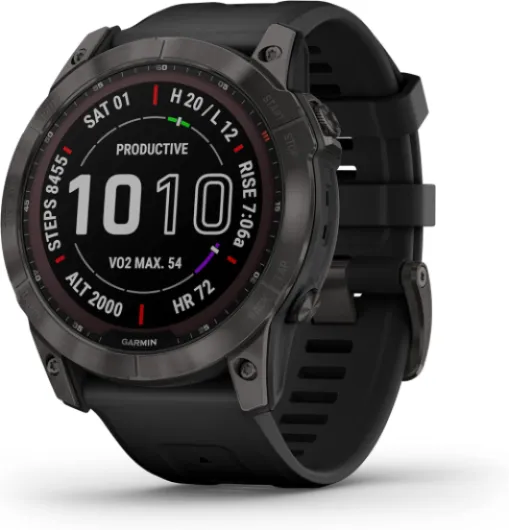
What you actually get with the Fenix 7X Sapphire Solar
Out of the box, you get the watch, a USB charging cable, and the usual small stack of paper. No charger brick, just the cable. Setup with the Garmin Connect app on my phone took about 10–15 minutes, including pairing, firmware updates, and syncing my old data. Nothing complicated, but it’s slower than setting up something like an Apple Watch. Once it’s done, though, you rarely need to mess with it again.
The watch itself is loaded with sports profiles and health tracking. Out of the ones I actually used: running, trail running, mountain biking, indoor cycling, strength training, hiking, and basic walk tracking. There are plenty more (ski, surf, golf, etc.) that I didn’t touch. The GPS side is serious: you get multi-band GNSS (GPS, GLONASS, Galileo), built-in maps (TopoActive), ski and golf maps, and a bunch of navigation tools like ClimbPro and breadcrumb routing. For people who actually get lost in the woods, it’s not just a gimmick.
On the health side, it tracks heart rate, blood oxygen (Pulse Ox), stress, sleep, respiration, body battery, and HRV-based training status. It’s not a medical device, but for day-to-day training and recovery, it’s more than enough. I found the sleep tracking and body battery the most useful to decide whether to push a workout or take it easier. The watch also does smartwatch basics: notifications, music storage (I tested with Spotify offline), Garmin Pay, and widgets for weather, calendar, etc. Just don’t expect smooth voice replies or full app stores here.
In short, the presentation is clear: this is a sports watch first, a smartwatch second. If you come in with that mindset, it makes sense. If you’re chasing fancy animations, an app store, and deep Android/iOS integration, you’ll probably find it a bit barebones. But if you want detailed training tools and long battery life, what’s here is pretty packed and actually useful instead of just showy.
Pros
- Excellent GPS accuracy, training metrics, and onboard maps for serious outdoor and fitness use
- Very long battery life with solar extending it further, so charging is rare
- Durable build with titanium and sapphire that handles knocks, sweat, and weather without worry
Cons
- High price, especially for the Sapphire Solar version, and overkill for casual users
- Large and thick on the wrist; not ideal for small wrists or people who want a discreet watch
- Smartwatch features and phone integration are basic compared to Apple/Google ecosystems
Conclusion
Editor's rating
The Garmin Fenix 7X Sapphire Solar is basically a serious training and outdoor tool that also happens to be a smartwatch. It’s big, tough, and packed with features that actually help if you run, ride, hike, or train regularly. GPS accuracy, battery life, maps, and training metrics are the strong points. The materials – titanium and sapphire – give you confidence to knock it around without stressing over every scratch. The LED flashlight sounds silly on paper but ends up being surprisingly useful in real life.
On the flip side, it’s not cheap, it’s not small, and its smart features lag behind Apple and Google watches. Notifications are fine, but replies, voice commands, and app ecosystems are basic. Solar helps but doesn’t replace charging; it just stretches an already strong battery. Comfort is decent for a big watch, but if you have small wrists or hate bulky devices, the 7X size is probably too much.
I’d recommend this watch to people who train several times a week, care about data, and actually go outdoors – runners, trail runners, hikers, cyclists, triathletes, and anyone planning long days away from power. It also makes sense if you’re rough on gear and want something you can keep for years. If your main use is emails, music control, and casual steps, or you want something slim and stylish, you’re better off with a cheaper Garmin, an Instinct, or a more phone-focused smartwatch.