Summary
Editor's rating
Value for money: hard to complain at this price
Design: big screen, clearly “smartwatch”, but not too flashy
Battery life: the real strong point
Comfort: light enough to forget, straps are decent
Durability & waterproofing: fine for daily life, not for the pool
Performance: health tracking is okay, but not perfect
What this watch actually offers (beyond the product page buzzwords)
Pros
- Very good battery life (around a week in real use)
- Bluetooth calling works and sound is acceptable for the price
- Big, readable screen with lots of watch faces and a useful LED flashlight
Cons
- Sleep tracking can be unreliable and sometimes misses nights
- Not suitable for swimming or hot showers despite being water-resistant
- Health and sports data are basic and not very detailed for serious training

Specifications
View full product page →| Brand | Blackview |
A budget smartwatch that tries to do everything
I’ve been using the Blackview R30MAX in pink as my daily watch for a bit, mainly because I wanted something cheap to track steps, sleep, and get notifications without having to pull my phone out all the time. I’m not a hardcore athlete or a gadget freak, so I was looking for something that just works, doesn’t look too bulky on the wrist, and doesn’t die after one day. This one popped up with a low price, good rating, and a bunch of features that, on paper, are way above its price range.
In practice, it’s a mixed bag but generally positive. Some things are surprisingly good for the money, like the battery and call function, while other things are clearly “budget level”, like the accuracy of some health data and the app polish. If you expect an Apple Watch or a high-end Garmin experience, you’ll be disappointed. But if you’re realistic and just want basic tracking, calls, and notifications, it’s actually pretty solid.
I mainly used it with an Android phone and the Da Fit app, wearing it day and night, in the shower (cold water only, no hot steam), while walking, doing some light workouts, and sleeping. I also tested the LED flashlight quite a bit because I was curious if it was just a gimmick. I compared some readings (heart rate, steps, sleep) with my older Fitbit and with a basic blood oxygen finger clip I already had at home.
To sum up this intro: it does a lot for the price, but not everything is perfect. Some features feel like checkboxes for the product page rather than things you’ll really use. Still, if your expectations are in line with the price, it gets the job done more often than not, especially for calls, basic fitness tracking, and battery life.
Value for money: hard to complain at this price
In terms of value, this is where the Blackview R30MAX makes the most sense. We’re talking about a watch that some people grabbed for around £16–20, which is very low for a smartwatch with calls, a big color screen, heart rate, SpO2, sleep tracking, and over 100 sports modes listed. If you compare it to big brands like Apple, Samsung, or Garmin, it obviously loses on polish, accuracy, and build quality. But those watches cost several times more, so it’s not a fair fight.
At this budget level, you mainly compare it to other cheap Chinese brands on Amazon, and there, it holds up pretty well. The strong points for value are: good battery life, working Bluetooth calls, a clear screen, decent step and heart rate tracking, and a bunch of extra tools like flashlight, calculator, and music control. The weak points are: inconsistent sleep tracking, non-swim-proof waterproofing, and an app that’s functional but not super refined.
If you only want a basic step counter and notifications, there are even cheaper bands out there, but they usually have smaller screens and no calling function. If you want serious training metrics, advanced GPS, and very accurate sleep analysis, you’ll have to spend a lot more. This watch sits somewhere in between: more than a simple band, far from a high-end smartwatch, but with a price much closer to the band.
So from a practical point of view, I’d say the value is good to very good if your expectations are realistic. It’s ideal if you just want to test the smartwatch world without investing a lot, or if you need a secondary watch for work, travel, or for a teenager. It’s not perfect and there are compromises, but for what you pay, it’s hard to be too harsh on it, as long as you know what you’re getting into.
Design: big screen, clearly “smartwatch”, but not too flashy
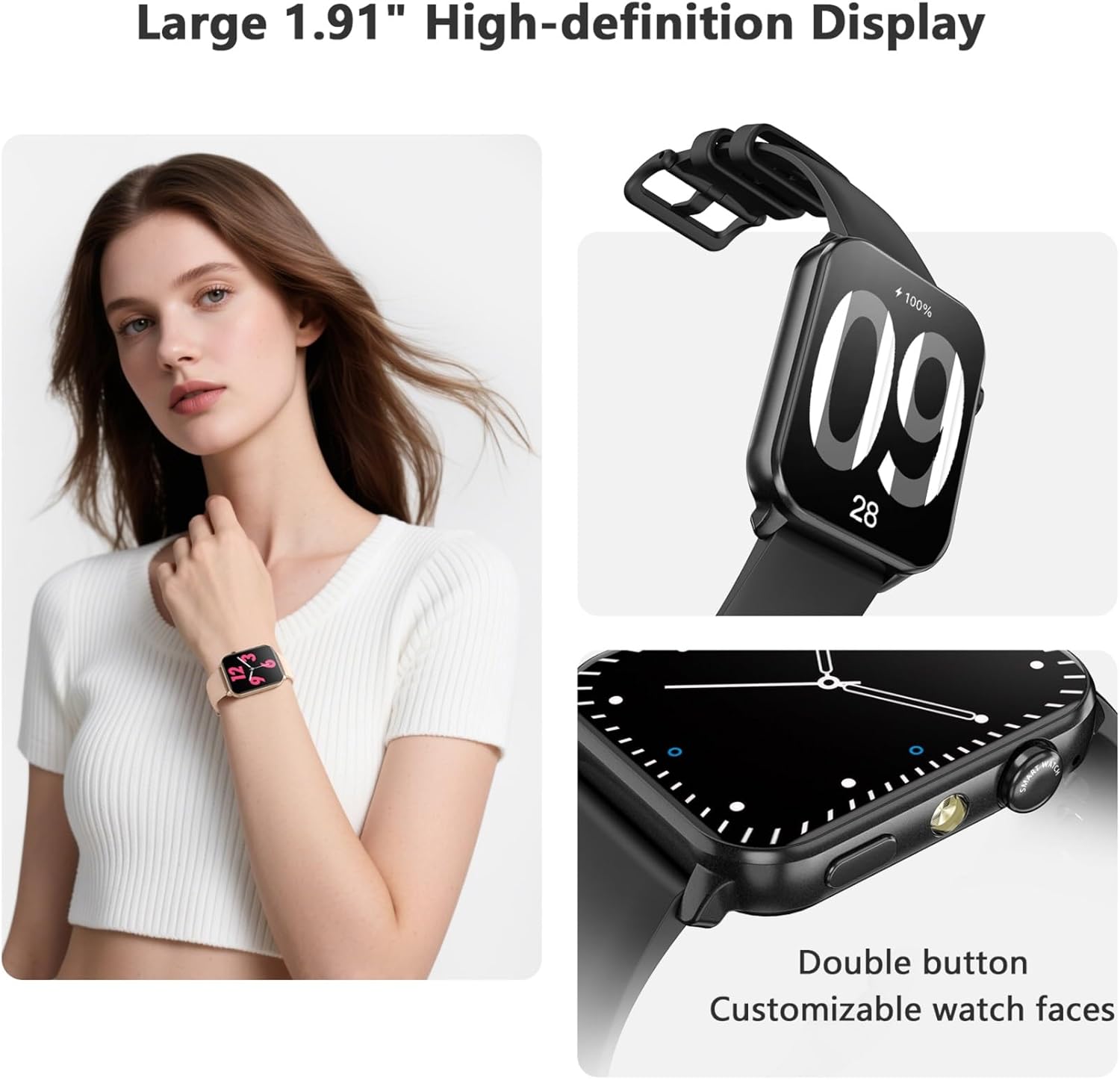
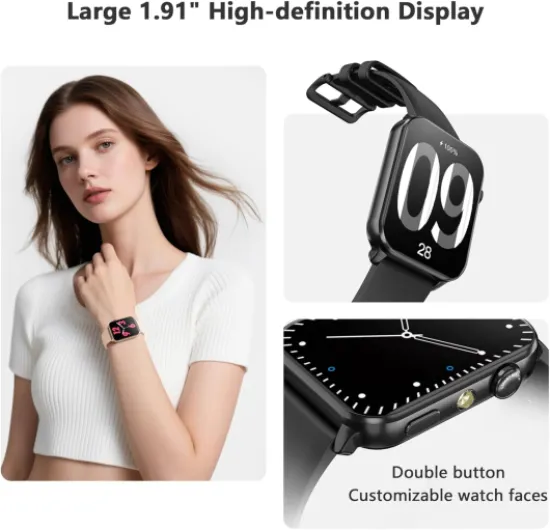
Design-wise, this is clearly a budget watch, but not in a bad way. The 1.91" screen is quite large, so if you have a very small wrist, it will look a bit chunky, but it’s still lighter than a lot of big-brand smartwatches. The pink version is more of a soft, slightly metallic pink on the body, with the straps matching pretty well. It doesn’t scream luxury, but it doesn’t look like a toy either. In real life, it’s closer to a mid-range fitness watch look than a cheap plastic kids’ gadget.
The bezels around the screen are there, you can see them, but they don’t bother too much once you choose a dark or well-fitted watch face from the app. The watch comes with more than 100 faces in Da Fit, and you can also use your own photo, which is nice if you want something simple or personal. I ended up using a basic digital face with big numbers because it’s just easier to read at a glance, especially outdoors.
There’s one main side button and the LED flashlight module integrated into the body. The button has a slightly loose feel compared to premium watches, but it responds fine. The overall shape is a rounded square, nothing special but familiar if you’ve seen an Apple Watch or similar devices. It sits flat on the wrist and doesn’t catch on sleeves too much. The watch is also not too thick, so sleeping with it on didn’t feel weird or uncomfortable for me.
In terms of looks, I’d call it simple and practical. It won’t turn heads, but it also doesn’t look cheap from a distance. Up close, you can tell it’s plastic and not metal, but at this price I don’t expect brushed stainless steel. For everyday use, work, casual outfits, and workouts, it blends in fine. If you’re looking for a fashion statement or something that looks like jewelry, this is not it. If you just want a normal smartwatch look with a large readable screen, it does the job.
Battery life: the real strong point
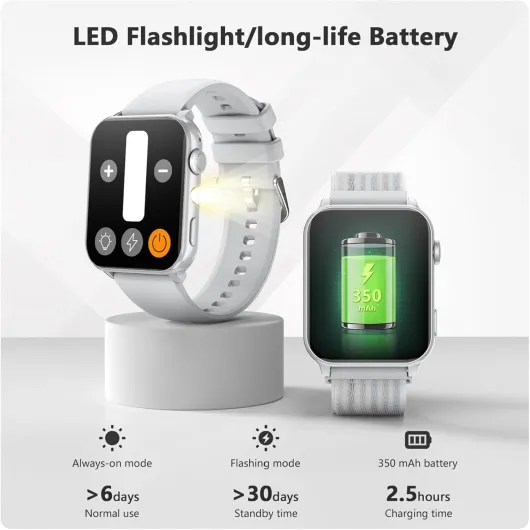
The battery is honestly one of the best parts of this watch. The brand claims up to 5 days of normal use and around 30 days on standby. In real life, with always-on heart rate, notifications on, a couple of short calls per day, and sleep tracking, I got about 6–8 days before needing to recharge. That lines up with what one of the Amazon reviewers said about getting 8 days. If you don’t use calls much and lower the brightness a bit, you can easily stretch it past a week.
Charging is done via a small magnetic cable. It’s not the strongest magnet in the world, but if you place the watch flat on a table, it stays attached fine. A full charge from almost empty took me roughly 1.5–2 hours, which is acceptable. I usually just plugged it in while working at my desk and it was done before I even thought about it. There’s no wireless charging or fancy stuff like that, but at this price, I didn’t expect it.
Battery drain changes depending on what you enable. If you crank the screen brightness to max, use the flashlight a lot, keep the screen waking up constantly with wrist movement, and take many calls, you’ll obviously burn through it faster. But even with fairly heavy usage on one day, I never saw it drop in a scary way. It’s not like some smartwatches where you wonder if you’ll make it to the evening. Here, you can relax and know it will easily last several days.
So for battery, I’d say it’s very solid for a budget smartwatch. You don’t need to baby it or think about charging every night. If you hate the idea of another device that needs daily charging, this is a good point in its favor. Just keep in mind there’s no fast-charge magic, just a normal 2-hour top-up every week or so, which I find totally acceptable.
Comfort: light enough to forget, straps are decent
In terms of comfort, I wore the watch pretty much all day and night for several days in a row. It’s light, so you don’t get that heavy feeling on the wrist like some chunky metal watches. The case is plastic, which helps with the weight. I didn’t have any major irritation issues, and I have fairly sensitive skin. I wore it slightly loose during the day and a bit tighter for workouts and sleep tracking so the sensors could do their job.
The watch usually comes with two straps: a standard silicone-style strap and a Velcro one. I ended up using the Velcro strap more, similar to what one of the Amazon reviewers said. It’s just easier to adjust and more comfortable when your wrist swells a bit during the day. The silicone strap is fine too, but it’s more classic and a bit more “sporty watch” in look. Both straps feel okay for the price, definitely not luxury level, but no rough edges or weird plastic smell in my case.
Sleeping with it was fine. The watch doesn’t dig into the wrist, and the back sensor area is fairly smooth. I’m a side sleeper, and even with my wrist under my head sometimes, it didn’t bother me too much. Of course, if you hate wearing watches at night in general, this won’t change that, but as far as smartwatches go, it’s on the comfortable side. The only thing I noticed is that if you wear it very tight, you might get a slight mark on the skin after several hours, but that’s pretty normal with most fitness watches.
For daily comfort, I’d say it’s good for the price range. Light, not sweaty, no major irritation. The Velcro strap is a nice bonus, especially if you’re not a fan of classic buckles. If you’re used to super soft premium silicone or leather straps from high-end brands, you’ll feel the difference, but again, we’re talking about a budget smartwatch here, and on that scale it does fine.
Durability & waterproofing: fine for daily life, not for the pool
For durability, I haven’t abused it, but I didn’t baby it either. I wore it at work, at home, walking the dog, cooking, cleaning, and in the rain. The body and screen held up pretty well. No major scratches after a couple of weeks, just tiny hairline marks that you only see if you look very closely under light. The plastic case obviously won’t handle heavy impacts like metal, but for normal daily life it’s fine. The strap pins and buckle didn’t loosen or feel flimsy.
Waterproofing is where you have to pay attention. The brand clearly says it’s okay for rain and hand washing, but not for swimming, diving, hot showers, hot springs, or saunas. I followed that and only used it under cold tap water when washing my hands or in light rain. No issues. But this is not a watch you should take to the pool or wear in the shower every day, especially hot showers. If you ignore that, don’t be surprised if it eventually fogs up or dies.
The LED flashlight part also survived fine. I used it quite a bit at night to find stuff in my bag or walk around a dark hallway. It never overheated or caused any weird battery drop. The casing around it still looks intact, no cracks or discoloration. The screen brightness outdoors is decent, so you can read it under sunlight without squinting too much, which also helps the sense of durability because you’re not constantly smashing the watch into your face to see things.
Overall, I’d describe the durability as decent for the price and for normal everyday use. If you’re rough with your gear, bump into things a lot, or want something for intense outdoor sports or swimming, you should probably look at a more rugged or properly waterproof model. But for typical urban and home use, walking, light workouts, and occasional rain, it holds up fine.
Performance: health tracking is okay, but not perfect
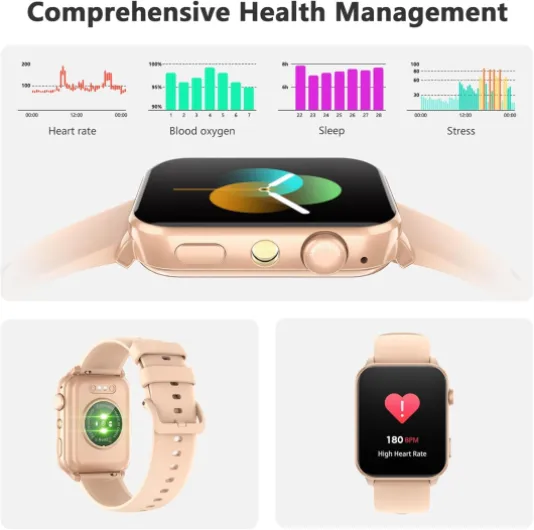
Performance-wise, I’ll split it into a few parts: health tracking, sports tracking, notifications, and calls. For steps, it’s fairly close to what I got with my older Fitbit and my phone’s built-in counter. On a typical 10,000-step day, the difference was usually within a few hundred steps, which is good enough for everyday use. It tracks daily distance and calories too, but those are just estimates based on your profile and steps, so don’t expect lab precision.
Heart rate readings during the day were mostly in line with what I expect and close to my other devices. It reacts a bit slower to sudden changes, like going up stairs quickly, but that’s pretty common on wrist sensors. For SpO2 (blood oxygen), I compared it with a basic finger pulse oximeter I have. When I was resting, values were usually within 1–2 points of the finger device. So it’s okay as a rough indicator, but again, nothing medical-grade, and the brand itself says it’s not for medical use.
The sleep tracking is where things get a bit more hit and miss. It does record sleep stages (light, deep, awake), but like some Amazon reviewers mentioned, sometimes it simply skips a night or only records part of it. I had one night where I clearly slept around 7 hours and it only showed 3. Another night it showed nothing, even though I wore it. When it works, the graphs are clear and give you a good idea of your general sleep pattern, but you can’t trust it 100% every single night. If sleep tracking is your main reason to buy, this might annoy you.
For sports modes, it covers the basics: walking, running, cycling, etc. It can connect to the GPS of your phone, but it doesn’t have its own GPS chip. When I went for a walk with my phone in my pocket and GPS on, the route and distance on the app were fairly accurate. Without the phone, it just estimates based on steps and time. So if you’re a runner who wants detailed pace and route data, this is not the best tool. For casual workouts, it’s fine. Notifications and calls work quite well once set up: messages pop up quickly, and calls can be answered on the watch with decent sound for the price, though not as clean as a proper Bluetooth headset.
What this watch actually offers (beyond the product page buzzwords)
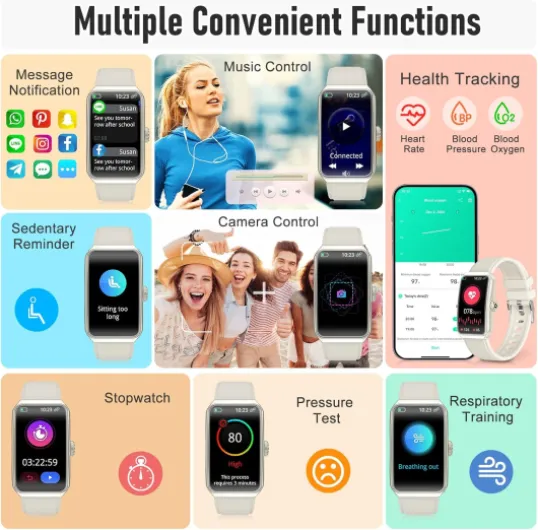
On paper, the Blackview R30MAX throws a lot at you: a 1.91" screen, Bluetooth calling, LED flashlight, 120+ sports modes, heart rate, SpO2, sleep and stress tracking, step counter, female health tracking, and a 350 mAh battery. It connects via Bluetooth to Android or iOS using the Da Fit app. You also get extras like a calculator, world clock, music control, camera shutter, simple games, and breathing exercises. It sounds packed, and technically it is, but not all features are equally useful in day-to-day life.
In my daily use, the features I actually used regularly were: step tracking, notifications, calls, heart rate checks, sleep tracking, and the flashlight. The sports modes list is long, but a lot of them are just copies with different names and the same basic data: time, calories, estimated distance, heart rate. So yes, there are 120+ modes, but don’t expect 120 different detailed training profiles. It’s more like a handful of real modes multiplied by specific sport names.
The watch syncs through the Da Fit app, which is fairly simple and not overloaded with menus. It shows the basics clearly: daily steps, sleep graphs, heart rate curves, and SpO2 history. You can also manage notifications from different apps (WhatsApp, Facebook, SMS, calls, etc.). It works, but it’s not super polished. Sometimes there’s a slight delay in notifications, and a couple of times I had to reconnect Bluetooth in the phone’s settings when calls didn’t go through on the watch.
Overall, in terms of presentation and “what it actually is”, I’d say it’s a budget smartwatch that tries to offer a bit of everything, but is really best for simple tracking and phone-related stuff. The long list of modes and functions looks nice in the description, but in real life you’ll mostly use a core set of features. For the price, that’s fine, but don’t buy it solely because of the “120+ sports modes” line or expect medical-level health data.
Pros
- Very good battery life (around a week in real use)
- Bluetooth calling works and sound is acceptable for the price
- Big, readable screen with lots of watch faces and a useful LED flashlight
Cons
- Sleep tracking can be unreliable and sometimes misses nights
- Not suitable for swimming or hot showers despite being water-resistant
- Health and sports data are basic and not very detailed for serious training
Conclusion
Editor's rating
Overall, the Blackview R30MAX in pink is a solid budget smartwatch if you’re mainly interested in basic fitness tracking, notifications, and the ability to take calls from your wrist. The big screen is easy to read, the battery life is genuinely good, and the watch is light and comfortable enough to wear all day and night. For the price, getting heart rate, SpO2, stress, and sleep tracking on top of that is a nice bonus, even if the data isn’t always perfect.
On the downside, the sleep tracking can be unreliable, sometimes skipping nights or under-reporting sleep. The waterproof rating is limited, so you have to keep it away from swimming and hot showers. The Da Fit app is simple and usable, but not on the same level as what you get from big brands. If you’re a serious athlete, a data nerd, or someone who needs very accurate health metrics, this is probably not the watch for you.
I’d recommend it to people who want a cheap everyday smartwatch to count steps, glance at notifications, occasionally answer calls, and get a rough idea of their sleep and heart rate. It also works as a first smartwatch for someone who doesn’t want to spend a lot. If you expect premium build, advanced training features, or fully reliable sleep analysis, you should look higher up the price ladder. Within its price bracket, though, it gets the job done and offers good value for casual users.