Summary
Editor's rating
Value for money: where it lands vs Apple Watch and cheaper bands
Design: plastic, light, and not trying to look like a luxury watch
Battery life: honest experience vs the 11-day claim
Comfort: great for 24/7 wear, once you ditch the stock band
Tracking performance: strong on fitness, a bit clunky on “smart” stuff
What the vívoactive 5 actually offers in real life
How effective is it for health and training, really?
Pros
- Battery realistically lasts around 5–7 days with normal use, far better than most smartwatches
- Very solid fitness and sleep tracking with useful extras like Body Battery and workout benefit
- Lightweight and comfortable for 24/7 wear, especially for sleep and workouts
Cons
- Design and materials feel a bit basic and plasticky for the price
- Smart features are limited (no mic/speaker, basic app ecosystem, minimal interaction with notifications)
- Sleep/nap detection can be inaccurate at times and is not easy to correct

Specifications
View full product page →| Brand | Garmin |
A smartwatch for people tired of charging every night
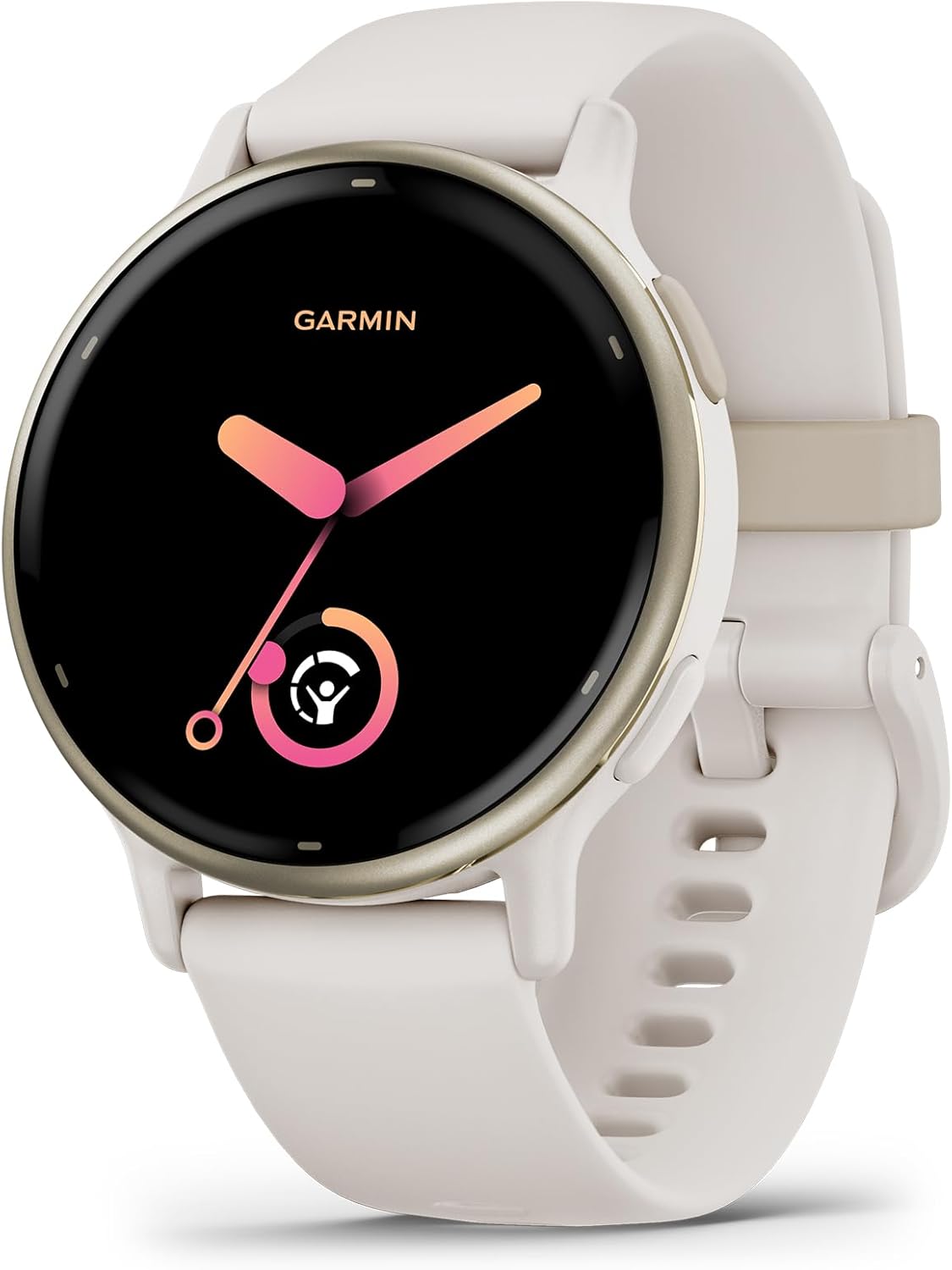
I’ve been using the Garmin vívoactive 5 in ivory for a few weeks, after years of bouncing between an Apple Watch and cheaper fitness bands. The short version: it feels like a watch made by people who care more about tracking your body than turning your wrist into a tiny smartphone. If you’re sick of your watch dying every day, this one is a breath of fresh air.
The first thing that stood out for me was the battery. I’m used to planning my day around when my watch can sit on the charger. With the vívoactive 5, I just charge it once every 5–7 days, depending on how much GPS and music I use. On a weekend trip, I didn’t even pack the charger, which is something I would never risk with an Apple Watch.
On the flip side, you do feel that it’s a fitness-first device. The smart features are there, but they’re basic: notifications, simple controls, no mic or speaker, no fancy app ecosystem. If you’re expecting a mini phone on your wrist, you’ll be disappointed. If you mainly want sleep tracking, workouts, and some health data, it’s much more convincing.
Overall, this is the kind of watch I’d recommend to someone who says, “I just want to track my health properly and not charge it all the time.” It’s not perfect, the software has a few quirks, and the 11-day battery claim is optimistic, but in day-to-day life it gets the job done better than most mainstream smartwatches I’ve tried.
Value for money: where it lands vs Apple Watch and cheaper bands
Price-wise, the vívoactive 5 sits in that middle zone: not cheap, not ultra-premium. I got mine for under $200 on promo, which felt fair for what it offers. At full price it stings a bit more, but you’re still paying less than many Apple Watch or top Samsung models, while getting much better battery life and more serious training tools.
Compared to an Apple Watch, you lose the rich app ecosystem, voice assistant, calls, and deeper integration with your phone. In exchange, you gain a watch that actually behaves like a long-lasting fitness device. If you’re mainly into notifications, Apple Pay, and quick replies, this Garmin will feel like a downgrade. If you care more about training load, recovery info, and not charging every night, it feels like a better use of money.
Against cheaper fitness bands (like basic Garmins, Fitbits, or budget brands), the vívoactive 5 gives you: a nicer AMOLED screen, more accurate and detailed tracking, onboard music, better GPS, and more serious training features. If you just want steps and basic sleep, a cheaper band is enough. If you want something that can actually support a running plan or structured training without paying top-tier prices, the vívoactive 5 sits in a good spot.
The nice thing is there are no subscriptions required to unlock features. You buy it once, you get the full Garmin ecosystem, training plans included. For me, that adds a lot of value compared to brands that lock advanced stats behind monthly fees. Overall, I’d call the value good but not mind-blowing: you’re paying a fair price for a well-rounded fitness watch that does its main job properly and doesn’t feel like a toy.
Design: plastic, light, and not trying to look like a luxury watch
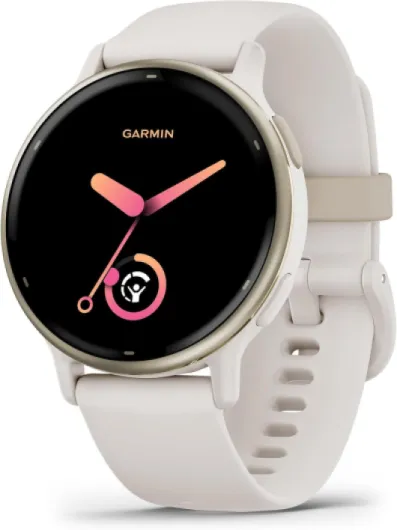
Design-wise, the vívoactive 5 is pretty straightforward. It’s a round 1.2" AMOLED screen, two buttons on the side, and a plastic case. The ivory color looks clean, more “sporty” than “fancy”. If you’re expecting a metal body that feels like a traditional watch, this isn’t it. It’s clearly a sports watch, and you can see that immediately.
The upside of all that plastic is the weight. It’s only about 1.3 ounces (around 36–37 g), which is light enough that you forget it’s on your wrist, even when sleeping. For 24/7 wear, that matters more to me than premium materials. I’ve had heavier metal smartwatches that looked nicer but were annoying in bed or during workouts. This one just disappears, which is exactly what I want from something I wear all day.
The AMOLED display is sharp (390 x 390) and bright enough outside. Colors pop, text is clear, and watch faces actually look decent. It’s not on the same level as the very latest Apple Watch in terms of smooth animations, but it’s good enough that I never felt annoyed by it. Touchscreen plus two buttons is a good combo: swipe most of the time, use buttons when sweaty or in the pool.
On the downside, the watch does look a bit basic up close. The bezel and body don’t scream “premium”, and if you like your watch to double as a piece of jewelry, this might feel a bit cheap. Also, the default band is fine but nothing special; I swapped it for a soft elastic band after a few days and it felt better. Overall: functional, light, and low-profile, but not something you buy for style points.
Battery life: honest experience vs the 11-day claim
The battery is probably the main reason most people look at this watch, so here’s the blunt version: you won’t get 11 full days unless you barely touch it, but you’ll comfortably get several days, which is already a big step up from daily-charging watches. In my use (always-on heart rate, sleep tracking every night, 3–4 GPS workouts per week, notifications on, no always-on display), I was landing around 5–7 days per charge.
If you start using GPS a lot and listen to music from the watch, the battery drops faster. Long GPS runs with music clearly eat into the battery, and then you’re more in the 4–5 day range. Still, that’s miles better than plugging in every night. The nice part is that you can charge it for about an hour and go from low to almost full, so I usually just top it up while I shower or sit at the desk once a week.
What I really liked is the mental freedom. I stopped thinking, “Can I start this workout or will my watch die halfway?” I also didn’t have to choose between sleep tracking and having battery left for the next day. I just leave it on, and it works. When it finally gets low, I charge it, and that’s it. No daily routine, no stress.
So, is the marketing line of "up to 11 days" realistic? Technically, probably, if you disable a bunch of features, avoid GPS, and keep the screen off most of the time. In normal use, count on 5–7 days. If you come from an Apple Watch or Wear OS device, that alone feels like a decent upgrade.
Comfort: great for 24/7 wear, once you ditch the stock band
In terms of comfort, this is one of the easiest watches to forget on your wrist that I’ve tried. The size is reasonable, the weight is low, and the rounded shape doesn’t dig into the skin. I wore it day and night, including in bed and in the shower, and I rarely felt the urge to take it off just to give my wrist a break.
The weak point for me was the stock silicone band. It’s fine, but it has that slightly sticky silicone feel that can get annoying if you sweat a lot or live somewhere warm. After a few workouts, I noticed a bit of sweat trapped under it and the usual mark on the skin. Nothing dramatic, but enough that I ended up buying a cheap elastic loop band, and the comfort improved a lot. The good news is that the watch uses standard quick-release bands, so swapping is easy.
For sleep, the comfort is honestly one of the best I’ve had. Compared to bulkier metal or square watches, this one doesn’t catch on pillows or feel like a brick on your wrist. The heart-rate sensor bump on the back is not too aggressive, so it doesn’t press into the skin painfully when you lie on your side. After a couple of nights, I just stopped noticing it entirely.
If you have very small wrists, the vívoactive 5 is still manageable. It’s not tiny, but it’s not a huge outdoor watch either. If you have very large wrists, it might look a bit compact, but functionally it’s fine. Overall, with a better band, I’d rate the comfort as very solid for all-day and all-night wear, which is key if you actually want to track sleep and not leave it on the nightstand.
Tracking performance: strong on fitness, a bit clunky on “smart” stuff
On the fitness tracking side, the vívoactive 5 does what it’s supposed to do. GPS locks reasonably fast, and distances for runs and walks matched what I got from my phone within a small margin. Heart rate during steady workouts (running, cycling, brisk walking) looked realistic and consistent. For very intense intervals or strength training, wrist-based heart rate is always a bit hit-or-miss, and this watch is no exception, but it’s no worse than others in this price range.
The sleep tracking is one of the strong points. It gives you a sleep score, breaks down light/deep/REM, and adds HRV and breathing data. Is it perfect? No. But compared to my old Apple Watch and basic bands, it lines up better with when I actually fell asleep and woke up. It also picks up naps automatically, which is nice in theory, but it can sometimes flag “lying on the couch reading” as a nap. The annoying part: you can’t delete those false naps easily, which messes with the Body Battery a bit.
Smartwatch performance is where you feel the limits. You get notifications (texts, calls, apps) and you can read them, but interaction is limited, especially on iPhone. No microphone, no speaker, no answering calls from your wrist. For me, that’s fine; I just want to see if something is urgent without pulling out my phone. If you’re used to dictating replies or talking to Siri from your watch, you’ll miss that here.
Overall, the UI is decent but not silky smooth. Swiping through widgets is quick enough, but you can feel a tiny bit of lag compared to premium smartwatches. Nothing that breaks the experience, just don’t expect flagship phone-level smoothness. For what I use it for—check stats, start workouts, glance at sleep—it’s more than good enough.
What the vívoactive 5 actually offers in real life
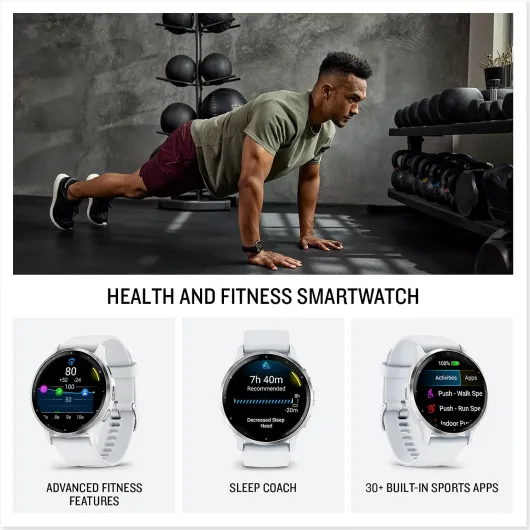
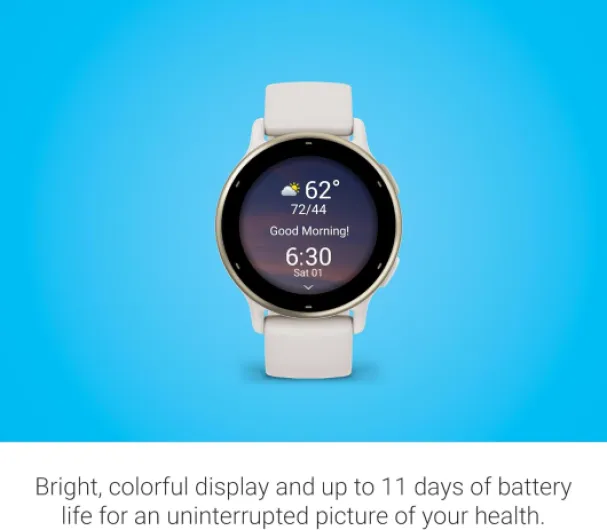
On paper, the vívoactive 5 is loaded: AMOLED screen, GPS, heart rate, sleep tracking with coaching, Body Battery, more than 30 sports modes, music storage, and up to 11 days of battery. In reality, you won’t use everything, but the core stuff (steps, workouts, sleep, notifications) is straightforward and reliable enough once you get used to Garmin’s logic.
The watch runs GarminOS, not Wear OS or anything from Apple, so don’t expect a big app store. You get Garmin’s built-in apps and you can add some extra watch faces and widgets through Garmin Connect IQ, but this is more like a serious fitness band with a nice screen than a full-blown smartwatch. Personally, I prefer that: less junk, less temptation to fiddle with nonsense, more focus on the basics.
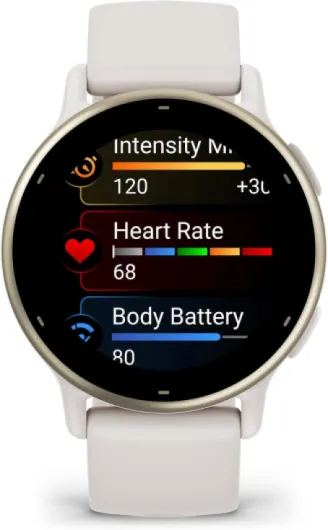
Health-wise, it tracks heart rate, stress, HRV (through sleep), naps, menstrual cycle, workouts, and gives you a “Body Battery” score that tries to show how drained or charged you are. Is it perfect science? No. But it’s useful as a rough guide. If your Body Battery says you’re at 15/100 and you feel like a zombie, it lines up often enough to be worth checking.
Where it stands out compared to cheaper bands is the combination of: decent GPS, proper sleep tracking, weekly training load/benefit info, and the fact you can store music from Spotify/Amazon/Deezer and go run without your phone. For someone who wants serious tracking but doesn’t care about replying to messages from the wrist, it’s a pretty solid package.
How effective is it for health and training, really?
For health tracking, I’d say the vívoactive 5 hits a good balance between data and simplicity. You get heart rate, stress, sleep, HRV, Body Battery, and respiration without drowning in charts you’ll never look at. The Body Battery feature is actually useful: on days where it showed a low charge, I generally felt tired or stressed, and it nudged me to take it easier. Not science-grade, but a decent reality check if you tend to push through fatigue.
The sleep coaching is also more helpful than I expected. It doesn’t just say “you slept X hours”; it gives a score and basic advice like “go to bed earlier” or “your sleep was short but efficient.” It’s not magic, but over a couple of weeks, it did make me more aware of bedtime and late screen time. The main downside is when it mislabels a couch session as a nap, then acts like you’re more rested than you feel.
On the training side, Garmin’s tools are solid. You get workout benefit (what the session did for you: aerobic/anaerobic), recovery time, and you can use Garmin Coach plans if you want guided running programs. For a casual runner or gym-goer, that’s plenty. It pushed me to mix easy and harder sessions instead of just doing the same pace every time. If you’re a serious athlete chasing marginal gains, you might want a higher-end Garmin, but for most people this is more than enough.
In practice, the vívoactive 5 helped me move more and sleep a bit better. I checked my stats, saw when I’d been sitting too long, and when my sleep had been bad for a few nights in a row. It doesn’t fix your lifestyle, but it gives you clear signals. For me, that’s effective enough to justify wearing it every day.
Pros
- Battery realistically lasts around 5–7 days with normal use, far better than most smartwatches
- Very solid fitness and sleep tracking with useful extras like Body Battery and workout benefit
- Lightweight and comfortable for 24/7 wear, especially for sleep and workouts
Cons
- Design and materials feel a bit basic and plasticky for the price
- Smart features are limited (no mic/speaker, basic app ecosystem, minimal interaction with notifications)
- Sleep/nap detection can be inaccurate at times and is not easy to correct
Conclusion
Editor's rating
The Garmin vívoactive 5 is a solid choice if you’re mainly interested in health and fitness tracking and you’re tired of charging your watch every night. It doesn’t try to be a tiny smartphone on your wrist, and that’s honestly its strength. Tracking is reliable, sleep features are useful, and the combination of GPS, Body Battery, and decent training tools makes it a good companion for casual to moderately serious exercisers. The battery life, while not quite the advertised 11 days in normal use, is still miles ahead of most mainstream smartwatches.
On the downside, the design is more plastic and sporty than premium, the software isn’t the smoothest out there, and the smart features are pretty basic—no mic, no speaker, limited interaction with notifications. If you want a watch to answer calls, talk to an assistant, or run lots of third-party apps, this is not the right product. Also, sleep and nap tracking, while generally good, still have some quirks that can be annoying if you’re picky about data accuracy.
I’d recommend the vívoactive 5 to people who say things like: “I want to move more, sleep better, and not babysit a charger.” Runners, walkers, gym-goers, and anyone who likes stats but doesn’t care about fancy wrist apps will probably be happy with it. If you’re after something that looks more premium on the wrist or behaves like a full-on smartwatch with deep phone integration, you’re better off with an Apple Watch, Galaxy Watch, or maybe a higher-end Garmin Venu. For what it aims to do—be a practical, fitness-focused watch with strong battery life—it hits the mark pretty well.