Summary
Editor's rating
Value for money: worth it if you hate subscriptions
Chunky but discreet: how it looks and feels on the hand
Battery life and charging: easy to live with if you build a routine
Comfort and sizing: great once you get it right, annoying if you don't
Durability and daily abuse: holds up, but not bulletproof
Tracking accuracy: good enough for trends, not medical-grade
What the Ultrahuman Ring AIR actually offers in real life
Pros
- No monthly subscription for core features, unlike some competitors
- Comfortable to sleep with and decent 4–5 day battery life
- Detailed sleep and recovery insights with a flexible, feature-rich app
Cons
- Sleep/wake detection and SpO2 are not always accurate
- Ring is thicker than a normal band and can scratch with daily use
- App can feel complex or overwhelming for beginners

Specifications
View full product page →| Brand | ULTRAHUMAN |
A smart ring that doesn't nickel-and-dime you every month
I’ve been curious about smart rings for a while, mostly because I hate sleeping with a watch on my wrist. I move a lot in my sleep, and every watch I’ve tried ends up digging into my skin or waking me up when it twists. So I picked up the Ultrahuman Ring AIR in Space Silver, size 12, mainly for sleep tracking and recovery, and also because there’s no monthly subscription, which was a big deal for me compared to Oura.
I’ve used it daily for a few weeks now, including nights, workouts, desk days, and general house chores. I’m not an athlete, just someone who wants to keep an eye on sleep, heart rate, and daily movement without wearing a chunky watch 24/7. My baseline comparison is a couple of Fitbits and a Pixel Watch I’ve used in the past.
Overall, the ring does most of what it promises: it tracks sleep in a decent amount of detail, gives you recovery and movement scores, and the app throws a lot of metrics at you. Some of it is genuinely useful, some of it feels a bit overkill if you’re new to this stuff. It’s not perfect: sleep detection times can be off, steps seem a bit undercounted, and the app can feel busy when you first open it.
If you want a straight answer: it’s a pretty solid option if you care about sleep and recovery and don’t want a subscription. But it’s not magic, and you do need to be ready to fiddle a bit with sizing, live with a fairly chunky ring, and accept that some metrics are still a work in progress.
Value for money: worth it if you hate subscriptions
In terms of value, the biggest selling point for me is simple: no monthly subscription for the core features. You pay once for the ring and you get sleep, activity, stress, heart rate, HRV, temperature, and recovery data in the app without a recurring fee. Considering that Oura, the obvious competitor, charges a monthly subscription on top of an already high ring price, Ultrahuman’s approach feels more straightforward.
One Amazon buyer managed to grab it on a Black Friday deal at around £232, which is pretty good for what you get. At full price, it’s not cheap, but you’re basically pre-paying for years of use instead of being tied to a subscription. The optional Ultrahuman X coverage (for loss/damage) and some paid PowerPlugs are extra, but they’re genuinely optional. The core experience is fully usable without paying anything beyond the ring itself.
Compared to a mid-range smartwatch, you don’t get notifications, music control, or apps on the wrist. If you want those, a watch is better value. But if your main goal is sleep and recovery tracking with minimal distraction, the ring makes sense. You’re paying for comfort during sleep and a cleaner day-to-day experience, not for smart features on your wrist.
Overall, I’d say the value is solid if: 1) you care a lot about sleep data, 2) you don’t want a subscription, and 3) you’re fine with a ring instead of a watch. If you’re just curious and not sure you’ll actually use the data, it’s a lot of money for a toy. There are cheaper trackers that give you a basic idea of steps and sleep. But if you know you’ll stick with it, the one-time cost makes more sense over the long run.
Chunky but discreet: how it looks and feels on the hand
The Space Silver Ring AIR looks like a simple metal band from a distance, but once you put it on, you notice it’s thicker than a normal ring. That’s the trade-off with all smart rings right now. It’s not ugly, it just has more height than a regular wedding band. On my size 12 finger (I wear it on my index most of the time), it doesn’t scream "tech gadget" unless you look closely at the inner sensors.
The finish on the Space Silver is nice enough. It’s more of a matte/brushed look than a mirror polish, which I prefer because it hides fingerprints. That said, one of the Amazon reviewers is right: these rings can scratch. If you bang your hands on door frames, lift weights with metal bars, or do a lot of DIY, you’ll pick up marks over time. Mine has picked up a couple of light scuffs already, nothing dramatic, but you can see them under the right light. If you want it pristine, you’ll either baby it or get some kind of protector.
In terms of style, it blends in fine in an office or casual setting. It doesn’t look like jewelry from a high-end brand, but it doesn’t look cheap either. It’s basically a functional band that passes as a normal ring unless someone knows what they’re looking at. I wouldn’t call it flashy, and that’s probably the point.
One thing to keep in mind: because it’s thicker, where you wear it matters. On a ring finger squeezed between two other fingers, you feel the bulk more. On the index finger, it’s less cramped but easier to bash into things. I ended up switching between fingers a couple of times before settling on what felt least annoying day to day.
Battery life and charging: easy to live with if you build a routine
Battery life has been solid. For me, in normal use with most features on (but not constantly checking the app), I get about 4–5 days on a charge. That lines up with what other reviewers said: somewhere between 3 and 6 days depending on settings and how often you sync. I never ran it down to 0% because I got into the habit of topping it up during showers or while sitting at my desk for a bit.
Charging is straightforward: you drop it on the little dock, it snaps into place, and you’re done. If you grab the Voyager charger, it’s a bit faster, but even with the standard one it’s manageable. Going from around 20% to full took me roughly 60–90 minutes. I usually just plug it in when I know I won’t be moving much, like while I’m working on the laptop or watching something.
Compared to a smartwatch that needs daily charging, this is a big plus, especially since it’s mainly a sleep tracker. The worst thing with sleep devices is forgetting to charge and then missing a night of data. With 4–5 days of battery, you have some buffer before that happens. The app also gives you a pretty clear battery percentage, so you’re not guessing.
One thing to note: if you go wild with every PowerPlug and constantly open the app, you’ll probably land closer to the 3-day mark, like the Japanese review mentioned. Still, that’s decent. There’s no wireless charging or fancy stuff like that, but for a ring, the current setup is perfectly fine. As long as you build a small charging habit into your week, battery life won’t be something you stress about.
Comfort and sizing: great once you get it right, annoying if you don't
Comfort-wise, once you nail the size, it’s easy to forget you’re wearing it. It’s definitely more comfortable to sleep with than any watch I’ve tried. No strap digging into my skin, no big case pressing on my wrist. I’m a side sleeper and the ring didn’t really bother me at night, which was my biggest concern going in.
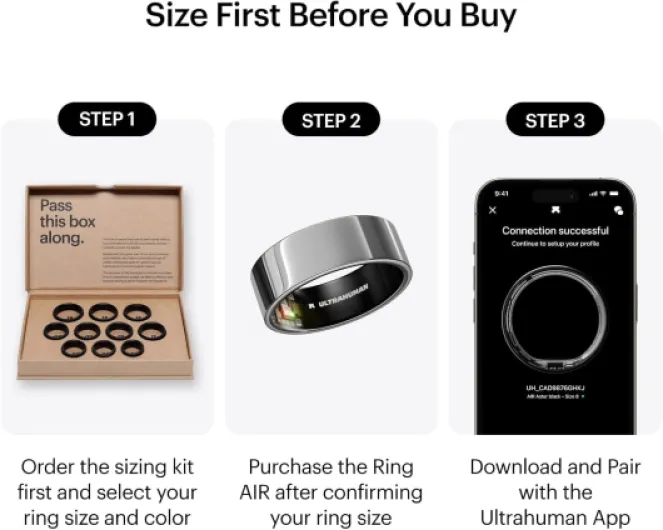
The catch is sizing. Ultrahuman is very clear that their sizes don’t match standard ring sizes, and they push you to buy the sizing kit first. Honestly, that’s the right move. I tried a couple of plastic sizes from the kit for a full day before choosing size 12. Even then, I noticed what one Amazon reviewer mentioned: depending on what you’re doing, the ring can feel slightly loose and slide around or even come off if you’re doing stuff like washing dishes or carrying bags. On the flip side, going down a size might feel tight when your fingers swell in the heat.
During workouts or when my hands are slightly swollen, the fit feels perfect; during cold mornings, it can feel a bit on the loose side. The inner surface is smooth, and I didn’t get any skin irritation or weird marks, even after wearing it 24/7 for several days. The main habit I developed is occasionally twisting or sliding it to make sure the sensor area sits under my finger correctly, like another reviewer said. It’s not a big deal, but it becomes a small fidget.
If you’re not used to wearing rings at all, there will be an adjustment period. If you already wear a ring daily, you’ll adapt faster, but remember this is thicker. My advice: take the sizing kit seriously, wear the plastic ring all day and while sleeping before ordering, and be honest about which finger you’ll actually use. That will save you from the "it keeps coming off while I’m doing chores" scenario.
Durability and daily abuse: holds up, but not bulletproof
Durability so far is good but not flawless. The ring’s body feels sturdy, and I never felt like it was going to crack or bend, even when I accidentally smacked it against a table or door frame. It’s clearly built to handle normal daily knocks. I wore it during light workouts, cooking, cleaning, and general daily stuff without any major issues.
The main concern is scratching. As one reviewer pointed out, the ring does scratch if you’re rough with your hands. Metal-on-metal contact, like with weights, keys, or tools, will leave marks over time. On my Space Silver model, small scuffs show up if you look closely under light. They don’t affect function, but if you’re picky about aesthetics, this might annoy you. You can apparently get covers or protectors, but that kind of defeats the clean look.
Water-wise, I had no problems with washing hands or getting splashed. I didn’t go swimming with it for long sessions, but casual water exposure was fine. The sensors inside are recessed enough that they don’t catch on skin or dirt easily, and the inside of the ring is still smooth after a few weeks of wear. No peeling, no weird gaps, nothing like that.
Long-term, I expect it to build up cosmetic wear like any metal ring you wear daily. If you’re expecting it to stay pristine like the day you unboxed it, that’s not realistic. If you treat it as a tool that lives on your hand, the durability is acceptable. Just be aware that if you do a lot of hands-on manual work, either take it off for those tasks or accept that it’ll look a bit beaten up faster.
Tracking accuracy: good enough for trends, not medical-grade
In terms of performance, the Ultrahuman Ring AIR is good for trends, but not something I’d trust as a medical device. For daily use, that’s fine. I compared it against a smartwatch I own for a few days, wearing both at the same time. Step count was consistently a bit lower on the ring, roughly in line with what one Amazon reviewer said: about 5% under my watch. So if my watch said 10,000 steps, the ring was around 9,500. Not a big deal unless you’re obsessed with exact numbers.
Heart rate during the day and at rest was pretty close between the two devices, usually within a couple of beats per minute. Resting heart rate overnight looked realistic and followed the same pattern I’m used to. Heart rate variability and skin temperature are harder to verify without lab gear, but the trends made sense: higher HRV on restful days, lower after stressful days or poor sleep; slight temperature bumps when I felt a bit off.
Sleep tracking is where things get interesting. When I clearly went to bed and fell asleep quickly, the ring’s sleep and wake times were close enough. But on nights where I was awake in bed scrolling my phone or just lying still, the ring sometimes thought I was already asleep. One Amazon review mentioned a huge mismatch (up at 04:58, ring said 08:09); I didn’t see anything that extreme, but I did see some mislabelled awake time. Wake-ups in the middle of the night were hit-or-miss: it caught the longer ones, skipped some of the short ones.
SpO2 is still in beta, and it shows. Mine rarely went below 98–99%, which I just don’t believe is correct all the time. Same feedback from another user. For now, I treat SpO2 as a rough indicator, not something to worry about. Overall, if you want perfect precision, you’ll be disappointed. If you just want to see whether your sleep and recovery are trending better or worse week to week, it does the job.
What the Ultrahuman Ring AIR actually offers in real life
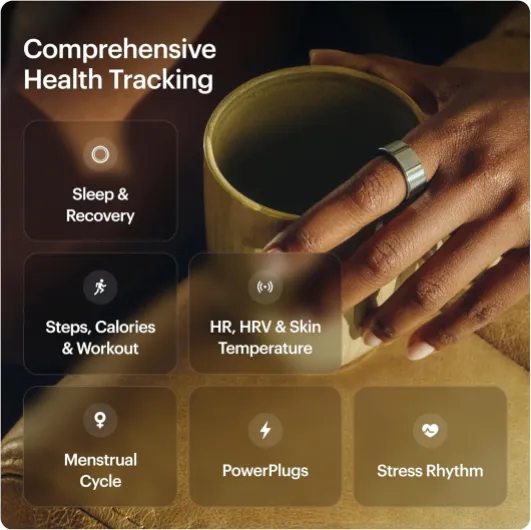
On paper, the Ultrahuman Ring AIR packs in quite a bit: sleep tracking (REM, deep, light, wake), heart rate, heart rate variability, skin temperature, activity, stress, and recovery scores. It connects over Bluetooth to the Ultrahuman app, which is where everything happens. There’s no screen on the ring, so you’re not checking anything on your hand; it’s all in the app. You can also enable extra modules in the app called "PowerPlugs" for things like caffeine timing or screen time, some free, some paid.
In practice, the ring is basically a quiet data collector. You wear it all day and all night, and then you open the app to see how badly (or well) you slept, how much you moved, and how stressed your body seems. The app gives you a daily “recovery” style view and nudges like “time to move” or “this is your caffeine window”. If you’ve used a Fitbit or Garmin before, you’ll recognize the idea, just in ring form instead of a watch.
I tested it mainly for three things: sleep tracking, daily activity, and resting heart rate/HRV. Sleep tracking is clearly the main focus: you get sleep stages, sleep debt, and suggestions like “try sleeping earlier” or “your late meal may have affected your sleep”. Some days, the sleep times were spot on; other days, it thought I was sleeping when I was just lying still in bed or on the sofa. That matches what some Amazon reviewers said about wake time being wrong.
Compared to a watch, the big difference is the experience: no notifications, no screen, no buzzing on your wrist. If you’re tired of your watch nagging you but still want the data, this is a nice middle ground. Just don’t expect it to replace a smartwatch for things like notifications or GPS workouts, even though the spec sheet mentions GPS — in reality, this is much more of a health/sleep tracker than a full-on sports device.
Pros
- No monthly subscription for core features, unlike some competitors
- Comfortable to sleep with and decent 4–5 day battery life
- Detailed sleep and recovery insights with a flexible, feature-rich app
Cons
- Sleep/wake detection and SpO2 are not always accurate
- Ring is thicker than a normal band and can scratch with daily use
- App can feel complex or overwhelming for beginners
Conclusion
Editor's rating
The Ultrahuman Ring AIR in Space Silver is a good fit if you’re mainly interested in sleep, recovery, and general health tracking without getting locked into a monthly subscription. It’s comfortable enough to wear 24/7 once you get the sizing right, the battery life is easy to live with (around 4–5 days for most people), and the app gives you a lot of detail on sleep stages, heart rate, HRV, and daily movement. The data is good enough for trends, and the daily nudges can genuinely help you pay more attention to rest and habits.
It’s not perfect, though. Sleep and wake times can be off, especially if you spend time lying still in bed, step counts tend to be slightly under, and SpO2 is clearly still in beta. The ring can scratch, and the app can feel a bit busy or complex for beginners. If you want a simple, super minimal interface or exact medical-grade numbers, this won’t fully satisfy you. Also, it doesn’t replace a smartwatch for notifications or sports features.
If you’re tired of wearing a watch at night, care a lot about sleep quality, and hate subscription models, this ring is a strong option. If you just want basic tracking or need smartwatch features, you’re probably better off with a cheaper band or a watch instead.