Summary
Editor's rating
Value for money: health-focused, but a bit behind on features
Design: looks basic, does the job
Battery life: depends heavily on what you turn on
Comfort: good for 24/7 wear, with a few small caveats
Durability and build: light, plastic, but holds up
Tracking performance: solid health data with a few quirks
What you actually get and what it really does
Pros
- Very good health tracking: stress, Body Battery, sleep score, heart rate, and more with detailed graphs in the free Garmin Connect app
- Light and comfortable for 24/7 wear, with a replaceable strap and slim profile
- Reliable connectivity and notifications, with simple but effective activity tracking for walking, running, and pool swimming
Cons
- Design and screen feel dated for the price: small monochrome display, basic interface, no built-in GPS
- Real-world battery life often closer to 3–5 days if you use all the features, not the full 7 days claimed

Specifications
View full product page →| Brand | Garmin |
A small band that’s mostly about health data
I’ve been using the Garmin Vivosmart 5 in mint (size S/M) for a couple of weeks, wearing it day and night except for showers. I came from cheaper bands and one big-brand smartwatch, so I had a decent idea of what I expected: solid tracking, decent battery, and something that doesn’t feel like a brick on my wrist. I wasn’t looking for a mini smartphone, just a tracker that gives me useful health info without constant fiddling.
The first thing that stood out is that this thing is clearly built around the Garmin ecosystem. The band itself is pretty simple, but the real brain is the Garmin Connect app. If you don’t like checking an app for details, this probably isn’t for you. The screen is small, basic, and really just there to show the essentials and let you start activities.
What I mainly wanted was to monitor stress, sleep, and heart rate, and see if the Body Battery feature actually matches how I feel. After a few days, I started to see patterns: on days where the watch said my stress was high and Body Battery was low, I really did feel drained. It’s not magic, but the data lines up enough to be useful. It’s the kind of tracker you use to manage your energy more than to show off on your wrist.
Overall, my first impression is: very focused on health stats, a bit old-school on features and design. It’s not trying to replace your phone, and compared to some flashy smartwatches, it feels a bit plain. But if what you want is numbers about your body, and you’re okay with a small screen and a fairly basic look, it gets the job done pretty well.
Value for money: health-focused, but a bit behind on features
In terms of value, the Vivosmart 5 sits in a slightly awkward spot. It’s more expensive than a lot of basic fitness bands, but cheaper than full-blown smartwatches. What you’re really paying for is Garmin’s health ecosystem: the Garmin Connect app, long-term data tracking, and generally reliable sensors. If you’re into graphs, trends, and fine-tuning your activity based on stress and sleep, that ecosystem has real value.
On the other hand, the hardware itself feels a bit dated for the price. The small monochrome screen, lack of built-in GPS, basic charging system, and limited watch face options make it feel behind some competitors in the same price bracket. You can find other brands that give you color screens, more smartwatch-like functions, and sometimes better battery life for similar or lower cost. The flip side is that those brands often have clunkier apps or less reliable long-term support.
From a practical point of view, if your main goal is: "I want good health tracking, a decent sleep score, stress and Body Battery, and I don’t care that much about fancy visuals", then the Vivosmart 5 offers good value. The app is free, there’s no subscription to see your data, and the metrics are detailed enough to actually change how you manage your day. If you’ve had cheaper bands that broke quickly or had bad apps, this will feel like an upgrade.
But if you’re more interested in smartwatch-style features (music control, rich notifications, lots of watch faces, voice assistants, etc.), or you want a color screen and a more modern design, you can probably find better value elsewhere. I’d say the Vivosmart 5 is worth it for health nerds and people who trust Garmin’s ecosystem, but just "okay" value if you mainly care about looks and general smart features.
Design: looks basic, does the job
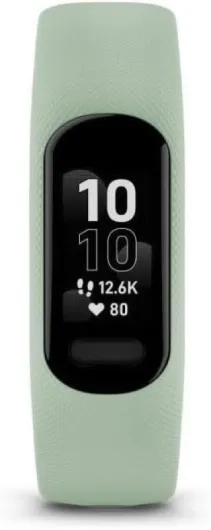
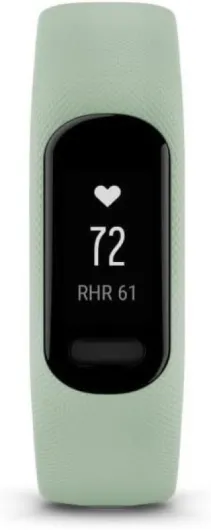
The Vivosmart 5 is not a watch you buy for style. It looks like a simple fitness band, slightly chunky but still light. The mint color is a bit playful without being too flashy, but the overall design is very plain. No metal bezel, no rotating crown, just a plastic capsule with a small touchscreen and a physical button underneath. If you like minimalist, you’ll probably say “fine”. If you want something that looks premium, this isn’t it.
The display is a 0.84-inch monochrome OLED-style screen. It’s brighter and slightly larger than the old Vivosmart 4, but still small compared to most smartwatches. Indoors it’s easy to read; outdoors in direct sun you sometimes need to tilt your wrist a bit, but it stays readable. There’s a raise-to-wake gesture, but I found it not always perfect, so I ended up tapping the button a lot. That’s not a big deal, just a bit old-fashioned compared to newer trackers that wake more reliably.
One design choice I do like: the strap is replaceable. On the older Vivosmart 4, once the strap broke, you were basically done. Here, the module pops in and out of the band, so if the strap dies or you get bored of the color, you can swap it. The included strap looks and feels a bit plasticky, but it’s functional. There are plenty of holes for adjustment, so it fits small wrists well, which is not always the case with bulkier watches.
In terms of layout, the interface is simple: vertical swipes to move between widgets (steps, heart rate, stress, etc.), tap to open, long-press or button to go back. No fancy animations or rich graphics, just text and small icons. It feels a bit dated, but the upside is that it’s fast and doesn’t lag. If you’re okay with a “tool, not jewelry” look and a very basic UI, the design is perfectly fine. If you want something that looks like a mini high-end watch, this one will feel a bit too bland and behind the times.
Battery life: depends heavily on what you turn on
Garmin advertises up to 7 days of battery life, and that’s technically possible, but only if you’re a bit conservative with the settings. With everything turned on (all-day heart rate, frequent Pulse Ox checks, lots of notifications, raise-to-wake, and a couple of tracked workouts), I was getting more like 3 to 4 days. That lines up with what some other users report. It’s not terrible, but don’t expect a full week if you use all the features aggressively.
Once I tweaked the settings—mainly turning Pulse Ox to “night only” or even off, reducing the screen timeout a bit, and not checking the screen every five seconds—I could get closer to 5 days. If you really strip it down (no Pulse Ox, fewer notifications, autowake off), you can probably hit the 7 days they claim. So, realistic range is about 3–7 days depending on how you use it, with most people landing around 4–5 days.
Charging is straightforward but not the nicest implementation out there. The band uses a proprietary cable that clips into the back, not a magnetic puck that snaps into place. It’s not hard, but it feels a bit dated compared to newer trackers. On the plus side, it charges fairly quickly. Plugged into a normal USB charger, I could go from around 20% to full in roughly an hour-ish. That’s easy enough to do while showering and having breakfast.
In day-to-day use, I didn’t find the battery stressful. It’s not like a smartwatch that needs daily charging, but it’s also not a “set and forget for two weeks” device. If you’re fine plugging it in every few days and maybe turning down Pulse Ox, you’ll be okay. If you absolutely hate charging and want a band that goes 10–14 days no matter what, you might be happier with something simpler and less sensor-heavy.
Comfort: good for 24/7 wear, with a few small caveats
Comfort is where the Vivosmart 5 actually does pretty well. It’s very light at around 25 grams, and the footprint on the wrist is narrow compared to big smartwatches. I wore it day and night, including during sleep, and after the first couple of nights I mostly stopped noticing it. For people who hate chunky watches digging into their wrist or catching on sleeves, this slim profile is a plus.
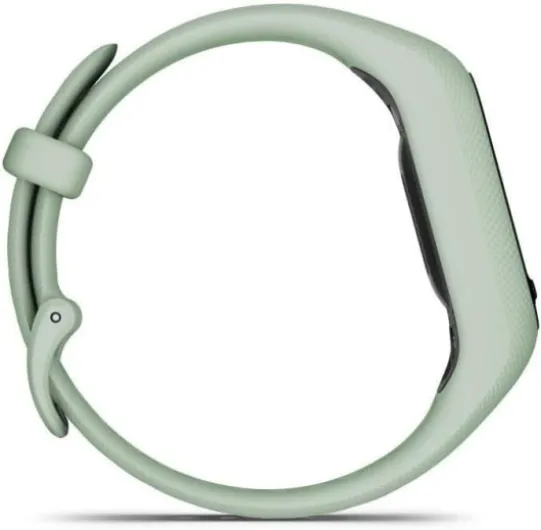
The strap is a soft plastic/silicone type with a classic buckle. It’s flexible enough to wrap nicely around the wrist, and there are lots of adjustment holes, so you can get it snug but not cutting off circulation. That’s important for heart-rate accuracy. I did notice that if I wore it too tight and got sweaty (during a run or doing dishes), moisture would stay trapped underneath and my skin got a bit irritated. Once I started sliding it up a bit and drying under it after a shower, that pretty much went away.
At night, it’s decent for sleep tracking. The module sticks out slightly from the strap, but not to the point where it digs into the wrist. I sleep mostly on my side and only really felt it if my wrist was bent under my head. Compared with a bigger smartwatch I used before, this is much easier to forget you’re wearing. The vibration for alarms and notifications is noticeable but not violent, which is good if you share a bed and don’t want a loud sound.
One thing to know: the screen is small and the text, while bigger than on the Vivosmart 4, is still not huge. If your eyesight is not great up close, reading long notifications directly on the band won’t be comfortable. For glancing at steps, heart rate, or the time, it’s fine. Overall, in terms of comfort and everyday wear, I’d say it’s one of the strengths of this device, as long as you take a second to adjust the strap and keep the skin underneath dry.
Durability and build: light, plastic, but holds up
The Vivosmart 5 is mostly plastic with a silicone-style strap, so you’re not getting a tank-like build here. That said, for everyday use it feels sturdy enough. I’ve banged it lightly on door frames, desks, and the edge of my sink without any cracks or major scratches. The screen is recessed slightly into the body, which helps protect it from direct hits. After a couple of weeks, I only saw a few tiny hairline marks you really have to look for.
It’s rated for pool swimming, and I’ve used it in the shower and during dishwashing with no issues. The physical button and the charging port cover haven’t shown any signs of water getting in. You can operate it with wet hands, though the touchscreen is a bit less responsive when dripping wet, which is pretty normal. Just don’t expect perfect swipes with soapy fingers.
The strap is the part I’d watch over time. It feels a bit on the cheap side, not in a fragile way, but more like basic plastic rather than a premium band. One important upside is that the strap is replaceable, unlike the older Vivosmart 4 where a broken strap basically killed the device. So even if it cracks or wears out after a year or two, you’re not forced to throw the whole thing away; you can just get a new band and pop the module in.
Overall, I’d call the durability good enough for daily life and workouts, but not something I’d abuse in heavy construction work or rock climbing. It’s light and doesn’t feel bomb-proof, but it also doesn’t feel fragile. For the price point and target use (office, gym, running, swimming), it holds up well, especially with the option to replace the strap if it ever fails.
Tracking performance: solid health data with a few quirks
On the tracking side, the Vivosmart 5 is pretty solid, but not perfect. Steps are in the usual ballpark for wrist trackers: slightly generous, especially if you wave your arms around while talking or cooking. Compared to my phone and another band, it was often a few hundred steps higher by the end of the day, but not to a crazy degree. For general activity and getting you to move more, it’s accurate enough.
Heart rate and stress tracking are where it feels more serious. The optical sensor does continuous monitoring, and during steady activities like walking or easy runs, it matched well with a chest strap I sometimes use. During very intense intervals it lagged a bit, which is normal for wrist sensors. Stress and Body Battery are based on heart rate variability and other metrics. After about a week, I started to trust the Body Battery number: on days after bad sleep or long stressful meetings, it showed lower energy, and I actually felt that way. It’s not perfect science, but it’s a useful indicator.
Sleep tracking is detailed. You get sleep stages, total sleep time, and a sleep score. It usually detected my sleep and wake times fairly well, though short wake-ups at night are sometimes missed or recorded as light sleep. That’s a common issue across brands. The score itself (out of 100) matched how rested I felt most mornings. The nice part is the breakdown in the Garmin app, which gives tips like “try to reduce stress before bed” or points out if your deep sleep is low.
For sports, the built-in activity profiles are enough for casual users: walking, running, pool swimming, cardio, yoga, etc. If you run or walk with your phone, it can pull GPS for distance and route. Swimming tracking is okay but not perfect: it doesn’t auto-detect swims; you have to start it manually. Length counts can be off by a bit, especially if you pause or change pace, but you can see a length-by-length breakdown in the app and roughly correct in your head. Overall, performance is reliable enough for health tracking and casual fitness, but if you’re a serious athlete obsessed with perfect data, you’ll probably want a full Garmin watch with built-in GPS and better swim metrics.
What you actually get and what it really does
Out of the box, it’s very simple: the Vivosmart 5 band, a USB charging cable, and a quick start guide. No extra straps, no charger brick, no fancy stuff. The cable is Garmin’s proprietary clip/port style, not a magnetic puck, and it plugs into the back of the tracker. Slightly old-school, but it works. You’ll need a USB port or your own adapter, which is pretty standard now anyway.
Feature-wise, it’s clearly a health and fitness tracker first. You get built-in sports profiles for walking, running, pool swimming, yoga, cardio, and a few more. It doesn’t try to do everything: no built-in GPS, no music control wizardry, no app store. For activities, it mostly uses your phone’s GPS if you want maps, and the band focuses on heart rate, steps, calories, and intensity minutes. If you’re expecting smartwatch-level features like fancy watch faces or complex notifications, you’ll probably find it a bit bare.
The health side is where it’s more complete. It tracks heart rate, stress, Body Battery, sleep score, respiration, Pulse Ox (SpO2), hydration, and women’s health. Sleep is broken down into stages and you get a sleep quality score in the Garmin Connect app. Pulse Ox can be set to track all night, but that hits the battery. The app is free and has a lot of graphs and history, which is nice if you like looking at trends over weeks instead of just today’s numbers.
In daily life, I’d describe it as: quiet, data-heavy, and a bit nerdy. It buzzes for calls, texts, and notifications if you want, but the small screen means you’re not going to stand there reading long emails on your wrist. It’s more: quick glance, then grab your phone. If you want a slim band that stays out of the way but still logs a lot of info in the background, it fits that role pretty well.
Pros
- Very good health tracking: stress, Body Battery, sleep score, heart rate, and more with detailed graphs in the free Garmin Connect app
- Light and comfortable for 24/7 wear, with a replaceable strap and slim profile
- Reliable connectivity and notifications, with simple but effective activity tracking for walking, running, and pool swimming
Cons
- Design and screen feel dated for the price: small monochrome display, basic interface, no built-in GPS
- Real-world battery life often closer to 3–5 days if you use all the features, not the full 7 days claimed
Conclusion
Editor's rating
After living with the Garmin Vivosmart 5 for a while, my take is pretty clear: it’s a straightforward, health-focused band that does its job well, but doesn’t try to impress you with flashy features. The tracking for heart rate, stress, Body Battery, and sleep is solid, and the Garmin Connect app gives you more than enough detail to actually understand your habits and energy levels. If you’re the kind of person who wants to manage fatigue, keep an eye on stress, and see how your sleep really looks over weeks and months, this band makes sense.
Where it falls short is in the “modern smartwatch” side of things. The design is plain, the screen is small and monochrome, there’s no built-in GPS, and the charging method feels a bit old-school. Battery life is decent but not mind-blowing, especially if you leave all the sensors running. For the price, there are other devices that look more modern and pack more features, but they don’t always have Garmin’s level of health data and app quality.
So, who is this for? It’s a good fit if you want a light, comfortable band you can wear 24/7, and your priority is health stats and reliability rather than style. It’s also good if you already use Garmin or like the idea of a free, data-rich app with no subscription. Who should skip it? People who want a bright color screen, lots of smart features, or a watch that feels cutting-edge for the money. In short: a solid, no-drama health tracker that feels a bit dated, but still gets the important stuff right.