Summary
Editor's rating
Value for money: strong features, high price
Design: outdoorsy look with a bit of bling
Battery life: good, but depends how hard you push the screen and sensors
Comfort: fine for all-day wear, but you feel it
Durability and water resistance: built to take a beating
Performance and sports features: where it actually shines
What you actually get with the fēnix 8
Pros
- Very strong sports and outdoor features with accurate multi-band GPS and topo maps
- Rugged build with sapphire glass and 40 m dive rating that can handle real-world abuse
- Good battery life for an AMOLED smartwatch, easily several days with regular training
Cons
- High price, especially if you don’t fully use the advanced training and outdoor features
- Bulky for smaller wrists and a bit noticeable for sleep or under tight sleeves
- Battery life shorter than older non-AMOLED Garmins when using bright always-on display and many sensors

Specifications
View full product page →| Brand | Garmin |
A serious watch for people who actually train
I’ve been using the Garmin fēnix 8 (43 mm, AMOLED, sapphire, soft gold with dark sandstone band) for a few weeks now. I came from an older Fenix model and an Apple Watch, so I had a decent idea of what to expect and what usually annoys me with watches. Short version: this thing is built for people who actually go out and do stuff, not just count steps around the office. But it’s not perfect, and it’s definitely not cheap.
From day one, what stood out was how much this watch packs in: multi-band GPS, dive rating to 40 m, flashlight, speaker and mic, ECG, strength plans, training readiness, all the maps and sensors. On paper it looks like a mini sports computer on your wrist. In practice, a good chunk of that is actually useful if you run, bike, hike, or swim regularly. Some features, like off-grid voice commands, feel more like nice-to-have extras than daily tools.
I wore it 24/7: workouts, showers, sleep, a couple of pool sessions, and one short dive. I also used it for calls and notifications when paired with an Android phone. So this isn’t a lab test; it’s just how it behaved in normal life with a decent amount of training. I didn’t baby it either: banged it on door frames, used it under rain, and wore it in the sea.
Overall, I’d say it’s a pretty solid watch for serious use, but the price is high and some things feel overkill if you’re more casual. If you mostly want a smartwatch for messages and a bit of running, there are cheaper and simpler options. If you’re into structured training and outdoor stuff, then it starts to make more sense, as long as you accept a few trade-offs.
Value for money: strong features, high price
Let’s be honest: the fēnix 8 is not cheap. You’re paying for the Garmin name, the build (sapphire, metal), and the pile of sports and health features. If you’re someone who mainly wants step counting, basic notifications, and casual runs, this watch is probably overkill. There are cheaper Garmin models and plenty of budget activity trackers that will handle that just fine for a fraction of the cost.
Where the value starts to make more sense is if you actually use the advanced stuff: multi-band GPS, maps, training readiness, structured workouts, dive modes, and the whole health monitoring package. If you train several times a week, do long outdoor sessions, and like having detailed stats and navigation on your wrist, then the price is easier to swallow. You’re basically getting a training tool and outdoor navigator, not just a smartwatch.
Compared to something like an Apple Watch or a generic Android smartwatch, the fēnix 8 wins on battery, durability, and sports depth. On the other hand, it loses a bit on app ecosystem, slickness of UI, and casual smart features. So if your priority is sports and outdoor performance, it’s good value in that niche. If you’re more about apps, media, and a polished smartwatch experience, you’ll probably feel like you’re paying a lot for features you don’t use.
Overall, I’d rate the value as decent but not outstanding. You’re getting a lot of tech and serious build quality, but you have to be the right user to really benefit from it. If you just want a nice-looking smartwatch and track a few workouts a month, you can save money and go for something simpler. If you’re all-in on training and outdoor adventures, then this starts to look like a reasonable investment rather than a toy.

Design: outdoorsy look with a bit of bling
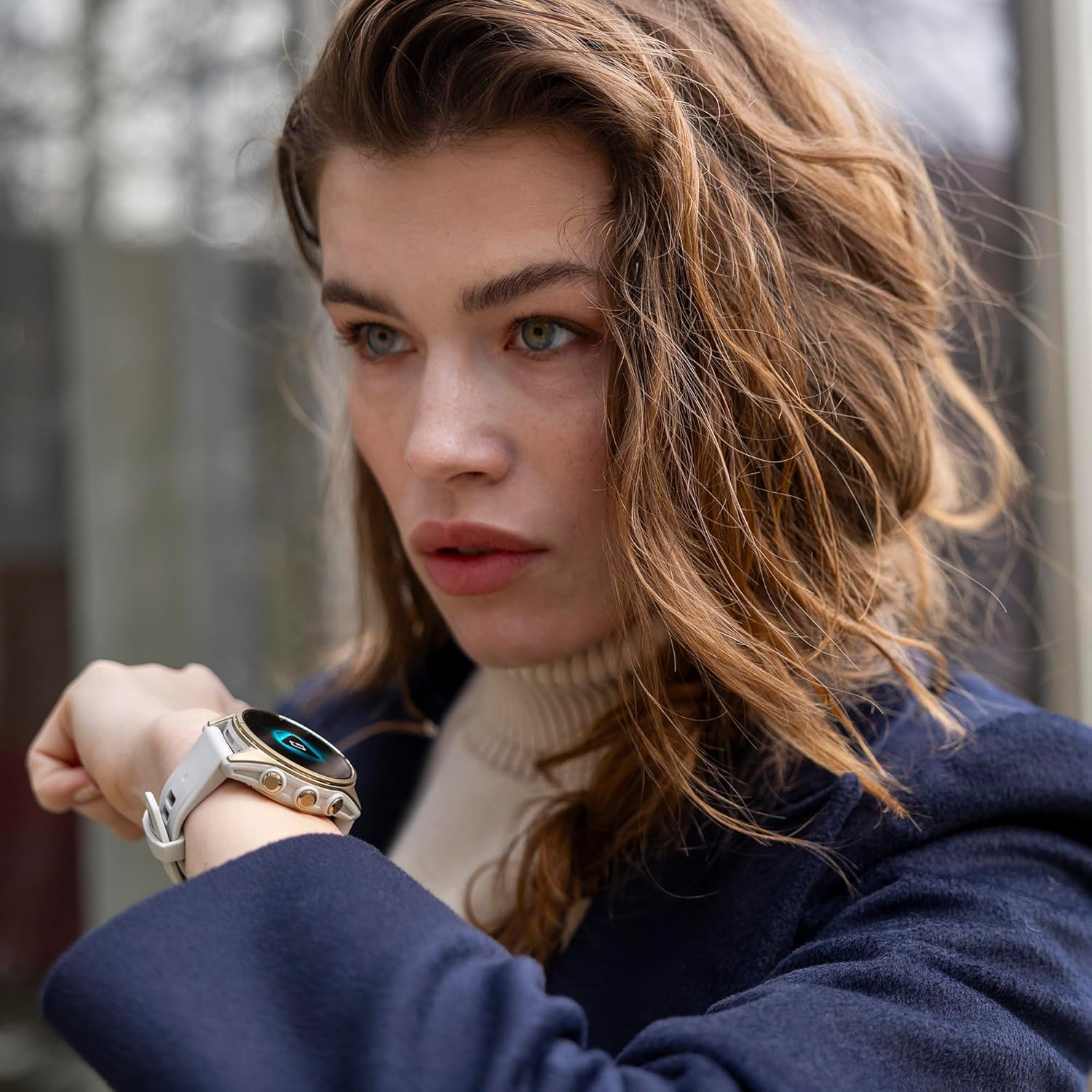
Design-wise, the fēnix 8 sticks to the classic Fenix style: round case, chunky bezel, visible screws, and physical buttons around the sides. It still looks like an outdoor watch first, smartwatch second. The soft gold bezel with the dark sandstone band is a bit of a mix: from a distance it looks like a fitness watch with a slightly dressier tone, but up close it still has that rugged, tool-like vibe. Personally, I like that it doesn’t try too hard to look like jewelry, but the gold tone might be too flashy for some.
The case is 43 mm across and about 14 mm thick, which is decent for a watch with this much hardware, but it does sit fairly tall on the wrist. On my medium wrist it looked fine, but under a tight shirt cuff it’s noticeable. If you’re used to slim fashion watches, this will feel bulky. Compared to my older Fenix 6, this one feels a bit more compact and refined, but it’s still clearly in the “sport watch” category, not something you’d wear with a suit every day.
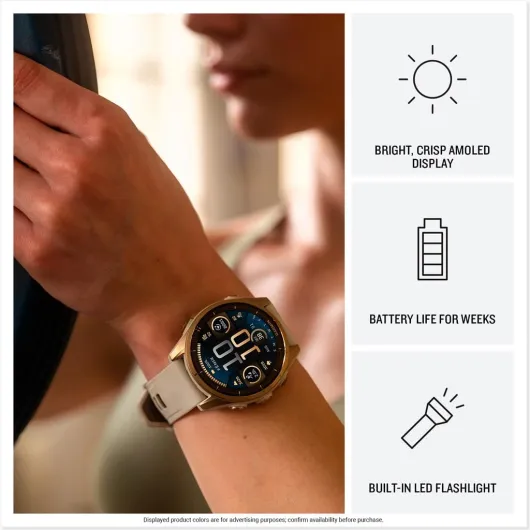
The AMOLED screen is the biggest upgrade visually. Colors are strong, text is sharp, and watch faces actually look modern instead of washed out. Outdoors, visibility is good, even in direct sun, though sometimes the auto-brightness takes a second to catch up when you go from indoors to bright light. Indoors, it looks great, and you can tune the always-on behavior if you want to save battery. If you’re coming from a transflective Garmin screen, this feels like going from old-school LCD to a modern phone screen.
Button layout is standard Garmin: five buttons plus the touchscreen. I still prefer using the buttons during workouts, especially in the rain or with sweat, but the touchscreen is handy for scrolling through menus and maps. The built-in LED flashlight is integrated into the case and looks pretty discreet; it doesn’t ruin the design, and you forget it’s there until you need it. Overall, the design is practical first, with a bit of color and style from the gold and sandstone combo, but it’s not exactly subtle.
Battery life: good, but depends how hard you push the screen and sensors
Garmin claims up to 10 days in smartwatch mode and up to 28 hours in GPS mode. In real use with the AMOLED screen, that’s a bit optimistic, but the battery is still one of the strong points compared to many other smartwatches. With always-on display enabled, medium brightness, continuous heart rate, sleep tracking, a couple of GPS workouts (around 4–5 hours total) and notifications, I ended up recharging roughly every 6–7 days. That’s still much better than the 1–2 days I got with an Apple Watch, but less than older non-AMOLED Garmin models I’ve used.
On one weekend, I pushed it more: long run with GPS (around 2.5 hours), some walking with navigation on maps, and the flashlight used quite a bit in the evening. That dropped the battery faster, and I went from 100% to around 45% in two days. So yes, the 28 hours of GPS seems realistic if you’re just tracking one long activity and not doing a ton of other stuff, but in mixed use, you should mentally plan for 1–2 heavy training days taking a noticeable chunk out of the battery.
The charging process is straightforward: proprietary Garmin cable, plugs into the back. It’s not wireless, which some people might miss, but the cable connection is solid and charges fairly quickly. I usually just plugged it in while I was showering and getting ready, or while working at my desk, and topping it up was painless. I never had a situation where it died unexpectedly because the watch gives you decent warnings before it gets critical.
Overall, battery life is good enough that you don’t have to think about it every day, which is the main point. It’s not as insane as some non-AMOLED, solar Garmins that can go for weeks, but for a bright-screen smartwatch with all these sensors, it’s solid. If you’re coming from a typical smartwatch, you’ll be happy. If you’re a Garmin veteran used to 2+ weeks of battery, you’ll feel the hit but probably accept it for the nicer screen.
Comfort: fine for all-day wear, but you feel it
On the wrist, the fēnix 8 is comfortable enough, but you’re always aware you’re wearing a proper sports watch. At 66 g with a 43 mm case, it’s lighter than it looks, but it’s not in the same league as a small fitness band or a slim smartwatch. I wore it 24/7 for several days, including sleep, and while it didn’t hurt or cause any irritation, I did find myself adjusting it a few times during the night because of the size and the way the case presses slightly against the top of the wrist when you bend it.
The dark sandstone band is soft and flexible out of the box, which helps a lot. It’s not one of those stiff straps that needs weeks to break in. The tang buckle is standard and holds well; I never felt like it was going to come loose during runs or swimming. The band has enough holes to fit both smaller and larger wrists, though if you have very small wrists, the watch might look oversized and the lugs will stick out a bit. It didn’t pinch or pull hair, which is a small but important detail when you’re wearing it all day.
During workouts, it stayed in place nicely. For accurate heart rate tracking, I had to wear it a bit tighter than I would for casual use, but that’s normal. On long runs and indoor cycling sessions, it didn’t slide around or feel too sweaty. The underside of the case is smooth enough, and the sensors don’t feel like they’re poking into your skin. The only time I really noticed the bulk was during strength training with wrist flexion or when doing push-ups; the case can press into the back of the hand a bit.
For sleep tracking, it’s acceptable but not forgettable. I could sleep with it, but if you’re very sensitive to having something on your wrist at night, this might bother you. Compared to an Apple Watch or a slimmer Garmin, the fēnix 8 is a bit more present on the wrist. In short, comfort is good for what it is: a rugged multisport watch. If you want something featherlight, this isn’t it, but for daily wear plus training, it works fine.
Durability and water resistance: built to take a beating
In terms of build quality, the fēnix 8 feels tough. The sapphire lens and metal bezel give a solid impression right away. I’ve knocked it against door frames, gym equipment, and a few rough surfaces without any visible scratches on the glass. The bezel might pick up minor marks over time if you really abuse it, but that’s normal for metal. The buttons are firm with a good click and don’t feel mushy or loose. After a few weeks of use, nothing rattled or felt cheap.
The 40 m dive rating is more than what most people will ever need. I used it for swimming in a pool and in the sea, plus one shallow dive. No leaks, no fogging, and the buttons worked underwater without any weird behavior. It’s also IPX8 rated, so rain, showers, and sweat are non-issues. The metal buttons are described as leakproof, and while I can’t test that to destruction, they certainly held up fine in my basic water use. For anyone who does regular swimming or light diving, this is reassuring.
The band feels durable enough but is still soft. After constant wear, including sweat and salt water, it didn’t discolor or crack. A quick rinse under water after swimming kept it clean. The quick-release system makes it easy to swap bands if you want something different or if it eventually wears out. I’d still expect the strap to show wear before the watch head does, which is normal.
Overall, I’d trust this watch for rough outdoor use: trail running, hiking, biking, and water sports. It’s not a delicate piece you’re scared to scratch. If you’re the type who forgets to take your watch off for anything, this one can handle it. Just keep in mind that the gold color might show cosmetic wear more visibly than a darker bezel over the long term, but functionally, it feels very solid.
Performance and sports features: where it actually shines
This is where the fēnix 8 makes sense. For sports and outdoor use, it’s very capable. The multi-band GPS with SatIQ locked onto signal quickly, usually within a few seconds even in areas with buildings and trees. On runs where I compared it to my phone and an older Garmin, the tracks were cleaner, especially around corners and under tree cover. Distance and pace readings felt consistent. For hiking, the built-in topo maps and ABC sensors (altimeter, barometer, compass) are genuinely useful if you actually use them and don’t just walk around town.
The training features are one of the main reasons to get this watch. Training readiness, stamina tracking, and recovery suggestions are not magic, but they give a decent sense of whether you’re overdoing it. After a few days of bad sleep, my readiness score dropped and the watch suggested easier sessions, which lined up with how I felt. Strength training plans and sport-specific workouts are handy if you don’t want to think too much about programming. The watch counts sets and reps reasonably well, but like most watches, it’s not perfect with exercises that don’t move the wrist much.
Health tracking is fairly complete: 24/7 heart rate, stress, respiration, Pulse Ox, and advanced sleep tracking. The sleep breakdown (light, deep, REM) seemed plausible, and the watch did a decent job of detecting when I actually fell asleep and woke up, though it sometimes counted late-night TV as “resting” when I wasn’t really asleep. The ECG feature is a nice safety net if you’re in a supported region and over 22, but it’s not something I used daily. It’s more of a check-you-do-occasionally thing rather than a constant metric.
The speaker and mic for calls work fine. I could answer calls on the wrist, and the other person heard me clearly indoors. Outside with traffic noise, it was okay but not great, which is normal for any wrist-based mic. Off-grid voice commands are a bit of a niche feature; they worked, but I didn’t find myself using them much. Overall, the performance side of the watch is strong: it gets the job done for serious training and outdoor sessions, with more data than most people will ever fully use.
What you actually get with the fēnix 8
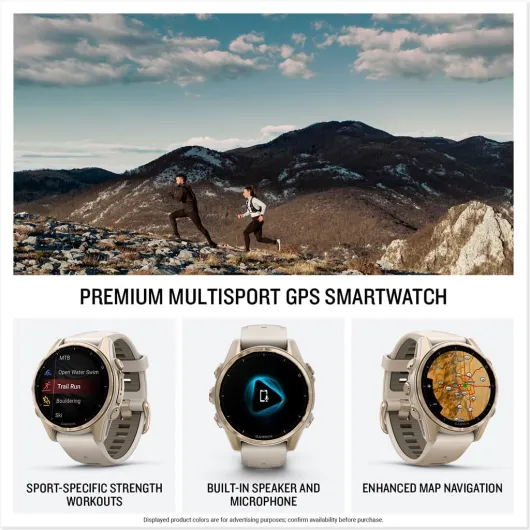
The fēnix 8 is marketed as a premium multisport GPS smartwatch, and that description is fairly accurate on the feature side. You get a 43 mm case, 1.3" AMOLED screen, sapphire glass, and a metal bezel (this one is the soft gold color). It runs Garmin’s own OS, has 32 GB of storage, built-in GPS with multi-band and SatIQ, and is rated to 40 m for diving. It’s not just splash proof; you can actually take it underwater with dedicated scuba and apnea modes.
Function-wise, it covers pretty much everything: running, cycling, swimming, hiking, strength training, multisport, plus a bunch of niche sports. It tracks heart rate, sleep, respiration, stress, Pulse Ox (if available in your region), and it has an ECG app for atrial fibrillation checks in supported countries. There’s a built-in LED flashlight on the case, a speaker and mic for calls, and support for using your phone’s voice assistant. It also has off-grid voice commands, which means you can trigger some actions without being connected to your phone.
Battery is advertised at up to 10 days in smartwatch mode and up to 28 hours in GPS mode. In real life, with the AMOLED screen and a few GPS workouts per week, I was closer to 6–7 days, which is still much better than most generic smartwatches, but less than the spec sheet if you push the screen brightness and use all the sensors. The watch weighs about 66 g, so it’s not tiny but it’s lighter than it looks, especially for something this rugged.
In the box you get the watch, a charging/data cable, and the usual documentation. No extra band, no fancy extras. For the price point, an extra strap would have been nice, especially for swapping between sport and more formal use. Overall, the package is simple: you’re clearly paying for the hardware and software ecosystem, not for fancy packaging or accessories.
Pros
- Very strong sports and outdoor features with accurate multi-band GPS and topo maps
- Rugged build with sapphire glass and 40 m dive rating that can handle real-world abuse
- Good battery life for an AMOLED smartwatch, easily several days with regular training
Cons
- High price, especially if you don’t fully use the advanced training and outdoor features
- Bulky for smaller wrists and a bit noticeable for sleep or under tight sleeves
- Battery life shorter than older non-AMOLED Garmins when using bright always-on display and many sensors
Conclusion
Editor's rating
The Garmin fēnix 8 is a serious multisport watch that makes sense if you actually train and spend time outdoors. The AMOLED screen is a big step up in readability and looks, the GPS is accurate, and the build feels like it can handle real abuse. Add in dive rating, topo maps, training readiness, and long battery life compared to typical smartwatches, and you get a tool that genuinely helps if you’re into running, cycling, hiking, swimming, or diving on a regular basis.
It’s not perfect, though. The price is high, the watch is still on the bulky side for smaller wrists, and the battery life, while good, is shorter than older non-AMOLED Garmins if you push the screen and sensors. Some features like off-grid voice commands and ECG are nice to have but won’t be daily essentials for most people. If you mainly want notifications, casual fitness tracking, and a sleek smartwatch look, this is probably too much watch for what you need and too expensive for the value you’ll actually get.
If you’re a runner, triathlete, or outdoor person who likes digging into data and wants a watch that can handle rough conditions, the fēnix 8 is a pretty solid choice and feels like a reliable training partner. If you’re more of a casual gym-goer or office user, you’re better off saving money and going for something lighter and simpler. It’s a powerful watch, but it really shines only when you actually use what it offers.