Summary
Editor's rating
Value for money: strong if you hate subscriptions and care about sleep data
Simple, discreet design that doesn’t scream ‘tech gadget’
Battery life: 6 days is possible, but not in the most intensive mode
Comfort: great once sized right, but sizing really matters
Titanium shell, plastic charger: feels solid but not luxurious
Durability: handles water and daily knocks, some minor marks over time
Tracking performance: solid for sleep and recovery, decent for workouts
What you actually get and how the sizing kit works
Pros
- Strong sleep and recovery tracking with clear HRV, heart rate and temperature insights
- No ongoing app subscription, all main features included in the purchase
- Comfortable, discreet titanium ring that’s easy to wear day and night once sized correctly
Cons
- Battery life drops to around 1–2 days in high-intensity tracking mode
- No built-in GPS and limited workout feedback compared to a good sports watch
- Comfort and accuracy depend heavily on getting the right size, so the process takes time

Specifications
View full product page →| Brand | ULTRAHUMAN |
A smart ring for people who actually want data, not just a toy
I’ve been wearing the Ultrahuman Ring AIR on and off for a few weeks now, mostly on my index and middle finger, and using it as my main sleep and recovery tracker. I came from using a regular smartwatch and a cheap fitness band, so I was curious to see if a ring could really keep up in terms of heart rate, sleep and daily activity. I’ll be blunt: it’s not perfect, but it does a pretty solid job overall, especially if you care more about data and less about flashy screens.
What pushed me to try this one instead of yet another watch was the idea of having something small, light and less annoying in bed. No subscription was also a big point for me. I’m tired of buying a device and then being asked to pay every month just to see my own data. With the Ultrahuman Ring AIR, the app is included in the price, and all the main features are there from day one, which is how it should be.
In daily use, I mostly cared about a few things: how accurate the sleep tracking feels, if the recovery and HRV numbers line up with how tired I feel, and whether I’d actually keep it on 24/7 without getting annoyed. I also paid attention to the battery life because the marketing talks about up to 6 days, and I know from experience those numbers usually assume the lightest possible usage.
So this review is not from the angle of a tech geek trying to test every tiny metric, but more like a normal user who wants to know: does it track well, is it comfortable, and is it worth the money compared to a watch or other rings. I’ll walk through the design, comfort, tracking performance, battery, durability and value, with the good and the annoying parts included.
Value for money: strong if you hate subscriptions and care about sleep data
In terms of value, you have to look at what you’re really paying for: a compact form factor, no ongoing subscription, and solid sleep/recovery tracking. Compared to something like Oura, which usually asks for a monthly fee to unlock full insights, Ultrahuman’s one-time cost starts to look more reasonable over a year or two. If you plan to use it seriously for the long term, avoiding another subscription in your life is a big plus.
On the other hand, if you already own a decent smartwatch from Garmin, Apple, or Fitbit, you have to ask yourself what the ring adds. For me, the main advantages over a watch are comfort during sleep and the fact that it’s more discreet. The data quality for sleep and HRV feels at least on par with mid-range watches, sometimes better in terms of resting heart rate stability. But for sports tracking, a good watch still wins because of built-in GPS, better workout controls, and a bigger screen for real-time stats.
So I’d say the Ultrahuman Ring AIR is good value if you’re in one of these situations:
- You mainly care about sleep, stress, HRV and general health trends.
- You dislike wearing a watch in bed or all day.
- You don’t want to pay a monthly subscription just to see advanced metrics.
Overall, for someone who’s serious about understanding their sleep and recovery and wants a small, low-profile device, the ring offers solid value for money. For casual users who just want to count steps, it’s probably overkill. And for hardcore athletes who live in their sports watch, it’s more of a complement than a replacement. It sits in that middle ground: not cheap, but fairly priced for what it delivers, especially with the app included.
Simple, discreet design that doesn’t scream ‘tech gadget’
Design-wise, the Ultrahuman Ring AIR goes for a pretty low-key look. Mine is the Matte Black version, and from a distance it just looks like a plain band. There’s no screen, no lights, nothing that stands out, which I actually like. If you’re expecting some flashy LED ring, this is not it. It’s closer to a regular wedding band in terms of appearance, just a bit wider and thicker because of the sensors.
The profile is slightly rounded on the outside and flat on the inside where the sensors sit. It’s not razor-thin, but for something with heart rate, temperature and SpO2 sensors inside, it’s fairly compact. On my hand it doesn’t look bulky, and it doesn’t catch on clothes much. I’ve worn it while typing all day, carrying groceries, and doing some light DIY stuff at home, and it mostly stayed out of the way. It’s about the same visual footprint as other smart rings like Oura, so if you’re okay with that category, you’ll be fine here.
There are no buttons or haptic feedback. Everything is controlled from the Ultrahuman app. The ring itself is basically a sensor shell with a Bluetooth link. There is a tiny LED on the inside that you’ll see when it’s on the charger, but otherwise you don’t see any electronics. The finish on the Matte Black is decent: it’s not glossy, so it doesn’t pick up fingerprints too badly. After a few weeks, I’ve picked up some very light micro-scratches, but nothing dramatic. I’d say it looks like a normal ring that’s been worn daily, not destroyed.
In short, the design is discreet and practical. It doesn’t look cheap, but it also doesn’t look like jewelry. If you want something flashy or decorative, this might feel a bit plain. If you prefer something that just blends in and doesn’t shout “wearable tech”, this fits that role well. I forgot I had it on more than once, which is exactly what you want from a health tracker you’re supposed to wear 24/7.
Battery life: 6 days is possible, but not in the most intensive mode
The advertised battery life is up to 6 days, and that’s technically reachable, but it depends heavily on your settings. Out of the box, with normal tracking (continuous HR but not the most aggressive sampling), I was getting around 4–5 days before feeling the need to recharge. That’s with sleep tracking every night, a couple of 45–60 minute workouts per week, and all notifications enabled in the app. So not the lightest use, but not extreme either.
When I switched to the more aggressive tracking mode (they call it something like turbo or high intensity in the app), the story changed. Battery life dropped to around 1–2 days, very similar to what one Amazon user mentioned. In that mode, you get fewer gaps in your heart rate graph and more precise data during workouts, but you pay for it with frequent charging. Personally, I don’t need perfect second-by-second heart rate logs all day, so I went back to the standard mode and only toggle higher intensity when I really want detailed data, like during a long run.
Charging is straightforward: place the ring on the dock, plug the USB-C cable into any charger, and you’re done in about 2 hours from low to full. I usually drop it on the charger while I shower and have breakfast; 20–30 minutes gives a big chunk of battery back. Because it’s not a watch, taking it off for a short charge doesn’t feel as annoying. The only catch is if you forget to put it back on before leaving home, then you lose a full day of data.
So in practice: if you use standard settings, assume 4–5 days of real-world battery. If you crank everything to the max, be ready for almost daily charging. It’s still better than most smartwatches that barely last two days, but don’t expect a full week unless your usage is light and you’re not constantly in high-intensity tracking. For me, the balance is acceptable, but I wouldn’t call the 6-day claim typical unless you’re careful with settings.
Comfort: great once sized right, but sizing really matters
Comfort is where this product can either work well or become annoying, and it depends heavily on getting the correct size. With the sizing kit, I tested size 9 and 10 on different fingers for full days. During a hot day and a workout, my fingers swelled a bit, and the size that felt perfect in the morning felt tight by evening. That’s why I agree with other users who say: wear the sizer for at least 24 hours before deciding. I settled on a fit that’s slightly loose in the morning but still secure later in the day.
Once I had the right size, day-to-day comfort was honestly good. The ring is light (around 2–3 grams) and after the first couple of days, I barely noticed it. Typing on a keyboard, gripping a barbell, doing push-ups – it didn’t dig in or pinch. The inner sensor ridge is smooth, so it doesn’t scratch the skin. The only moment it bothered me was when I carried heavy grocery bags with thin handles; the ring pressed between the handle and my finger joint. That’s more an issue with any ring than this specific one.
For sleep, it’s miles better than a chunky watch. I usually hate sleeping with anything on my wrist because it gets caught in sheets or presses against my face. With the ring, I mostly forgot it was there. One night I did wake up and feel it pressing a bit when my hand was under my head, but that was rare. If you’re very sensitive to any jewelry while sleeping, you might still notice it, but compared to a watch, this is much easier to live with.
The only downside comfort-wise is that if your fingers change size a lot with temperature or weight changes, you might find it either a bit loose or a bit tight at some times of the day. There’s no adjustment like with a strap. So I’d say: comfort is very good once you nail the size, but if you have big knuckles or fluctuating finger size, expect some compromise. It’s not painful or anything, just something you’re aware of now and then.
Titanium shell, plastic charger: feels solid but not luxurious
The ring itself uses a titanium band, which is pretty standard for this category. In practice, that means it’s light, doesn’t rust, and should hold up decently to daily wear. On the inside you have the sensor array with the optical heart rate LEDs and temperature sensors, covered by a smooth inner surface. You don’t feel individual components; it’s just a slightly raised inner ring that sits against your skin. For my skin, there was no irritation, even when I wore it day and night for a week straight.
The materials on the charging dock are basic plastic. It’s small and light, and the ring sits on top. It feels a bit cheap in the hand, but it works fine. Magnets line it up so you don’t have to fiddle too much. The USB-C to USB-C cable is generic but decent. Overall, the materials outside the ring itself feel more functional than premium. This doesn’t bother me much because I only see the charger for a couple of hours every few days, but it’s worth noting if you expected something more high-end there.
In terms of water protection, the ring has an IPX8 rating and is rated to 100 meters water resistance. I’ve worn it in the shower, washing dishes and during sweaty workouts without any issue. I’m not a diver, so I can’t tell you how it behaves at depth, but for normal life it handled water just fine. No fogging, no weird behavior after hot showers. The titanium plus sealed electronics combo seems solid so far.
If I compare it to a mid-range smartwatch, the ring itself feels more durable than a plastic fitness band but less “premium” than a stainless steel watch case. It sits in between: good, practical materials, but not something you’ll admire for craftsmanship. For a health tracker that’s mostly hidden, I think that’s acceptable. I care more about it surviving knocks and water, and so far it’s passing that test.
Durability: handles water and daily knocks, some minor marks over time
After a few weeks of wearing it almost nonstop, the Ultrahuman Ring AIR seems to hold up pretty well. I’ve worn it in the shower, while washing dishes, in the rain and during sweaty workouts. With its IPX8 rating and 100m water resistance spec, it’s clearly meant to stay on most of the time. I haven’t seen any fogging under the sensors or weird behavior after hot showers, which is good. Some cheap trackers struggle with repeated heat and moisture; this one hasn’t so far.
The titanium band definitely helps with durability. I’ve knocked it against door frames, dumbbells and the edge of my desk a few times. The Matte Black finish picked up a couple of very fine marks, but you have to look closely to see them. It’s not bulletproof, but for normal life it’s fine. If you work a manual job where your hands are constantly scraping metal or concrete, you’ll probably scratch any ring, including this one. For office, gym, and home use, it’s more than enough.
The inner sensor area still looks clean. I try to rinse it quickly after very sweaty sessions so sweat and soap don’t build up around the sensors. The plastic charger is the only part that feels a bit fragile. I wouldn’t want to step on it or stuff it loosely in a heavy bag. But it just sits on my desk, and I’ve had no issues. The USB-C port is standard, so if the cable dies, you can replace it easily.
Long-term, I’d expect the ring to last several years if you’re not abusive with it. There’s a 1-year warranty, which is decent but not generous. So far nothing suggests it’s going to fall apart early. I’d rate durability as: solid for everyday life, with normal signs of wear. It’s not jewelry-level finish, but it’s also not flimsy. If you’re the type who destroys watches quickly, you’ll still need to be a bit careful, but for most people this should hold up fine.
Tracking performance: solid for sleep and recovery, decent for workouts
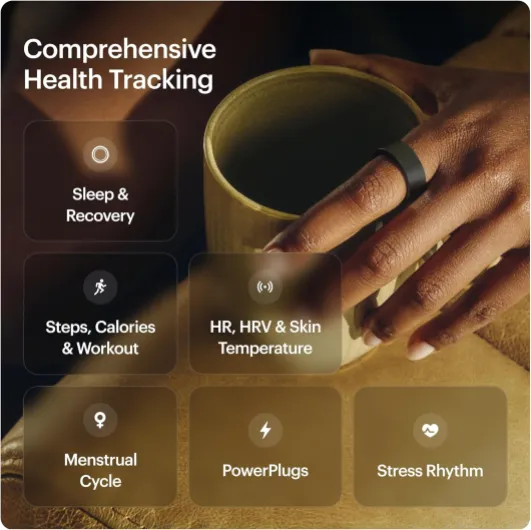
On the tracking side, the Ultrahuman Ring AIR focuses on sleep, recovery and all-day activity, and it does that fairly well. Sleep breakdown into light, deep, REM and wake periods more or less matched how I felt when I woke up. On nights where I went to bed late and woke up a few times, the app clearly showed more fragmented sleep and gave a lower recovery score the next morning. On nights where I slept like a rock, the deep sleep and HRV numbers were higher, and the app recommended going harder with training. It’s not magic, but the patterns line up with reality.
The Dynamic Recovery Score is a mix of HRV, resting heart rate and skin temperature. On days after heavy workouts or poor sleep, my HRV dropped and resting heart rate went up a bit, and the ring flagged that. It’s useful if you like having a simple “today you’re good / take it easy” indicator. Just don’t treat it as a doctor. It’s a guide, not a diagnosis. I also noticed that alcohol or very late meals the night before clearly messed with the numbers, which is actually helpful feedback to improve habits.
For workouts, you have 20+ modes (running, cycling, strength, yoga, etc.), but keep in mind there’s no GPS in the ring. It relies on your phone’s GPS or just tracks heart rate and duration. During runs, heart rate trends looked similar to my chest strap, with some lag during intervals, which is normal for optical sensors. For strength training, it mainly records heart rate and time; it won’t count reps or anything fancy. So it’s decent for keeping an eye on how hard your session is, but it’s not a replacement for a dedicated sports watch if you’re really into pace, power or advanced stats.
The all-day activity tracking (steps, general movement) is okay. Step counts were in the same ballpark as my phone and watch, sometimes a bit lower, which I actually prefer over inflated numbers. It also tracks skin temperature and SpO2, but those are more background metrics than something you’ll check every day. Overall, I’d rate performance as: very good for sleep and recovery, good enough for casual workouts, basic for serious sports tracking. If you’re a data nerd runner or cyclist, you’ll still want your watch. If you care mostly about sleep, stress and general health, the ring does the job.
What you actually get and how the sizing kit works
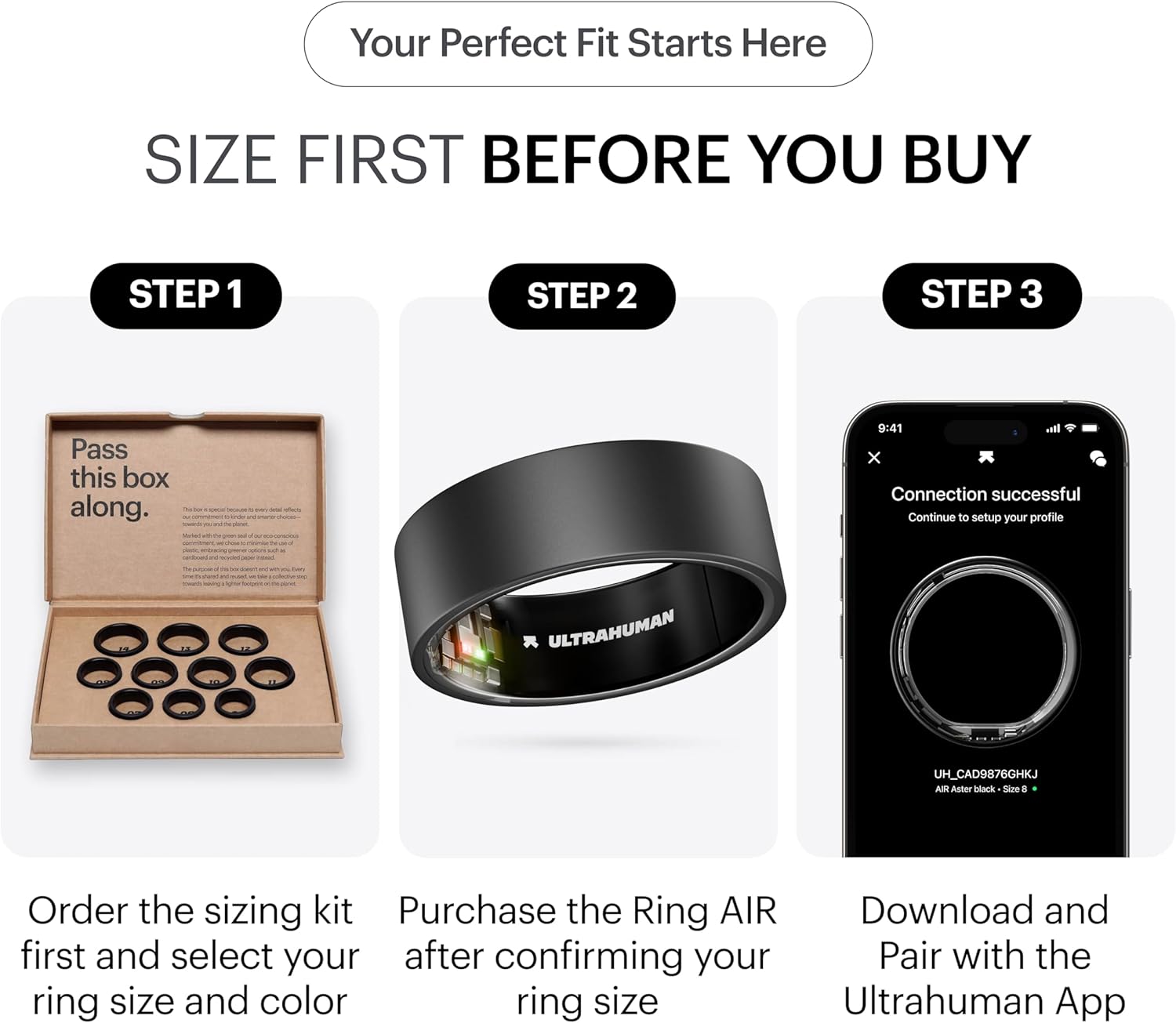
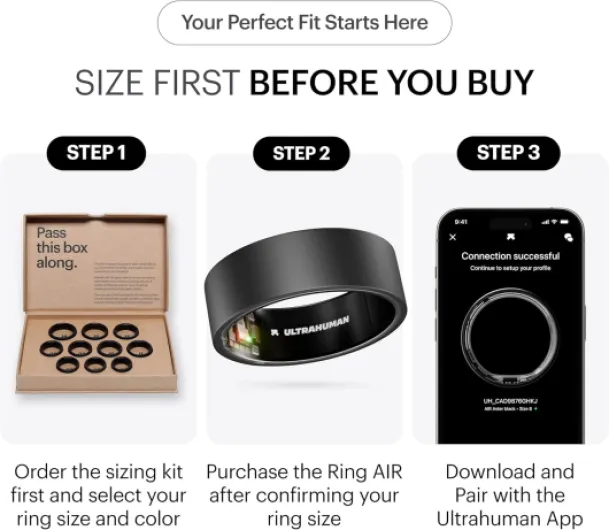
The way Ultrahuman sells this thing is a bit different from most gadgets. You don’t just pick a size and hope for the best. You first get a sizing kit with plastic rings from size 5 to 14 and colour samples. I actually like this approach because rings are way less forgiving than watch straps. If the ring is too loose, tracking suffers; if it’s too tight, you’ll hate wearing it. I wore two different sizer rings for full days, including one workout and a night’s sleep, before picking my final size. That step alone probably saved me a return.
The kit itself is simple: a strip of plastic rings that mimic the width and thickness of the real titanium ring, plus small plates showing the actual finishes (Matte Black, Raw Titanium, some gold tones, etc.). The plastic feels cheaper and grippier than metal, but that’s expected. The important part is that the inner profile and fit are close to the real thing, so you get a realistic idea of how it will sit on your finger and how hard it is to get over the knuckle.
Once you pick your size and colour, you order the real ring. In the box you get the Ring AIR, a small charging dock and a USB-C to USB-C cable. No wall plug, but that’s standard these days. Setup is straightforward: open the Ultrahuman app, create an account, pair the ring via Bluetooth and let it do a firmware update. That took me about 10–15 minutes from unboxing to wearing it and seeing data in the app.
Overall, the whole presentation and onboarding are clean and functional. It feels like a health gadget, not a fashion accessory. If you’re used to Apple or Garmin packaging, this feels a bit more basic, but it gets the job done. The main thing to know is: don’t skip the sizing kit. If you rush the size, you’ll either have poor readings or you’ll hate the ring because it digs into your finger after a long day.
Pros
- Strong sleep and recovery tracking with clear HRV, heart rate and temperature insights
- No ongoing app subscription, all main features included in the purchase
- Comfortable, discreet titanium ring that’s easy to wear day and night once sized correctly
Cons
- Battery life drops to around 1–2 days in high-intensity tracking mode
- No built-in GPS and limited workout feedback compared to a good sports watch
- Comfort and accuracy depend heavily on getting the right size, so the process takes time
Conclusion
Editor's rating
The Ultrahuman Ring AIR is a solid choice if you care mainly about sleep, recovery and all-day health tracking and you’re tired of wearing a watch 24/7. The form factor is comfortable once you’ve nailed the size, the titanium build holds up to daily life, and the app gives clear, useful insights without hiding features behind a subscription. Sleep stages, HRV-based recovery scores and temperature trends all line up pretty well with how you actually feel, which is what matters in the end.
It’s not perfect though. The promised 6-day battery life is realistic only with moderate settings; if you push the tracking to the highest intensity, you’ll be charging almost daily. The charger feels a bit cheap, there’s no built-in GPS, and for serious sports tracking a proper watch is still better. Comfort also depends a lot on getting the right size, so the sizing kit step is basically mandatory, not optional.
Who is it for? People who want a discreet, always-on health tracker, hate subscriptions, and care more about sleep and recovery than live workout data will get good value here. Who should skip it? If you’re a casual user just wanting step counts, a cheaper band will do. If you’re a performance-focused runner or cyclist, keep your sports watch and see this, at best, as an extra recovery tool. Overall, it’s a competent, no-nonsense smart ring that does its job well without trying to be everything at once.