Summary
Editor's rating
Value: who should actually buy this
Design: finally not a brick on the wrist
Battery life: the nice surprise
Comfort: you forget it’s there (in a good way)
Durability: light but not fragile
Tracking & GPS: good enough for normal people
What this thing actually does (and doesn’t)
Pros
- Very small and light, genuinely comfortable to wear all day and night
- Built-in GPS and solid Garmin health tracking in a discreet watch design
- Battery life close to a week in real use, even with notifications and some GPS
Cons
- Small screen and patterned lens make reading long notifications and stats less comfortable
- Not suited for serious athletes who want advanced metrics and a larger display

Specifications
View full product page →| Brand | Garmin |
A smartwatch that actually looks like a watch
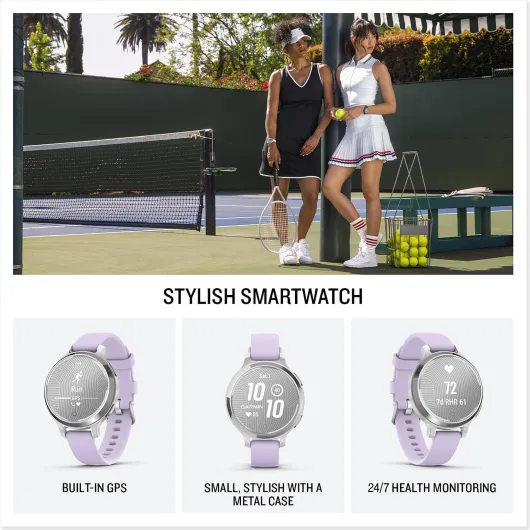
I’ve been wearing the Garmin Lily 2 Active Cream/Gold (renewed) for a bit now, and my first reaction was basically: finally, a smartwatch that doesn’t look like a chunky plastic gadget. I usually bounce off sports watches because they’re huge on a smaller wrist, and they scream “running geek”. This one is clearly made for people who want tracking and notifications, but still want something that passes as a normal watch in everyday life.
I used it like a normal person: office days, a few runs, some walks, sleeping with it, and random house chores. No crazy triathlons, just typical use. I paired it with an Android phone, kept Bluetooth and notifications on, and used GPS a few times per week. I didn’t baby it: shower steam, washing dishes, hitting it on door frames, the usual.
What stood out quite fast is that it’s small and light, and that changes everything in day-to-day use. You kind of forget it’s on, which is not the case with bigger Garmins or Apple Watches. On the other hand, the small size also means tiny screen, and you feel that as soon as you try to read a long message or dig into stats on the watch.
Overall, my feeling after wearing it is this: it’s a lifestyle fitness watch first, and a sports tool second. If you’re expecting a mini Fenix on your wrist, you’ll be disappointed. If you just want solid health tracking in a watch that doesn’t look techy, it makes sense. It’s not perfect, and there are a couple of things that annoyed me, but it does get the basics done pretty well.
Value: who should actually buy this
Value really depends on what you expect from a smartwatch. The Lily 2 Active is clearly not the cheapest tracker on the market, but you’re paying for Garmin’s ecosystem, decent GPS, and the small, watch-like design. As a renewed product, the price is usually lower than new, which helps a lot. In that context, I’d say it’s good value if you specifically want a small, discreet watch with solid health tracking.
If you compare it to cheaper fitness bands, those might give you similar step counts and heart rate for less money, but they usually look more like plastic gadgets and often lack built-in GPS or the more complete Garmin app experience. On the other hand, if you compare it to bigger Garmin models at similar prices (sometimes on sale), those will destroy it in advanced sports metrics, larger screens, and customisation. So if sports performance is your main thing, this is not the best deal.
Where the Lily 2 Active makes sense is for people who want:
- Something that looks like a normal, small watch
- Decent GPS and health tracking without going full pro athlete
- Battery that lasts close to a week
- Women’s health features like menstrual and pregnancy tracking
For me personally, the trade-off is the small screen. You pay a mid-range price for a watch that’s very comfortable and discreet, but you sacrifice readability and some ease of use. If you’re fine checking details mostly on your phone and just using the watch as a glanceable companion, it’s a solid package. If you want to do everything from your wrist, I’d look elsewhere. So, good value for the right person, average value if you don’t care about the small, stylish form factor.
Design: finally not a brick on the wrist
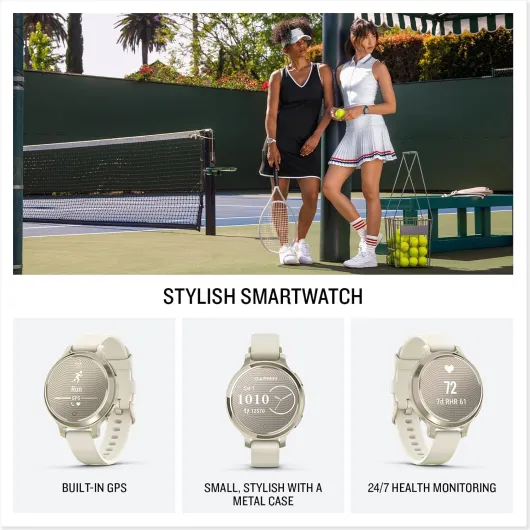
The 35 mm case is the main story here. Compared to most smartwatches that sit around 40–45 mm, this one feels almost like a classic small analog watch. On a smaller wrist, it just looks normal, not like a mini computer strapped to your arm. The cream and gold combo is pretty neutral: not flashy, not cheap-looking. It goes fine with casual clothes and office outfits. It doesn’t scream “sports watch”, which I appreciated a lot.
The patterned lens with a hidden display is a nice idea in practice: when the screen is off, it looks like a patterned watch face. When you raise your wrist or tap, the LCD display lights up behind it. It’s a cool trick, but there is a trade-off: in some angles or bright light, the pattern slightly reduces contrast, so it’s not as crisp as a plain screen. Still readable, but if you’re used to bright AMOLED screens, you’ll feel the difference.
The watch has a metal case with two side buttons, which gives it a more classic watch feel compared to single-button fitness bands. The buttons are small but clicky enough. The bezels are not ultra-thin, so you don’t get that edge-to-edge modern look, but in real life it’s fine. The 1-inch screen is clearly small, and you see that as soon as you scroll through long notifications or workout data. This is not the watch you buy if you want to read emails on your wrist.
Day to day, I liked the design because it just blended in. No one asked me about my “sports watch”, they just assumed it was a normal watch. If you want something that looks sporty or techy, this might feel a bit too tame. But if your main goal is a smartwatch that looks like jewelry more than a gadget, the design hits that mark pretty well, with just the downside of the smaller, less legible screen compared to chunkier models.
Battery life: the nice surprise
Garmin claims up to 9 days of battery life, and in real life it’s not far off if you use it like a normal person. With always-on heart rate, sleep tracking every night, notifications on, and GPS workouts 2–3 times a week, I was getting around 6–7 days before needing a charge. When I used GPS less, it pushed closer to 8 days. So no, it’s not the full 9 days in active use, but it’s clearly better than recharging every day or every two days like some other brands.
Charging is through Garmin’s usual proprietary cable. It’s not my favorite thing (I always prefer USB-C directly), but it’s standard for them. From low battery (around 10%) to full, it took roughly 1.5 to 2 hours on a normal USB charger. I usually just plugged it in while showering and getting ready and topped it up easily enough. The watch gives clear low-battery warnings, so you’re not caught totally off guard before a workout.
What I liked is that battery drain during GPS sessions felt reasonable. A 45-minute run barely moved the percentage down by more than a few points. If you’re someone who does one or two GPS workouts a week, you’ll hardly notice the impact. If you’re doing daily GPS runs, obviously the total days per charge will drop, but you’re still not in the “charge every night” situation.
Overall, battery life is one of the strong arguments for this watch. It lets you keep sleep tracking + notifications + GPS here and there without thinking about the charger all the time. Not perfect, but compared to many smartwatches that barely last a couple of days, this feels pretty relaxed. The only real downside is the proprietary charger, so don’t lose that cable if you travel a lot.
Comfort: you forget it’s there (in a good way)
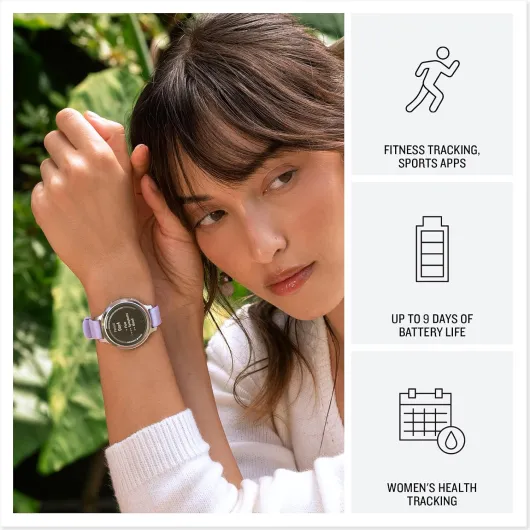
The comfort is honestly one of the strongest points of this watch. At around 29 grams, it’s very light. After a few hours, I just stopped noticing it, which never happened with bulkier Garmins I tried before. The small case doesn’t dig into your wrist when you bend your hand back, which is something that annoyed me a lot with bigger watches while typing or doing push-ups.
The silicone band is pretty standard Garmin style: flexible, skin-friendly, and easy to clean. It didn’t cause me any rash or irritation, even when I wore it 24/7 for several days including nights. The buckle is simple and secure, no fancy clasp that randomly opens. Adjusting it to get a good heart rate reading without feeling squeezed was easy enough. If you want to swap the band, you can, but keep in mind it’s designed to stay on the slim, dressy side.
Sleeping with it was also fine. I usually hate sleeping with watches, but the small size and low weight made it bearable. The only minor annoyance at night is the screen sometimes lighting up if you twist your wrist, but you can tweak the settings or use do-not-disturb modes to tone that down. During workouts, it stayed put without sliding up and down the arm, which helps with heart rate accuracy.
On the downside, the small screen and compact body also mean you sometimes have to be more precise with taps and swipes. If you have big fingers, you might mis-tap from time to time, especially in a hurry. But overall, in terms of pure comfort, it’s one of the easiest wearables I’ve used: it just disappears on the wrist, and that’s exactly what you want for something you’re supposed to wear all day and night.
Durability: light but not fragile
Even though it’s a renewed unit, mine felt solid in daily use. The metal case helps a lot: it doesn’t feel like hollow plastic. I knocked it a few times on door frames and desks, and there were no visible marks. The screen/lens didn’t pick up scratches during my test period, but I wasn’t scraping it on concrete either. For normal office, home, and workout use, it seems to handle things fine.
It’s clearly not built like a rugged outdoor tank, so if you’re into climbing rocks or doing heavy manual work, I’d be more careful or choose a tougher Garmin. But for the target audience (office, gym, running, walks), it’s enough. The silicone strap also held up well: no cracks, no weird stretching, and the pin system stayed stable. If it ever wears out, you can replace the band anyway.
Water-wise, it handled sweat and splashes with no issue. I wore it in the shower a few times and while washing dishes, and it didn’t complain. I wouldn’t treat it like a hardcore dive watch, but for daily life and casual swimming, it’s fine. Garmin usually has decent water resistance on this type of model, and this one doesn’t feel like an exception.
Because it’s renewed, the unknown is long-term battery health, but during my testing it behaved like a new one. No weird drops from 20% to 0%, no overheating, nothing like that. If you’re worried, there’s a 1-year limited warranty, which at least gives some backup. So overall, it feels light but not flimsy. Just don’t expect it to survive the same abuse as a chunky outdoor watch, and you’ll be fine.
Tracking & GPS: good enough for normal people
In terms of fitness and health performance, the Lily 2 Active is pretty solid for everyday use, as long as you accept that it’s not a hardcore sports watch. Steps and general activity tracking felt realistic: no crazy step inflation compared to my phone, and day-to-day trends made sense. Heart rate during steady activities (walking, light jogging, cycling on a trainer) was in line with a chest strap I used for comparison, with the usual small wrist-based delay during intervals.
The built-in GPS is a nice upgrade from trackers that rely on your phone. I tested it on a few 5–7 km runs and walks. Distance and route were close to what I got from other GPS devices and mapping apps. It’s not perfect to the meter, but for recreational running or walking, it’s absolutely fine. You can see your pace, distance, and basic data on the watch, but for detailed stats, you clearly rely on the Garmin Connect app. The small screen doesn’t invite you to scroll through endless data pages mid-run.
The sports apps cover a decent mix: running, walking, cardio, yoga, Pilates, dance fitness, and some others like golf. If you’re into niche sports, this is not the model for you, but for general fitness it’s enough. The guided on-screen workouts are basic but handy: simple animations and timers that tell you what to do. Nothing fancy, but it helps if you don’t want to think too much about structuring a quick session.
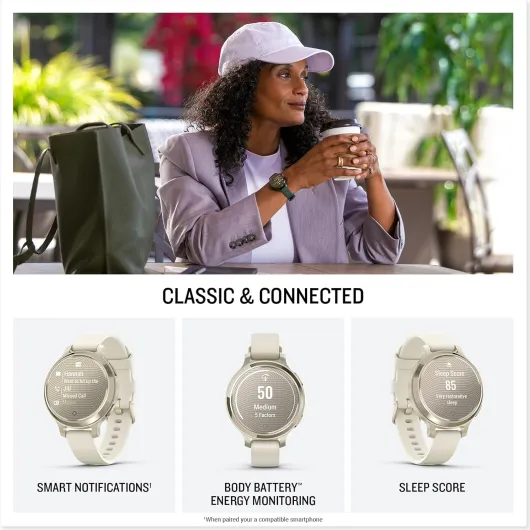
For health stuff, features like sleep score, Body Battery, stress, respiration, and women’s health tracking give you a good overview. I wouldn’t treat the numbers as medical data, but they’re useful trends. Sleep stages are estimates, and sometimes it mislabels time in bed as light sleep, but that’s common on many wearables. Overall, performance is good for casual to moderate users. If you’re a serious runner or triathlete obsessed with detailed metrics, there are better Garmin models. For most people who just want tracking that isn’t nonsense, it does the job.
What this thing actually does (and doesn’t)
On paper, the Garmin Lily 2 Active is a 35 mm smartwatch with GPS, heart rate, sleep tracking, stress tracking, women’s health tracking, and smart notifications. So basically, it covers the usual health and fitness basics. It has built-in GPS, which is important: you don’t have to drag your phone with you to record outdoor runs or walks. For a small watch, that’s a nice touch. It also comes with Garmin Coach plans if you want to train for a 5K, 10K, or half-marathon, but keep your expectations realistic: with this screen size, you do most of the setup and analysis in the app, not on the watch.
The watch handles steps, calories, intensity minutes, sleep score, Body Battery, respiration, stress, and hydration tracking. It also has menstrual and pregnancy tracking, which is clearly one of the target features for this model. You also get incident detection and assistance when paired to your phone, so if you fall or trigger it, it can send your live location to emergency contacts. I didn’t have a real incident (thankfully), but I tested the feature and the alert did go out properly.
In daily use, what you actually notice is simpler: it vibrates when you get calls, messages, calendar alerts, and app notifications, and you can quickly glance at them without pulling out your phone. You can’t really type long replies or do fancy stuff like on an Apple Watch; it’s more about checking what’s going on and deciding if you need your phone. The interface is pretty basic but clear enough, with swipe gestures and two buttons.
The renewed aspect: mine felt like new in practice. No scratches, battery behaved like a new unit, and it came with the official charging cable and documentation. If you’re picky, you obviously don’t get the same “unboxing” vibe as a brand-new product, but functionally I didn’t see a difference. So as a package, it’s a small, lifestyle-focused smartwatch with the standard Garmin health tools and a few safety options, but without the heavy sports-nerd features you find on their bigger models.
Pros
- Very small and light, genuinely comfortable to wear all day and night
- Built-in GPS and solid Garmin health tracking in a discreet watch design
- Battery life close to a week in real use, even with notifications and some GPS
Cons
- Small screen and patterned lens make reading long notifications and stats less comfortable
- Not suited for serious athletes who want advanced metrics and a larger display
Conclusion
Editor's rating
Overall, the Garmin Lily 2 Active Cream/Gold (renewed) is a small, comfortable smartwatch that focuses more on looking good and being easy to wear than on hardcore sports features. It tracks the basics well: steps, heart rate, sleep, stress, Body Battery, and it has built-in GPS for outdoor activities. Battery life around a week in real use is a big plus, and the light weight makes it one of the few watches I didn’t mind wearing 24/7, including at night.
It’s not perfect. The screen is small, and the patterned lens, while pretty, doesn’t help readability in every situation. You also don’t get the same depth of sports metrics and big, bright display you’d find on larger Garmin models or some competitors. This is clearly not targeted at serious data-obsessed athletes. It’s for people who want a watch that looks normal, tracks health reliably, and gives notifications without shouting “tech toy”.
If you have a smaller wrist, care about style, want women’s health features, and prefer to check detailed stats on your phone rather than on your watch, this fits well. If you want a big, bright screen, advanced training tools, or you read long messages on your wrist all the time, you should probably skip it and go for a bigger model. As a renewed unit, assuming the price is clearly lower than new, I’d call it a pretty solid everyday choice for casual to moderate users who prioritize comfort and looks over raw performance.