Summary
Editor's rating
Value: expensive but makes sense for the right person
Chunky outdoor look, no nonsense
Battery and solar: very good, but don’t expect free energy
Comfort: fine for daily wear, borderline big for sleep
Built to take abuse, not to look fancy
GPS, training metrics and everyday tracking: lots of data, mostly useful
What this watch actually offers in real life
Pros
- Very strong battery life (about 10–14 days real use) with solar helping to slow drain
- Accurate multi-band GPS and solid maps for running, hiking and skiing
- Rugged build with 10 ATM water resistance and practical built-in LED flashlight
Cons
- Big and a bit bulky, not ideal for small wrists or people who hate sleeping with a watch
- Screen is only average indoors compared to AMOLED competitors and smart features are limited

Specifications
View full product page →| Brand | Garmin |
A serious watch for people who actually train
I’ve been using the Garmin fēnix 7 Pro Solar (47 mm, graphite) as my main watch for a few weeks, coming from older Garmins and a basic Fitbit before that. Short version: this is not a flashy smartwatch for scrolling apps, it’s a training tool that also tells the time and shows your notifications. If you mostly run, hike, bike or go to the gym several times a week, it starts to make sense. If you just count steps, it’s probably overkill.
What stood out for me right away is how much stuff Garmin crammed into this thing: multi‑band GPS, topo and ski maps, golf courses, hill score, endurance score, training readiness, HRV, sleep tracking, flashlight, solar charging… At the beginning it honestly feels like too much. The first three days I spent more time turning things off and tweaking screens than actually training with it.
Once I got over that setup phase though, it settled into a pretty solid routine: I charge it maybe every 10–14 days, it tracks all my runs and strength workouts, gives me a morning status, and I barely think about battery. Compared to my old smartwatch that had to be charged every 2–3 days, that alone is a big quality‑of‑life upgrade. I don’t baby the battery, GPS is on a lot, and it still holds up well.
It’s not perfect. The interface still feels a bit old‑school compared to Apple or Samsung, the screen is fine but nothing special indoors, and if you have thin wrists the 47 mm case is borderline big. But in daily use, it does what it promises: tracks a lot of data, lasts a long time, and survives sweat, rain and the occasional knock without drama.
Value: expensive but makes sense for the right person
Let’s be clear: the fēnix 7 Pro Solar is not cheap. You’re paying serious money for a watch here. The question is whether it’s worth it for you. In my opinion, if you train regularly and actually use the features — GPS, structured workouts, maps, training readiness, long battery — then the price is easier to swallow. You’re effectively getting a training computer on your wrist that you can rely on for years, not just a gadget for notifications.
Compared to cheaper Garmins (like the Forerunner line), you mainly pay for: better build, longer battery, maps on the watch, the flashlight, and a more rugged feel. If you don’t care about onboard maps or multi‑band GPS, you can save a lot of money going down the range. Also, if you’re into bright AMOLED screens and smart features, the Epix or even an Apple Watch might feel more satisfying visually, even if you lose some battery life.
Where I think the value is decent is for people who are into multisport and outdoor stuff: runners who also hike, ski, bike, maybe do the odd ultra or multi‑day trek. For that type of user, having one device that covers all of that, with long battery and tough construction, is pretty solid. You buy it once and you’re set for a long time, instead of cycling through cheaper watches every year or two because the battery or features start to feel limited.
If you mostly walk the dog, check steps, and go to the gym a couple of times a week without caring about advanced stats, this is honestly overkill and not great value. You’d be paying for features you’ll barely open. So I’d rate the value as good but only if your use matches what the watch is good at: serious tracking, long battery, and outdoor reliability.
Chunky outdoor look, no nonsense
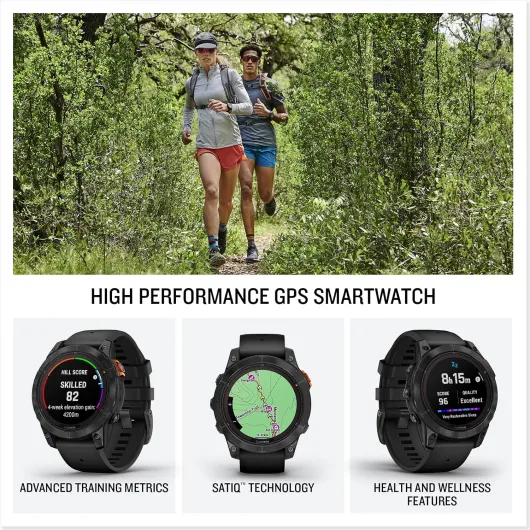
Design‑wise, this is very much an outdoor / sports watch, not a dress watch. The 47 mm case and the steel bezel make it look serious on the wrist. On my medium wrist it looks fine, but it’s definitely not discreet. Under a shirt cuff it fits, but you feel it. If you have very small wrists, you’ll probably be more comfortable with the 7S size some other reviewers mentioned.
The screen is a 1.3" transflective MIP panel at 360×360. Outside, especially in daylight, it’s great: you barely need the backlight, everything is readable at a glance. Indoors, it’s just okay. It’s not bright or punchy like an AMOLED watch or a phone screen. If you’re used to Apple Watch level of brightness, this will look a bit dull on the sofa at night. Personally, I got used to it quickly because I care more about outdoor readability and battery than pretty colors.
The mix of touchscreen + five physical buttons is actually one of the best parts of the design. I use touch for scrolling menus and maps, but during workouts I mostly use the buttons so sweat or rain doesn’t mess anything up. You can even disable touch during activities if you want. The interface still has that old Garmin feel (lots of menus and submenus), but once you memorise the button combos, it’s fast enough.
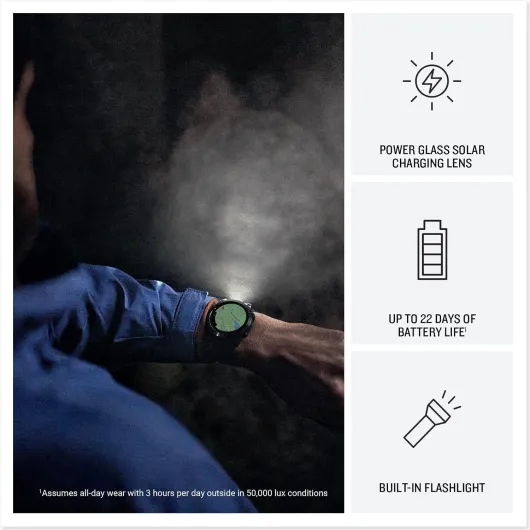
The built‑in LED flashlight at the top of the case sounds gimmicky until you actually use it. I’ve already used it for: finding keys in a dark hallway, checking a bike chain at night, and as a safety light on a late run. It’s not a replacement for a headlamp, but as a hands‑free light that’s always on your wrist, it’s surprisingly practical. It’s one of those features you don’t think you need until you have it, then you miss it on other watches.
Battery and solar: very good, but don’t expect free energy
Battery life is one of the main reasons to pick this watch over something like an Apple Watch. Garmin claims up to 22 days in smartwatch mode with some solar. In my real use, with notifications on, always‑on heart rate, roughly 4–5 hours of GPS activities per week, and some sunlight but not desert conditions, I’m getting around 10–14 days per charge. That’s still strong. I’m not trying to save battery either; backlight is on auto and I play with the maps now and then.
Solar charging is helpful but not magic. The watch has a Power Glass solar lens and you can see a small sun icon and a solar chart on one of the widgets. On days where I’m outside for a couple of hours, I can see that it slows down the battery drain. Instead of losing, say, 10% in a day, I might lose 7–8%. On cloudy indoor‑heavy days, it basically behaves like a non‑solar model. So yes, it helps, but if you expect the watch to live forever on sunlight, you’ll be disappointed.
GPS battery life is also solid. A 1‑hour run with multi‑band + SatIQ usually costs me around 2–3% battery, sometimes 4% if I’m also using maps and backlight a lot. Multi‑hour hikes obviously eat more, but I’ve never been worried about it dying during a long day out. For ultrarunners or multi‑day hikes, this is exactly the type of watch you want: you can leave the charger at home for a weekend and be fine.
Charging itself is straightforward but uses Garmin’s proprietary cable (USB‑A on the other end). A full charge from around 10% to 100% takes roughly 1.5–2 hours in my case. It’s not a big deal because you don’t charge often, but it’s one more cable to keep track of. Overall, I’d say battery and solar performance are one of the strong points: not magic, but very reliable and much less annoying than watches that need daily charging.
Comfort: fine for daily wear, borderline big for sleep
The watch weighs around 79 g with the strap, which is not feather‑light but also not a brick. Compared to my old Fenix 5X, this feels a bit lighter and sits flatter on the wrist. The included silicone strap is basic but comfortable: slightly stretchy, plenty of adjustment holes, and it doesn’t irritate my skin even when sweaty. I wear it all day, including at the office and during workouts, with no real discomfort.
Where the size shows is sleep tracking. Wearing a 47 mm, fairly thick watch all night is not ideal if you’re picky about what’s on your wrist in bed. The first two nights, I was aware of it every time I rolled over. After a week I mostly forgot about it, but if you’re very sensitive to bulk at night, it might annoy you. I’d say it’s acceptable, not great, for sleep comfort. Some people will just take it off at night and skip the sleep data, which kind of defeats part of the point.
Breathability is decent. The underside has the usual Garmin sensor bump, but it’s not too sharp and doesn’t leave marks on my skin unless I wear it very tight. During runs and gym sessions, sweat accumulates a bit under the strap like with any silicone band, but a quick rinse under the tap solves it. For long hikes in hot weather, I’d probably swap to a nylon or fabric strap just for extra comfort, but the stock band is fine for most people.
Day to day, after the initial adjustment period, I basically forget it’s there until it vibrates. The only time it really feels big is when I’m typing on a laptop and the watch hits the desk edge, or when I’m doing push‑ups and the case presses into my wrist. Not a deal‑breaker, just something you notice with any larger watch. If you want absolute comfort and minimal bulk, this is not that — but as a rugged sports watch, it’s pretty solid.
Built to take abuse, not to look fancy
The fēnix 7 Pro Solar feels like it’s built to be knocked around. The fiber‑reinforced polymer case with steel bezel and back gives it a tough feel without being too heavy. I’ve already bumped it into door frames, metal gym equipment, and rocks on a trail. So far, no serious marks on the bezel and no visible damage to the lens. This version isn’t the Sapphire model, so I slapped on a cheap tempered glass protector like one of the Amazon reviewers mentioned, just for peace of mind.
The watch is rated to 10 ATM / 100 m water resistance. I’ve used it in the shower, in the pool, and in heavy rain with zero issues. No fogging, no weird behavior. It’s definitely more than enough for swimming and general water exposure. I wouldn’t worry about it at all in day‑to‑day life, even if you’re rough with your gear. Buttons still click nicely after getting soaked and dusty.
The strap and buckle are holding up fine. The silicone hasn’t stretched out or cracked, and the quick‑release pins make swapping straps easy if you want something more formal or more breathable. The only wear I’ve noticed is minor: a few hairline marks on the metal from general use, but nothing that affects function. It still looks decent after a few weeks of normal abuse.
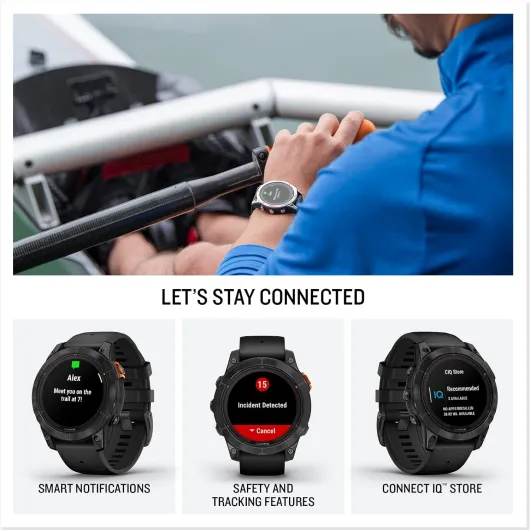
Software‑wise, Garmin pushes regular updates. I’ve already had one firmware update that added some tweaks and bug fixes. Sync with the phone app (Android in my case) is stable over Bluetooth. I haven’t had random reboots or freezes. So on both the hardware and software side, it feels reliable. Not flashy, but solid — which is basically what you want if you’re buying something to use on runs and hikes rather than just as a fashion accessory.
GPS, training metrics and everyday tracking: lots of data, mostly useful
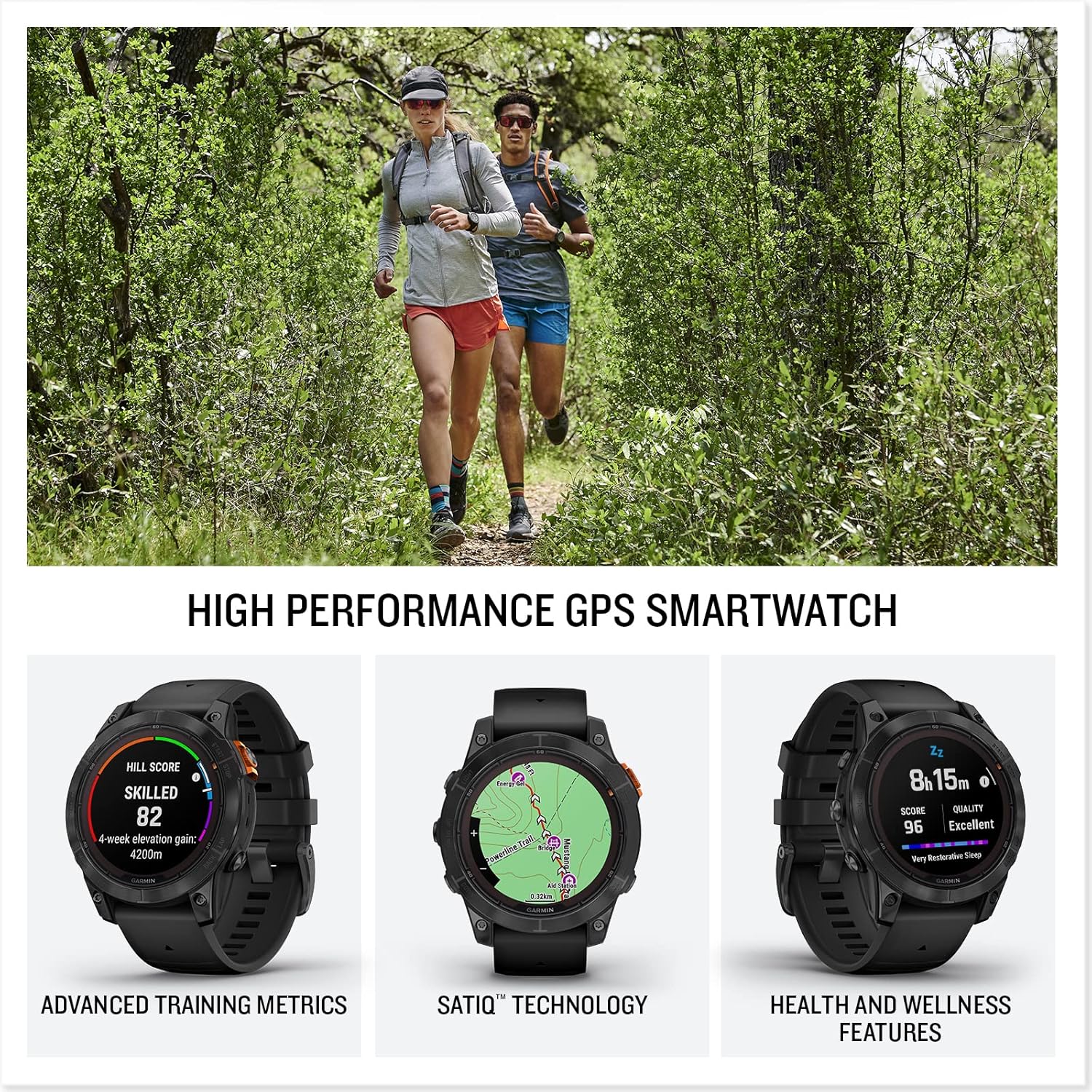
On the performance side, this thing is strong. The multi‑band GPS with SatIQ has been very reliable for me. I’ve taken it on city runs with tall buildings, forest trails, and open road bike rides. Tracks look clean in Garmin Connect, and pace is stable enough that I don’t feel like it’s jumping around every few seconds. In dense forest, distance and route still look realistic when I compare them to known trail distances and friends’ watches.
Training features are where Garmin leans hard. You get: hill score, endurance score, training readiness, training load, VO2 max, suggested workouts, race predictor, etc. Some of this is honestly overkill. I ended up focusing on a few key things: training readiness in the morning, my 7‑day training load, and recovery time after hard sessions. Those three alone are useful to avoid stacking hard days when my body clearly isn’t recovered. The watch sometimes suggests I rest when I feel fine, or vice versa, so I treat it as input, not gospel.
Strength training is better than I expected. It auto‑detects a fair number of exercises, but it still mislabels some moves and rep counting can be off if your form is weird. I usually adjust sets and reps at the end of the workout, which takes 30 seconds. For running, the pacing tools (like PacePro and race day pacing) are handy if you like structured sessions. If you’re more casual and just want distance, time and heart rate, those advanced modes will probably sit unused.
As an everyday tracker, it covers the basics well: steps, floors, heart rate, stress, sleep, body battery. The morning report that bundles sleep, HRV and readiness is the one feature I actually read every day. It’s not magical insight, but it’s a nice quick summary: “You slept X hours, your HRV is normal, you’re ready for a harder workout” or “maybe ease off today.” As long as you remember this is all based on algorithms and not medical gear, it’s a decent guide.
What this watch actually offers in real life
On paper the fēnix 7 Pro Solar looks almost ridiculous: multisport tracking, GNSS GPS, topo maps, golf and ski maps, pulse ox, HRV, training readiness, hill score, endurance score, flashlight, solar charging, 22‑day battery claim… the list is long. In practice, I ended up using about 30–40% of all that regularly, which is still a lot. My main use has been running (road and trail), hiking, strength sessions, and general activity tracking during the day.
The GPS performance is the main thing I notice when I compare it to my older Fenix and a phone. With multi‑band + SatIQ on, tracks are tighter around turns, especially in city streets with tall buildings or in the woods. On my usual 10 km run, my old watch often showed 9.7–9.8 km; this one is almost always between 9.9 and 10.1 km. That’s not magic, just less guesswork in tricky spots. The downside is you have to trust the watch to pick the right GPS mode (SatIQ does that for you), which most people will just leave on auto.
The health side is packed: HRV status, training readiness, sleep score, body battery, stress, pulse ox (which I honestly only checked a few times). The morning report is actually useful: it shows how you slept, your recovery, and what sort of training load makes sense. It doesn’t tell you anything you couldn’t figure out with a bit of discipline and a notebook, but it’s convenient to have it summarised when you wake up.
One thing to be aware of: topo maps for the whole world are not magically on the watch. Out of the box I had to connect it to Garmin Express and download the regions I needed. Each region is several GB and the watch has 32 GB total, so you pick your areas. Once installed, the maps are detailed enough for hiking and trail running. Zooming and panning on a 1.3" screen isn’t comfy, but for quick checks of where the trail goes or how far the next turn is, it gets the job done.
Pros
- Very strong battery life (about 10–14 days real use) with solar helping to slow drain
- Accurate multi-band GPS and solid maps for running, hiking and skiing
- Rugged build with 10 ATM water resistance and practical built-in LED flashlight
Cons
- Big and a bit bulky, not ideal for small wrists or people who hate sleeping with a watch
- Screen is only average indoors compared to AMOLED competitors and smart features are limited
Conclusion
Editor's rating
Overall, the Garmin fēnix 7 Pro Solar is a serious training and outdoor watch that does what it says: long battery, solid GPS, loads of training metrics, and a rugged build that doesn’t need babying. It’s not the prettiest or smartest in terms of apps and flashy screen, but as a tool for running, hiking, skiing and general fitness, it’s very dependable. The combination of buttons and touchscreen, plus the flashlight and onboard maps, makes it practical in real situations, not just on spec sheets.
It’s not for everyone though. The 47 mm case is big, the interface has a learning curve, and a lot of the advanced metrics will be wasted if you just want simple step counting. The screen is fine outdoors but nothing special indoors, and solar charging helps but doesn’t replace a cable. For people who already live in the Garmin ecosystem or who train 3–4 times a week and like numbers, it’s a strong option. For casual users who care more about looks, smart apps and a bright screen, there are cheaper or more stylish watches that make more sense.
If you recognise yourself in the “I train a lot and I’m outside often” profile, this watch will probably make you happy for several years. If not, you’re paying a premium for features you’ll barely touch.