Summary
Editor's rating
Good value if you’re in the Samsung ecosystem, just know the limits
Big rectangular screen, fitness band body
Real-world battery: not 13 days, but comfortably multi-day
Easy to forget on your wrist, which is the whole point
Light, mostly plastic feel, built to be worn not admired
Smooth enough, but remember this is a tracker, not a tiny phone
What the Galaxy Fit3 actually offers in real life
Tracking that’s accurate enough for normal people
Pros
- Comfortable, lightweight design with a large, bright AMOLED screen
- Solid battery life (around a week in real use) with fast charging
- Reliable tracking for steps, heart rate and sleep without subscription fees
Cons
- No built-in GPS, relies on your phone for location
- Charger uses USB-C on the plug side, awkward if you only have USB-A chargers
- Requires two Samsung apps (Wear + Health), feels a bit overcomplicated for a simple tracker

Specifications
View full product page →| Brand | Samsung |
A budget band that actually feels usable day to day
I’ve been using the Samsung Galaxy Fit3 (black, UK version with the 3‑year warranty) as my daily tracker for a while now, and I’ll be straight: this is not a full-blown smartwatch, it’s a fitness band with a big screen and a few smart features bolted on. If you go in with that mindset, it’s a pretty solid bit of kit. If you expect a mini Galaxy Watch or an Apple Watch rival, you’ll probably be annoyed within a couple of days.
My use case is simple: I wanted something to track steps, heart rate, sleep, and occasional workouts, plus show notifications, without having to charge it every night. Before this, I used a basic Fitbit and tried a couple of cheap Amazon bands that were frankly a pain to use. Compared to those, the Fit3 feels more polished and a lot more reliable, especially once it’s set up properly with Samsung Health and the Wear app.
Where it stands out for me is the mix of battery life and screen size. Most bands that last a week or more have tiny screens that are annoying to read. Here you get a 1.6" AMOLED display that’s easy to see, but the battery still comfortably stretches several days. It’s not magic, but it’s a good compromise. The health stats are not medical-grade, but they’re consistent enough that you can actually see patterns over time, which is all I really want.
It’s not perfect: no built‑in GPS, the USB‑C charging cable is a bit of a nuisance if you only have old USB‑A chargers, and the ecosystem clearly favors Samsung phones. But for the price bracket it sits in, plus the 3‑year warranty, it feels like a sensible, no‑nonsense choice if you just want a tracker that gets the basics right and doesn’t need a subscription on top.
Good value if you’re in the Samsung ecosystem, just know the limits
For the price bracket this sits in, the Galaxy Fit3 is good value for money, especially with the 3‑year extended warranty in the UK. You’re basically paying mid‑range tracker money for a device that feels more polished than the random no‑name bands on Amazon, without being anywhere near the cost of an Apple Watch or full Galaxy Watch. It lands in that sweet spot where you get proper software support, decent build quality, and no monthly subscription to unlock key features.
Compared to a basic Fitbit, you’re getting a larger and nicer screen, tighter integration with Android (especially Samsung phones), and no paywall on advanced stats. One Amazon reviewer literally said their old Fitbit felt like a 1980s car next to this, which is a bit harsh but I get the point: the display and interface feel more modern. On the other hand, Fitbit’s single app experience is simpler, and if your friends all use Fitbit for challenges, you might prefer to stay there.
The main trade‑offs that affect value are: no built‑in GPS, reliance on two Samsung apps, and the fact that it’s clearly tuned for Samsung phones. It still works with other Android devices, but you may have to install extra plugins and fiddle with notification settings a bit more. If you wanted something that just works perfectly with an iPhone, this is not it; you’d be better off with a device that officially supports iOS properly.
Taking everything into account – the price, the 3‑year warranty, the feature set and the real‑world experience – I’d say this is a solid buy for casual users who want reliable tracking and strong battery life, and who don’t care about fancy apps or wrist‑based GPS. If you need full smartwatch features, contactless payments, lots of third‑party apps or serious sports tools, it will feel limited and you should budget more for a higher tier device.
Big rectangular screen, fitness band body
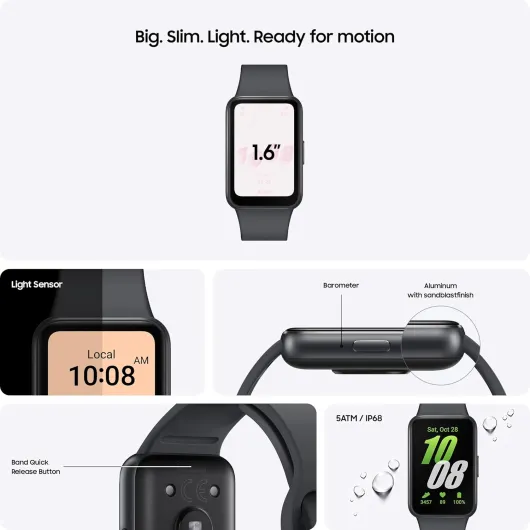
Design-wise, the Galaxy Fit3 sits somewhere between a classic thin fitness band and a small smartwatch. The body is a slim rectangle (about 29 x 43 mm, 10 mm thick) with a 1.6" AMOLED screen on the front and a single side button. On the wrist, it looks more like a modern fitness band than a chunky watch, so if you hate bulky wrists, this is a decent compromise. The black version is pretty low-key; it doesn’t scream tech gadget from across the room.
The screen is the main selling point visually. At 1.6" with 208 x 208 resolution and up to around 550 nits brightness, it’s sharp enough that text is easy to read, and the fonts don’t look jagged. Outdoors, you can still see it, though in bright sun you’ll want the brightness up. Swiping through menus is straightforward: up for notifications, down for quick settings, sideways for widgets. It’s not as smooth as a flagship smartwatch, but it’s responsive enough that it doesn’t feel cheap or laggy in daily use.
The watch face options are better than I expected at this price. Through the Samsung Wear app you can pick from quite a few layouts, from very simple digital clocks to more data‑heavy ones showing steps, heart rate, battery and so on. You can also slap a photo as a background if you like that kind of thing. It’s not a massive feature, but it makes the device feel a bit more personal and less generic band‑like.
One thing I appreciated is the overall lightweight feel. At around 18.5 g, you basically forget it’s there after a while, which is helpful for sleep tracking. The flip side is it doesn’t feel like a premium metal watch; it’s more in the practical plastic/aluminium tracker territory. If you want something that looks like a proper watch with a steel case and rotating bezel, this is not it. But if you just want a clean, simple design that doesn’t get in the way, it does the job well.
Real-world battery: not 13 days, but comfortably multi-day
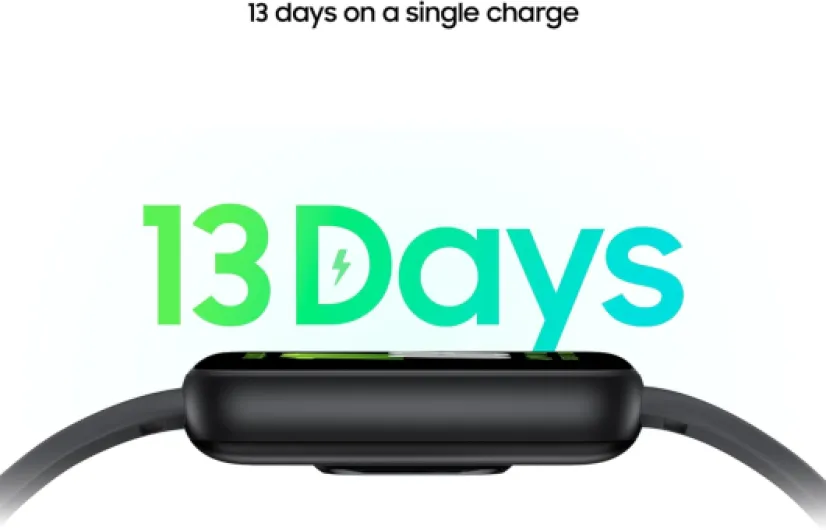
Battery life is one of the main reasons to pick this over a full smartwatch. Samsung claims up to 13 days, which is optimistic unless you run everything in ultra‑basic mode. In my use (always‑on screen off, heart rate on, sleep tracking with SpO2 at night, notifications on), I was getting around 6–8 days per charge. That lines up pretty well with what some Amazon reviewers mention: roughly a week, give or take, depending on how bright you set the screen and how many workouts you log.
If you go heavier – lots of workouts, screen brightness high, constant checking of stats – you’re probably looking at about 4–5 days. One user said 5 days with everything running, which matches that. On the other hand, if you really tweak settings (no always‑on, lower brightness, fewer notifications), getting close to 10 days doesn’t seem unrealistic. Either way, it’s comfortably in the “charge once a week” category for most people, which is a big step up from daily charging watches.
Charging is pretty quick. The spec says around 30 minutes to get to 65%, and that matches what I’ve seen: you can go from low battery to more than half in the time it takes for a shower and breakfast. Full charge takes roughly an hour. A lot of people, including me, ended up doing exactly that: drop it on the charger during a shower or when sitting at the desk for a bit, and it’s topped up without thinking too much about it.
The annoying part is the cable: it’s a magnetic pogo connector on one end (proprietary) and USB‑C on the other. If most of your chargers are still USB‑A, you’ll need a small USB‑A to USB‑C adapter or a newer plug. This isn’t a deal breaker – adapters are cheap – but it’s something Samsung should make clearer in the product page. Once you sort that out, battery life is one of the strong points: no constant charger anxiety, which makes it much easier to actually use sleep tracking and 24/7 monitoring properly.
Easy to forget on your wrist, which is the whole point
Comfort is actually one of the strongest points of the Galaxy Fit3. At under 20 g, it’s very light, and combined with the slim profile it doesn’t dig into your wrist or feel like a brick when you sleep. I’ve worn heavier smartwatches to bed before and always ended up taking them off after a few nights because they were annoying. With the Fit3, I mostly forgot it was there, which is exactly what you want if you’re serious about sleep tracking.
The strap took me a day or so to get used to because of that tuck-under style, but once you find the right hole it stays put and doesn’t pinch. The material doesn’t get too sweaty or itchy, even during workouts. I wore it for runs and gym sessions and never felt like it was sliding around or choking my wrist. If you’re very sensitive to rubbery straps, you might want to swap it out, but for most people it should be fine out of the box.
In terms of fit for tracking accuracy, it works best if it’s snug but not tight, about a finger’s width from the wrist bone. If you wear it too loose, heart rate and SpO2 readings can get flaky. I noticed that when I had it on a looser notch, the blood oxygen measurement sometimes failed or took longer. Tightening by one notch fixed it. So there’s a bit of trial and error at first, but once you find the sweet spot, you can leave it there and forget it.
One thing to note: if you have a very small wrist or very large wrist, double‑check the band length (around 210 mm). For most average wrists, it’s fine and you still have several holes left either way. Overall, in daily use, comfort is a clear plus: no sharp edges, no weird pressure points, and it’s light enough that you don’t feel the urge to take it off the second you get home.
Light, mostly plastic feel, built to be worn not admired
The Galaxy Fit3 is built with practicality over luxury in mind. The case is aluminium according to the specs, but in hand it feels like a lightweight mix of metal and plastic, more on the functional side than anything fancy. That’s not a criticism for this price range, just a reality. The back has the usual sensor window and charging contacts, with a magnetic pogo connector for the charger. It snaps on easily enough, and I haven’t had issues with it disconnecting while charging.
The strap is a fluoroelastomer band, basically a soft silicone‑like material. It uses a standard buckle and a tuck-under design, meaning the loose end of the strap slides under the band instead of flapping on top. At first it feels a bit odd if you’re used to classic watch straps, but in practice it keeps everything neat and reduces wear on the outside of the strap. It also means less chance of catching the loose end on something. The stock strap is fine for everyday use and workouts, doesn’t feel rough or cheap against the skin.
Durability-wise, after regular wear you can expect the usual tiny hairline marks on the body if you knock it against door frames or gym equipment, but nothing catastrophic. Several users mention that adding a cheap screen protector is a good idea if you’re worried about scratches on the glass, and I’d agree. It’s still a small glass panel on your wrist; it will eventually meet something harder than it. With a protector, you can be a bit more relaxed about bumps and keys in pockets.
Overall, materials are in line with the price: light, practical, not premium. It’s clearly built to be worn 24/7 and survive sweat, showers and general daily abuse rather than to impress anyone with fancy finishes. If you want something that feels more expensive in the hand, you’ll have to jump up to Galaxy Watch or similar, and you’ll lose the ultra‑light feel and probably some battery life too.
Smooth enough, but remember this is a tracker, not a tiny phone
Performance-wise, the Galaxy Fit3 is good enough for what it’s built to do. Menus open quickly, swipes register without much delay, and I haven’t had random freezes or reboots. You’re not running heavy apps here, so the 16 MB RAM and tiny storage aren’t really a limitation; it’s not trying to be an app platform like a proper smartwatch. Think of it more as a remote display for Samsung Health and notifications.
Notifications come through reliably most of the time, but it does depend on your phone and how aggressively it kills background apps. On a Samsung phone with the Wear and Health apps allowed to run freely, I got messages, calls and app notifications without much delay. A couple of users mention that sometimes notifications stop and the watch needs a quick reconnect – I’ve seen that once or twice after a long period without touching the phone, but a manual sync or reopening the Wear app usually fixes it in seconds.
One thing to keep in mind: you need two apps – Samsung Wear for settings and watch faces, and Samsung Health for stats. That’s a bit clunky compared to Fitbit’s all‑in‑one app. Switching between them is not a huge deal once you get used to it, but it feels slightly overcomplicated for such a simple device. Also, some of the more detailed sleep features benefit from having the phone on charge and the Health app open overnight, which feels old‑school but that’s how Samsung handles deep sleep analysis.
There’s no standalone GPS, so all GPS‑based tracking relies on the phone. If you go running without your phone, you’ll still get steps and heart rate, but distance and route won’t be as accurate or mapped. For me that’s fine – I always run with my phone anyway – but if you want phone‑free outdoor tracking, this is a clear limitation. Overall, performance is stable and predictable, just don’t expect full smartwatch flexibility or a big app ecosystem.
What the Galaxy Fit3 actually offers in real life
On paper, the Galaxy Fit3 ticks a lot of boxes: activity tracking for 100+ workouts, heart rate monitoring, sleep tracking with SpO2 (blood oxygen) at night, notifications, basic music control, and a claimed battery life of up to 13 days. It runs Samsung’s own software (Tizen) and talks to your phone over Bluetooth. There’s no standalone GPS in the band, it piggybacks on your phone’s GPS when needed. It’s rated IP68 and 1.5 m water resistance, so showers and rain are fine, but I wouldn’t treat it like a dedicated swim watch for hardcore pool sessions.
In practice, the core features are steps, heart rate, sleep and notifications. The 100+ workouts thing sounds big, but like most trackers, you’ll probably end up using walking, running, cycling, maybe a few gym modes and that’s it. Auto‑detection for walking and a few other activities works decently well: after a few minutes of walking it usually kicks in and logs it without you doing anything. The heart rate readings line up closely with a basic chest strap I tried for comparison during a couple of runs, not perfect but close enough for casual tracking.
Sleep tracking is where it’s surprisingly decent for the price. You get sleep stages (light, deep, REM), duration, and blood oxygen samples during the night if you turn that on. It’s not as fancy as some premium watches, but I could easily see which nights I slept badly and roughly how often I woke up. The catch: to get all the detailed graphs, you really need Samsung Health on your phone, and if you want the data to sync smoothly, keeping your phone nearby and sometimes on charge overnight helps.
The smart side is limited but useful. You can see incoming WhatsApp messages, texts, calls and app alerts, and dismiss or quick‑reply in a basic way (depending on your phone). You can control music playback, set timers and alarms, and use small tools like find my phone. It’s enough for daily life, but don’t expect third‑party apps galore or the kind of app store you get on a full smartwatch. That’s the trade‑off: good fitness basics, light smart features, strong battery.
Tracking that’s accurate enough for normal people
In terms of effectiveness as a fitness tracker, the Galaxy Fit3 does the core jobs well enough for everyday users. Step counting is in the right ballpark: when I compared it side by side with another tracker (and roughly counted on a short walk), the numbers were close, usually within a few percent. One Amazon reviewer compared it with a Fitbit and got almost identical step counts, which matches what I’ve seen – nothing wildly off or random.
Heart rate tracking is also decent. It updates regularly throughout the day, and during workouts it reacts quickly enough to show your effort level. Compared against a chest strap on a run, the average and max heart rate were very similar. You might see small spikes or drops here and there, but for casual training and general health monitoring, it’s more than enough. If you’re a serious athlete who wants perfectly clean graphs, you’re probably not shopping in this category anyway.
Sleep tracking is one of the more useful features. It logs total sleep, time in light/deep/REM, and also gives you an overview of how restless the night was. When I had a bad night, the chart reflected that clearly: more wake-ups, shorter deep sleep. The blood oxygen during sleep is also handy for spotting if you regularly dip too low, though you shouldn’t treat it as a medical diagnosis. You do need your phone and the Samsung Health app to see the full detail, which is slightly annoying but standard for this kind of device.
Workout modes are plentiful on paper, but the main ones – walking, running, cycling, general workouts – are what most people will use. Auto‑detection for walking and some exercises kicks in after a few minutes, which is handy if you forget to start a workout. It’s not foolproof, but it saves you from losing whole walks. Overall, it gets the basics right: consistent tracking, clear stats, and no weird data gaps, as long as you wear it properly and keep it synced with your phone.
Pros
- Comfortable, lightweight design with a large, bright AMOLED screen
- Solid battery life (around a week in real use) with fast charging
- Reliable tracking for steps, heart rate and sleep without subscription fees
Cons
- No built-in GPS, relies on your phone for location
- Charger uses USB-C on the plug side, awkward if you only have USB-A chargers
- Requires two Samsung apps (Wear + Health), feels a bit overcomplicated for a simple tracker
Conclusion
Editor's rating
The Samsung Galaxy Fit3 is a straightforward, no‑nonsense fitness tracker that does the basics well and doesn’t beg for a charge every night. If you mainly care about steps, heart rate, sleep, and getting your notifications on your wrist, it handles all of that cleanly with a bright, readable screen and a body light enough to wear 24/7. The data is consistent, the battery easily lasts several days, and the 3‑year warranty in the UK is a nice bit of peace of mind for a device you’ll probably wear every day.
It’s not perfect. There’s no built‑in GPS, the charger being USB‑C on the plug side is a small hassle if your chargers are older, and needing both Samsung Wear and Samsung Health is a bit clunky. It also makes the most sense if you already use a Samsung phone, where the apps and notifications behave best. But for the price, you’re getting a tracker that feels stable, doesn’t hide key features behind subscriptions, and just quietly gets the job done.
I’d recommend it to anyone on Android (ideally Samsung) who wants a simple fitness band with a good screen and strong battery life, and who doesn’t care about fancy smartwatch extras. If you want standalone GPS, contactless payments, big app stores or tight integration with iOS, you should look at more expensive watches instead. For everyday step counting, sleep tracking and light smart features, this is a sensible, budget‑friendly option.