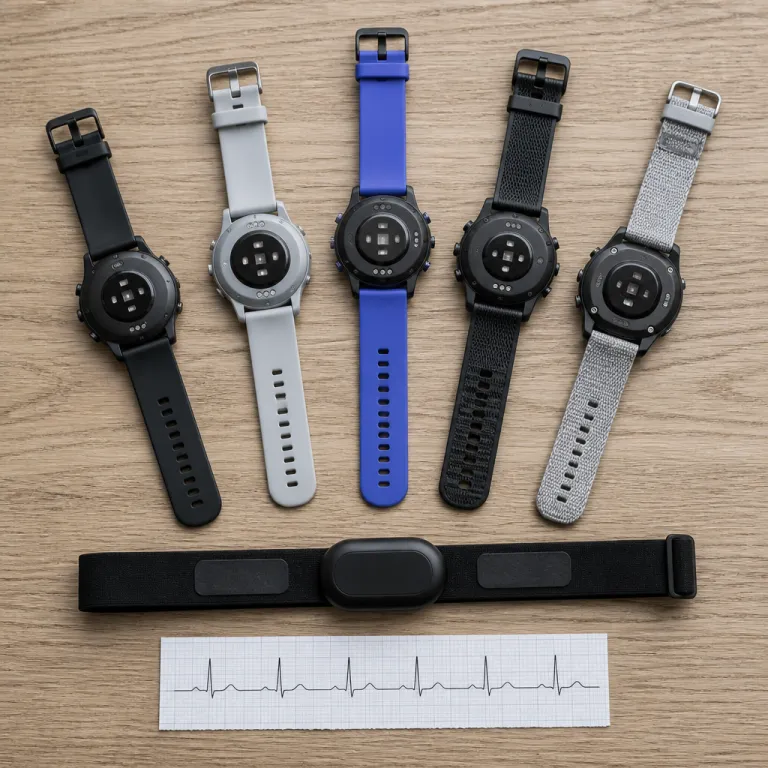
How accurate can a watch really be compared with a chest strap ?
The phrase “most accurate heart rate monitor watch” hides a hard truth. No wrist based watch can match a good chest strap for raw heart rate accuracy when your body is moving fast. The gap shrinks during easy runs and daily fitness tracking, but it never fully closes.
In controlled lab tests, a Polar H10 chest strap still tracks heart rate almost beat for beat against a medical ECG, while even the best watches drift when rate spikes hit during intense workouts. That is why serious athletes still pair a chest strap with a Garmin Forerunner, an Apple Watch Series model, or other fitness trackers when they care about clean rate data. If you want the most accurate heart rate monitor watch for intervals, you are really buying a great watch plus a reliable chest strap, not a magic wrist based solution.
Chest straps sit close to the heart and read the electrical signal directly, so their rate readings stay stable when your body twists, your arm swings, or sweat builds under the strap. Wrist based optical sensors rely on light bouncing through skin and tissue, which means tattoos, arm hair, darker skin tones, and loose bands all chip away at accuracy. Most people can get excellent rate tracking from a watch if they wear it correctly, but the margin for error is always higher than with chest straps.
Think of it this way ; the chest strap is your reference instrument, while the watch is your dashboard. The strap feeds precise heart rate and other metrics into the watch or app, and the watch turns those data into training guidance you can actually use. If you chase the most accurate heart rate monitor watch without understanding this hierarchy, you risk paying for shiny features while your rate monitor quietly lies during your hardest runs.
Ranking accuracy by use case : resting, steady runs, intervals, cycling, sleep
When people ask for the most accurate heart rate monitor watch, they rarely specify the situation. Resting heart rate, steady endurance runs, brutal intervals, indoor cycling, and sleep all stress sensors differently. A watch that nails night time rate tracking can still stumble badly during strength training or sprints.
For resting and daily fitness tracking, the latest Apple Watch Series models and the Garmin Forerunner 970 sit near the top of the accuracy pile, because their based optical sensors sample frequently and filter noise well. During easy runs outdoors, these watches and other high end fitness trackers usually stay within a few beats of a Polar H10 chest strap, which is close enough for most people planning long runs or a 15 km race. If you are mapping out paces and heart rate zones for a new distance goal, guides such as this explanation of what a 15K means for your training pair nicely with accurate heart data from your chosen watch.
Intervals and intense workouts are where the story changes. Above roughly 160 beats per minute, especially when cadence is high, wrist based optical sensors start to misread rate spikes and smooth over rapid changes, which makes the rate data look calmer than your body actually feels. On the bike, arm tension and handlebar pressure compress the watch against the wrist in odd ways, so even the best watches from Garmin, Apple, and Polar can show lagging rate readings or sudden drops that do not match your effort.
Sleep is almost the opposite problem ; movement is low, but blood flow slows and temperature shifts, which can confuse some sensors. Rings such as the Oura Ring 4 often beat watches for nocturnal heart rate accuracy, yet a watch series from Apple or Garmin still gives very usable night metrics for most people. If you want the most accurate heart rate monitor watch for twenty four hour rate tracking, you should weigh how much you care about night data versus perfect interval tracking with a chest strap.
Chest strap vs wrist vs ring : when each wins for training
Choosing the most accurate heart rate monitor watch starts with choosing the right sensor on the right part of the body. A chest strap wins for pure heart rate accuracy during runs, cycling, and strength training, because it reads the electrical signal of each beat. Wrist based watches win for convenience, smart features, and all day tracking, while rings quietly excel at sleep and recovery metrics.
If your training revolves around structured intervals, tempo runs, or power based cycling sessions, pairing a Polar H10 or similar chest strap with a Garmin Forerunner 970 or an Apple Watch Series model is still the best setup. The strap handles the rate monitor job, sending clean rate data to the watch, while the watch logs GPS, pace, and other metrics in the app. For serious athletes chasing personal best times, this combination gives both accurate heart readings and rich training analytics without forcing you to choose.
For mixed fitness, where you juggle runs, gym strength training, and daily activity, a high quality wrist based watch can be enough. The most accurate heart rate monitor watch in this scenario is the one you actually wear all day, because consistent rate tracking beats theoretical accuracy you never use. If you also care about subscription costs and long term value, it is worth looking at a curated list of good fitness trackers that avoid monthly fees, then adding a chest strap later if you outgrow the built in sensor.
Rings such as Oura Ring 4 sit in a different niche. They are not the most accurate heart rate monitor watch for workouts, because they are not watches at all, but they often beat watches for night time rate tracking and recovery metrics like HRV. Many serious athletes now run a two device setup ; a Garmin or Apple Watch for workouts and a ring for sleep, using the combined rate data to fine tune training load and rest days.
Why wrist heart rate fails on the bike and during intense workouts
Wrist based optical sensors look simple from the outside, but they are fighting physics. To estimate heart rate, the watch shines light into your skin and measures how blood flow changes that light, then converts those tiny fluctuations into rate readings. When your arm is relaxed and your body is steady, this based optical method can produce surprisingly accurate heart data.
During intense workouts, everything that helps accuracy starts to fall apart. High cadence runs shake the watch, flex the wrist, and change the distance between the optical sensors and the skin, which introduces noise that the algorithm must filter. On the bike, gripping the bars hard or resting your forearms on aero pads compresses the watch unevenly against the body, so the sensor sees motion and pressure artifacts that it sometimes mistakes for real heart rate changes.
That is why even the most accurate heart rate monitor watch on paper can show flat lines, sudden drops, or delayed rate spikes when you hammer a climb. The watch is not lying on purpose ; it is averaging chaotic rate data into something that looks plausible, but not precise. Chest straps avoid this by sitting close to the heart and moving with the rib cage, so they keep a stable electrical connection even when the rest of the body is bouncing.
Strength training adds another twist, because isometric holds and heavy lifts change blood pressure and muscle tension without always changing heart rate in a smooth way. Many fitness trackers interpret these shifts as rate spikes or dips, which can make your session look wilder than it felt. If you care about accurate heart tracking during lifting, the most reliable setup is still a chest strap paired with a watch, while accepting that some exercises will always confuse optical sensors.
How brands test accuracy and why marketing claims mislead most people
When a brand calls its latest model the most accurate heart rate monitor watch, you rarely see the test protocol behind that claim. Companies often validate their watches in controlled lab conditions with smooth treadmill runs, stable temperatures, and carefully selected testers. Those scenarios minimize motion artifacts and skin challenges, which flatters wrist based optical sensors and inflates accuracy metrics.
Real life training looks nothing like that. Outdoor runs include sharp turns, hills, wind, and changes in cadence, while cycling adds road vibration and handlebar pressure that no lab treadmill can mimic. Strength training and high intensity intervals create abrupt rate spikes and rapid transitions between effort levels, which are exactly the situations where wrist based watches struggle most.
Another quiet trick lies in how brands average and present rate data. Some watches sample heart rate every second but display smoothed values over five or ten seconds, while others log one minute averages that hide short rate spikes entirely. A watch can therefore claim high accuracy against a chest strap over a full workout, even if it misses the exact peak heart rate during your hardest interval.
For most people, the practical takeaway is simple ; treat marketing claims as a starting point, not a verdict. Look for independent tests that compare watches and chest straps across runs, cycling, and strength training, and pay attention to how each device handles the messy middle of a session, not just the average. The most accurate heart rate monitor watch for your body is the one that stays close to a chest strap when your breathing is ragged and your form is falling apart, not just when you are jogging easily.
Practical tips to get the most accurate readings from any watch
Even the best designed watch can only work with the skin and body you give it. To get closer to chest strap level accuracy from a wrist based rate monitor, you need to control the simple variables that most people ignore. Band tightness, placement, and basic skin preparation matter more than another generation of optical sensors for many users.
Start with placement ; wear the watch about one to two finger widths above the wrist bone, where the tissue is softer and blood flow is stronger. Tighten the strap so the watch does not slide during runs or intense workouts, but not so tight that it leaves deep marks or cuts off circulation. For strength training, you may need an extra notch of tightness, because gripping weights and flexing the wrist can otherwise break contact and corrupt rate readings.
If you have dense arm hair or tattoos under the sensor, consider shifting the watch slightly higher on the forearm for key sessions. Clean the underside of the watch and your skin regularly, because sweat, sunscreen, and dust can scatter the light from based optical sensors and reduce accuracy. In cold weather, warm up gently before starting rate tracking, since cold skin constricts blood vessels and makes it harder for the watch to see a clear heart rate signal.
Finally, be honest about when to bring in a chest strap. If you are testing new training zones, racing hard, or monitoring health related heart metrics, pair your watch with a strap for those sessions and let the app merge the data. The most accurate heart rate monitor watch is often a system ; a good watch, a reliable chest strap, and a user who understands how to get the best from both.
Battery life, apps, and long term tracking : choosing the right accuracy trade off
Accuracy does not live in a vacuum ; it lives inside a device you wear every day. A watch with flawless heart rate tracking but poor battery life or a clumsy app will end up in a drawer, while a slightly less accurate heart rate monitor that feels great on the wrist will keep feeding your training log. The most accurate heart rate monitor watch for you is the one that balances precision, endurance, and usability over months, not just one lab test.
Garmin tends to lead on battery life, especially in models like the Forerunner 970, which can handle long runs and multi day tracking without constant charging. Apple Watch Series devices usually trade some endurance for a richer app ecosystem and tighter integration with the phone, which many fitness trackers cannot match. If you care about going two weeks between charges while still logging reliable heart rate and other metrics, a guide to fitness trackers that outlast everything else on one charge can narrow your shortlist quickly.
Long term tracking also depends on how your chosen app handles rate data, sleep, and training load. Some ecosystems prioritize simple graphs and daily summaries, while others dig into HRV, VO2max, and training readiness metrics that serious athletes use to plan runs and strength training blocks. Whatever you choose, remember that accurate heart readings are only as useful as the decisions you make from them ; the goal is not the step count or the perfect graph, but what you do with that information tomorrow.
Key figures on heart rate accuracy in wearables
- In peer reviewed comparisons, high quality chest straps such as the Polar H10 show correlation coefficients above 0.99 versus medical grade ECG for heart rate during steady state exercise, which makes them the reference standard for consumer training devices.
- Independent tests of recent Apple Watch Series models report average heart rate errors of roughly 2 to 5 beats per minute during easy runs, rising to 7 to 10 beats per minute during high intensity intervals, which reflects the known challenges of wrist based optical sensors at high cadence.
- Studies on cycling show that many wrist based watches underestimate peak heart rate by 5 to 15 beats per minute when riders grip the handlebars tightly, because arm tension and vibration interfere with rate readings more than during running.
- Research on sleep tracking indicates that modern rings and watches can estimate average nocturnal heart rate within about 1 to 3 beats per minute of a chest strap in healthy adults, which is accurate enough for most people monitoring recovery trends rather than clinical conditions.
- Surveys of recreational runners suggest that more than 60 % of users who buy a chest strap eventually pair it with a watch rather than replacing the watch, confirming that the most accurate heart rate monitor watch setup for serious athletes is usually a combined system.
FAQ
Is a chest strap always more accurate than a watch for heart rate ?
For exercise, a good chest strap is still more accurate than any wrist based watch, because it reads the electrical signal of each heartbeat directly. Watches rely on optical sensors that are more vulnerable to motion, skin tone, tattoos, and band fit. During rest and light activity, the gap narrows, but during intense workouts the chest strap remains the reference.
Which watch is best if I want near chest strap accuracy without extra gear ?
High end models such as the Garmin Forerunner 970 and recent Apple Watch Series devices offer some of the most reliable wrist based heart rate tracking today. They still fall short of a chest strap during hard intervals and cycling, but they perform well for steady runs, daily fitness tracking, and sleep. If you refuse to wear a strap, these watches are strong candidates for the most accurate heart rate monitor watch experience you can get on the wrist alone.
Why does my watch show weird heart rate spikes during strength training ?
Strength training involves gripping weights, flexing the wrist, and holding isometric positions that change blood pressure and muscle tension without always changing heart rate smoothly. Wrist based optical sensors can misinterpret these changes as rate spikes or drops, especially if the band is loose or the watch sits on a bony area. Tightening the strap, moving the watch slightly higher, or using a chest strap for key sessions can reduce these artifacts.
Do I need a ring as well as a watch for accurate sleep tracking ?
You do not need a ring for accurate sleep heart rate, but some rings such as Oura Ring 4 have shown very strong nocturnal accuracy and comfortable wear. Many people are happy with sleep metrics from a Garmin or Apple Watch, especially if they already wear the watch overnight. A ring becomes more attractive if you dislike sleeping with a watch or want a dedicated device for recovery metrics.
How should I wear my watch to improve heart rate accuracy during runs ?
Place the watch one to two finger widths above the wrist bone on the top of the arm, then tighten the strap so it does not slide but still feels comfortable. Start your run only after the watch locks onto a stable heart rate, and consider an extra notch of tightness for intervals or races. These small adjustments help the optical sensors maintain consistent contact with the skin, which improves rate readings significantly.