Summary
Editor's rating
Value for money: strong if you accept the compromises
Design: simple, a bit generic, but practical
Battery life: one of the best parts (if you don’t abuse calls)
Comfort: very light, easy to wear all day
Durability & waterproofing: decent so far, but still a budget build
Performance: good for notifications and calls, basic for health
What this Yoever watch actually offers on paper
Pros
- Very good battery life (around 10–14 days in real use with full features)
- Comfortable and light enough to wear 24/7, including sleep
- Bluetooth calling and notifications work reliably and are easy to use
Cons
- Health and fitness tracking are only approximate, not for serious athletes
- Software and interface feel a bit basic and less polished than big brands

Specifications
View full product page →| Brand | Yoever |
A cheap smartwatch that tries to do everything
I’ve been using this Yoever smart watch (the 1.85" one that can answer/make calls) for a bit now, paired with an Android phone. I bought it as a budget alternative to a Samsung or Fitbit, just to see if a low-cost watch could cover daily stuff: notifications, calls, steps, sleep, and some basic workouts. I went in with moderate expectations, because at this price you usually have to accept a few compromises.
Overall, it’s a feature-heavy watch for the money. It does calls over Bluetooth, shows notifications from WhatsApp, SMS, etc., tracks heart rate, SpO₂, sleep, and has more sport modes than I’ll ever use. It runs through the VeryFit app, which I already knew from other cheap wearables, so setup for me was straightforward. If it’s your first smartwatch, there’s a bit of menu digging at the start, but nothing crazy.
In daily use, it behaves like a typical budget smartwatch: lots of functions, some are genuinely useful, some are more gimmicky. The watch is light, the screen is decent, and the battery is clearly one of its strong points. On the flip side, the health data is more "rough indication" than medical-grade, and a few details in the interface remind you this is not a premium Samsung or Apple watch.
If you’re expecting a polished ecosystem and ultra-precise tracking, you’ll be a bit let down. If you just want a cheap, practical watch that covers calls, notifications, and basic fitness, then it gets the job done pretty well. That’s the mindset you should have going in, and you’ll be fine.
Value for money: strong if you accept the compromises
For the price, I’d say this Yoever watch offers good value, as long as you’re realistic. You’re not paying for a big brand name or super tight integration with a specific ecosystem. You’re paying for a bunch of features that mostly work well enough: calls, notifications, heart rate, sleep, steps, and basic workouts. If that’s what you want, it’s hard to argue against it.
Compared to a Fitbit or Samsung watch, you give up on things like deeper health analytics, more accurate sensors, smoother software, and sometimes better build quality. But you also pay a lot less. If you just need something to help you move more, keep an eye on your sleep, and avoid constantly grabbing your phone for every buzz, this watch will do it without emptying your wallet.
I also like that they include a second strap and the option for extended warranty and small gifts. Yes, you trade some privacy data (address, email) if you go for the gifts, but at least you get something tangible back. The VeryFit app is not perfect, but it’s usable, and it stores your history clearly enough for a casual user.
If you’re very picky about accuracy, polished UI, or you want something you’ll keep for 4–5 years, I’d say save up for a more serious brand. But if your budget is tight or you just want to try out the smartwatch experience before committing to something expensive, this is a sensible entry point. It’s not flawless, but for the price, it’s more than decent.
Design: simple, a bit generic, but practical
Design-wise, this watch is pretty standard rectangular smartwatch fare. If you’ve seen a basic Amazfit or a cheap Fitbit-style watch, you won’t be surprised. The 1.85" screen fills most of the front with reasonably thin bezels for this price range. There’s one side button plus a rotating crown that actually works for scrolling and selecting, which is a nice touch. It’s not luxury-level, but it doesn’t scream toy either.
The black version I used is discreet and goes with anything. The casing is metal, so it feels a bit more solid than the fully plastic watches in the same price bracket. It’s not heavy at all, which is good for sleep tracking and workouts. The watch faces are varied – there are a bunch preloaded, and you can add more through the app or even set a photo. Some faces are a bit tacky, but you can definitely find a clean, simple one that shows time, date, steps, heart rate, and battery at a glance.
Navigation is fairly intuitive: swipe up, down, left, right for the main menus, then use the crown to scroll through longer lists. The crown and button have a decent click; they don’t feel premium, but they also don’t feel like they’ll fall off in two weeks. The only thing that reminds you it’s cheap is the overall finish: edges and transitions are okay, but not super neat if you look closely.
On the wrist, it looks like a normal smartwatch, not a toy gadget. If you’re picky about very polished design or you’re used to Apple Watch-level finish, you’ll see the difference right away. But if you just want something that looks decent at work, in the gym, and on the sofa, it does the job without looking ridiculous.
Battery life: one of the best parts (if you don’t abuse calls)
Battery life is one of the things that surprised me in a good way. The brand says up to 20 days of regular use. In real life, with notifications on, heart rate monitoring, some sleep tracking, and a few short calls here and there, I was more in the 10–14 day range, which is still very solid. If you hammer it with lots of Bluetooth calls, always-on screen (if you use that), and frequent workouts with GPS via phone, you’ll obviously drain it faster.
Charging is via a magnetic cable that snaps on the back. It’s not the strongest magnet in the world, but it holds well enough on a flat surface. A full charge took me around 2.5 hours, which matches what they claim. I usually plugged it in while working at my desk or during a shower + breakfast, and a top-up of 30–40 minutes gave me several days of use. No wireless charging here, but at this price I didn’t expect it.
What I liked is that I didn’t have to think about the battery every day. Compared to a Samsung or Apple watch where you’re often charging daily or every two days, this feels much more relaxed. You can go on a weekend trip with plenty of juice left and no charger anxiety. The battery indicator seems fairly accurate too; it doesn’t suddenly jump from 30% to 5% like some super cheap devices do.
If you want to stretch the battery, you can turn down brightness, reduce auto heart rate checks, and limit notifications a bit. But honestly, even with everything on, it’s already decent. For someone who hates constant charging but still wants smart features, this is one of the main reasons to pick this watch over a more power-hungry brand name device.
Comfort: very light, easy to wear all day
On comfort, I have almost nothing to complain about. The watch is very light for the size, so you quickly forget you’re wearing it. I wore it all day and at night for sleep tracking, and it never really bothered me. The silicone strap is soft enough, no sharp edges, and the standard buckle holds fine. I didn’t get any skin irritation, even with a bit of sweat during workouts.
The extra woven/nylon strap is a nice bonus. It’s lighter and more breathable, and I ended up using that one more often during the day. If you have a small wrist, you’ll probably still be okay – the watch head is not huge, and the strap has enough holes. On a larger wrist, it doesn’t look tiny either. It’s kind of a middle-ground size that fits most people.
For sleep, I was a bit worried the watch would feel bulky, but honestly, it’s fine. The back sensor area is slightly raised as usual, but it doesn’t dig in. The only time I felt it was when I slept with my wrist under my head, and even then it was more "I know it’s there" than painful. If you’re used to not wearing anything at night, it’ll take a couple of nights to adapt, like any watch.
During workouts or walking, it stays in place well as long as you tighten the strap properly. Not too tight though, or your skin will sweat more under the silicone. Overall, comfort is one of the strong points here. It’s not luxurious, but you can easily wear it 24/7 without it becoming annoying, which is the whole point of a tracker like this.
Durability & waterproofing: decent so far, but still a budget build
On durability, I obviously can’t speak for 2–3 years of use, but after regular daily wear, no major issues so far. The case is metal, which helps against small bumps. I’ve knocked it against a door frame and desk edges a few times, and there are no big scratches or dents. The Panda Glass screen hasn’t picked up any obvious scratches yet, but I’d still recommend a cheap screen protector if you’re clumsy or work in rough environments.
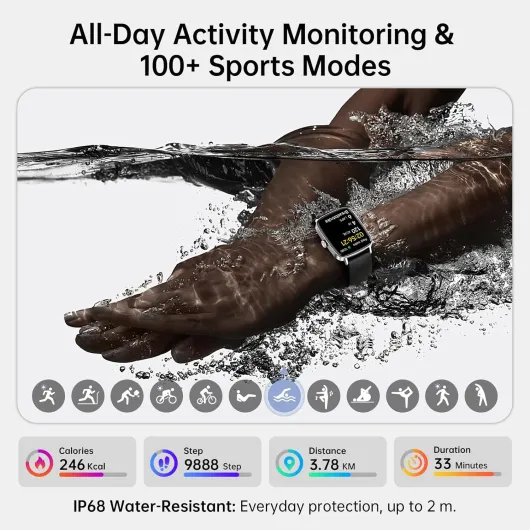
The IP68 rating is enough for showering, rain, and swimming in a pool. I used it under the tap and in the shower without any problem. I wouldn’t take it for deep diving or hot tubs for hours, but for normal life, it’s fine. Buttons and crown still work smoothly after getting wet. Just don’t press buttons constantly underwater and you should be okay.
The straps are what you’d expect at this price: they do the job, but they’re not lifetime pieces. The silicone one is holding up well, no cracking yet, and the extra woven strap hasn’t frayed. The quick-release pins are standard 22 mm, so if something breaks or you want a nicer band, it’s easy to replace with third-party straps from Amazon.
Where you feel the budget side is in the small details: the vibration motor feels a bit cheap, menu animations can stutter occasionally, and the overall finish is less polished than premium brands. But nothing has failed outright, and for a watch at this price, that’s already a good sign. If you treat it like a mid-range gadget and not a tank, it should hold up fine for everyday use.
Performance: good for notifications and calls, basic for health
In terms of performance, the Bluetooth connection with my Android phone (Samsung) was stable. Calls worked fine: I could answer directly on the watch, the other person heard me clearly enough, and I could hear them as long as I wasn’t in a very noisy place. Don’t expect hi-fi sound, but for quick calls at home, in the car (parked), or in the office, it’s totally usable. The dial pad and favorite contacts on the watch are handy when your phone is in another room.
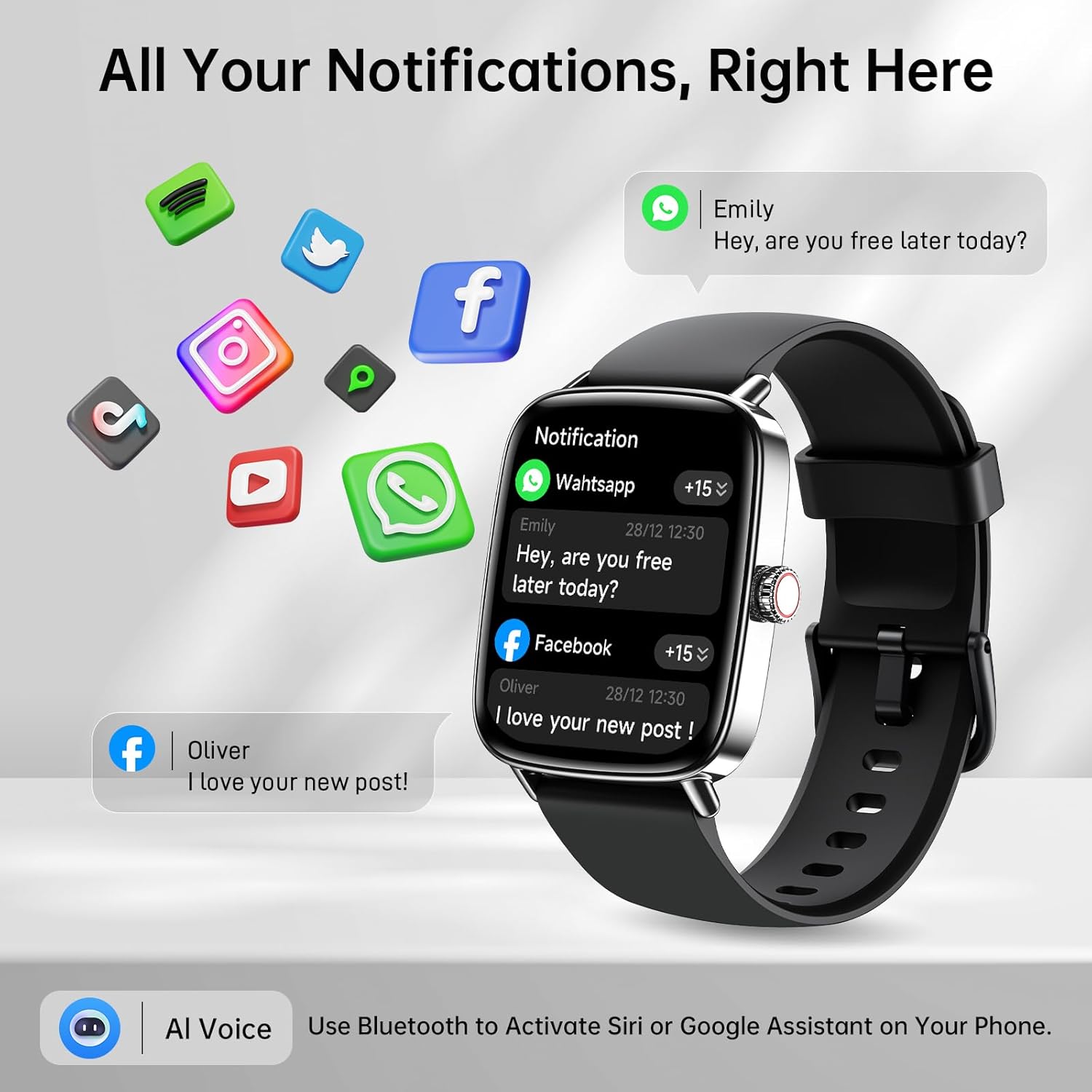
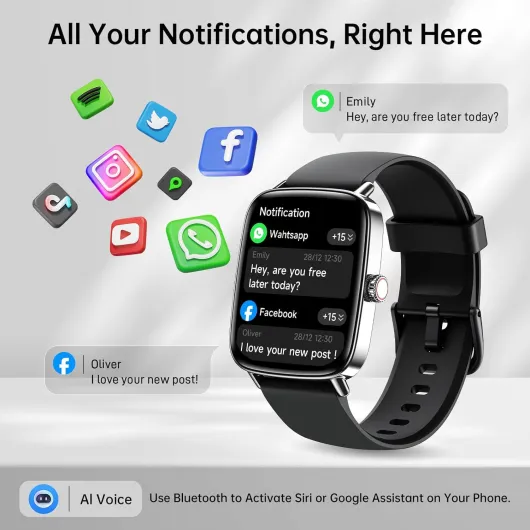
For notifications, it does the job: WhatsApp, SMS, email, calendar, and social apps all popped up quickly. You can’t reply with full messages, but you can read enough to know if it’s urgent. One thing I liked is being able to clear notifications from the watch, which keeps things tidy. Vibration is strong enough; you won’t miss alerts unless you’re really distracted. There’s also a Do Not Disturb mode that’s easy to enable when you’re in a meeting or want to sleep.
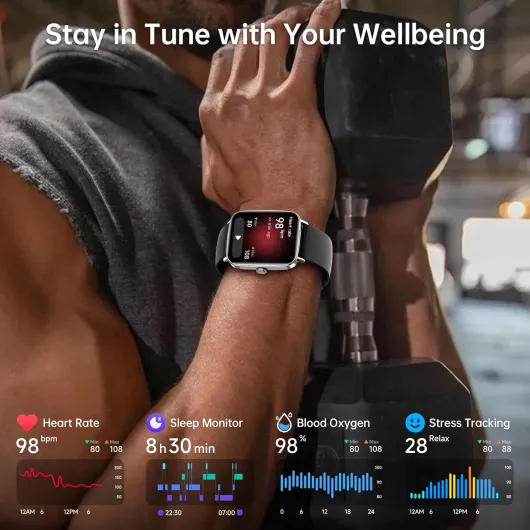
For fitness and health, it’s more of a guide than a precise tool. Steps were in the same ballpark as my phone and another tracker I compared with, maybe a bit generous some days. Heart rate is usually okay at rest and during light activity, but it can lag during intense bursts, which is normal for cheap optical sensors. SpO₂ and stress levels felt more like “extra info” than something I’d base decisions on. Sleep tracking gives you total sleep time and phases; it matched my rough memory of when I fell asleep and woke up, but I wouldn’t use it for serious sleep analysis.
The sports modes are plentiful, but many are basically the same metrics (time, heart rate, estimated calories, sometimes GPS via phone). For running and walking, it’s fine. For more niche sports, it’s more about logging that you did an activity than getting precise, sport-specific data. If you’re casual about your fitness, it’s enough. If you’re training seriously, you’ll want something more advanced with better sensors and GPS built in.
What this Yoever watch actually offers on paper
On paper, this Yoever watch throws a lot at you. You get a 1.85" TFT touchscreen (320×385), Bluetooth 5.3, call handling directly on the watch, 24/7 heart rate monitoring, SpO₂, sleep tracking, stress tracking, and supposedly 110+ sport modes. It connects to Android 6.0+ and iOS 9.0+ via the VeryFit app. The brand advertises up to 20 days of regular use with a 350 mAh battery, IP68 waterproofing, and a weight of around 32 grams without the strap, so very light.
In the box, I got the watch, a magnetic charging cable, a silicone strap already mounted and an extra woven/nylon-style strap, plus the usual paperwork. There’s also a card with a QR code that lets you register for an extended warranty and some free gifts (straps, charger plug, screen protector). You have to give an email, name, address and Amazon order number – some people won’t like that, but at least they’re clear they can’t pull that info from Amazon directly.
The feature list is long: notifications for calls and apps, Bluetooth calling with dial pad and contacts, music control, remote camera shutter, timers, alarms, weather, sedentary reminder, water intake reminder, stress alerts, low SpO₂ alerts, find my phone, and even a couple of simple games. There’s also access to voice assistants (Siri / Google Assistant) via your phone, so you can trigger voice commands from the watch.
In short, spec-wise it tries to mimic what you see on more expensive watches. The difference is in the small details: the animations are more basic, translations are sometimes a bit off, and some of the 110 sport modes are just variations of the same thing with a different name. But if you look at it purely by feature count for the price, it’s pretty solid value on paper.
Pros
- Very good battery life (around 10–14 days in real use with full features)
- Comfortable and light enough to wear 24/7, including sleep
- Bluetooth calling and notifications work reliably and are easy to use
Cons
- Health and fitness tracking are only approximate, not for serious athletes
- Software and interface feel a bit basic and less polished than big brands
Conclusion
Editor's rating
Overall, the Yoever 1.85" smartwatch is a feature-packed budget option that does the basics well enough for most everyday users. Calls and notifications work reliably, the screen is clear, and the watch is light and comfortable to wear all day and night. Battery life is a clear strong point, easily outlasting many big-brand watches, and the IP68 rating makes it practical for daily life, including showers and casual swimming.
On the flip side, it’s still a budget device. Health and fitness tracking are more approximate than precise, and the 110+ sport modes are mostly just variations of the same data. The software experience is okay but not polished, and you can feel that in small stutters and slightly rough translations. If you’re a serious athlete or you want super accurate data, this won’t be enough.
Who is it for? People who want a cheap, practical smartwatch to handle calls, messages, basic health tracking, and occasional workouts, without charging every day. Who should skip it? Those who care a lot about sensor accuracy, deep app integration, or premium build and are willing to pay extra for a Samsung, Apple, Garmin, or similar. For the price, it’s a pretty solid deal, but you need to go in with the right expectations.