Summary
Editor's rating
Value for money: good tech, but you really pay for the logo
Design: smart layout, but the build feels more cheap than premium
Battery and day-to-day use: fine on power, annoying on connectivity
Durability: feels light, and some units don’t survive long-term
Performance and accuracy: solid for trends, shaky if you chase exact numbers
What the InBody Dial H20 actually does (beyond just weight)
Pros
- Very accurate and stable weight measurements, comparable to medical beam scales
- Segmental BIA with hand grips gives more realistic body fat trends than basic step-on scales
- Good for tracking long-term changes in fat and muscle rather than just daily weight
Cons
- App and Bluetooth connection are often buggy, slow to sync, and sometimes fail completely
- Build quality feels cheap for the price, with thin plastic and a light overall feel
- Body fat and muscle readings can vary a lot day to day if conditions are not consistent

Specifications
View full product page →| Brand | InBody |
A "pro" body scan scale at home… but is it worth the price?
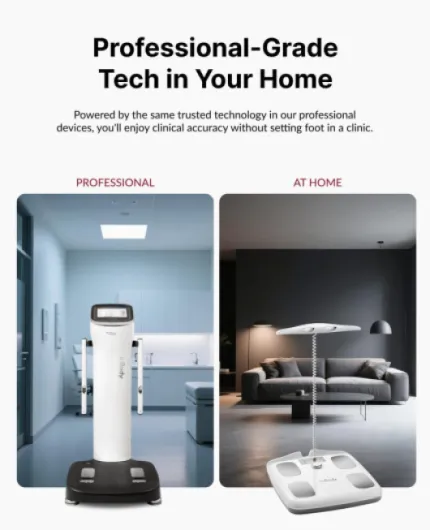
I’ve been messing around with body fat scales for years, from the cheap step-on-only ones to the Omron with handles, and I picked up the InBody Dial H20 because I wanted something closer to what you see in clinics and gyms. The brand sells it as “most accurate”, same tech as their pro machines, plus an app to track everything. On paper, it sounds like the perfect tool if you’re into fitness or cutting weight and want more than just a number on the scale.
In practice, it’s a mixed bag. The good news: the weight reading itself is very solid and lines up with a medical beam scale I have access to. The body fat numbers, when you use it correctly and at the same time every day, are reasonably consistent and not miles away from a professional InBody reading. So if you care about trends more than the exact decimal, it actually helps.
The bad news: the whole experience stands or falls with the app and Bluetooth connection, and that part is honestly annoying. Syncing can be slow, sometimes it just refuses to connect, and if you’re in a rush before work, standing there waiting for your phone to talk to the scale gets old very fast. A few users even had the connection die completely after a few months, which matches the general “buggy app” feeling I got.
So my overall first impression: this thing is good for tracking direction and motivation, not a lab instrument. It feels overpriced for what it is, especially given the cheap-ish plastic and the app headaches. If you’re expecting hospital-grade accuracy and flawless software, you’ll be disappointed. If you just want a more serious tool than a $30 bathroom scale and you’re okay dealing with some quirks, then it starts to make more sense.
Value for money: good tech, but you really pay for the logo
Let’s talk about the wallet side. The InBody Dial H20 sits way above the price of a basic smart scale from brands like Eufy, Renpho, or Withings. You’re basically paying a premium for two things: the InBody name and the hand-held segmental measurement. Compared to the cheap step-on-only scales that mostly guess body fat from your weight and height, this one does offer more serious measurements and, when used properly, gives closer results to a professional machine. So there is some justification for the higher price.
The problem is the overall package versus the cost. For this money, you expect solid build quality, smooth app experience, and decent long-term reliability. Instead, you get: a plastic body that feels mid-range at best, an app that can be buggy and slow to sync, and some reports of units failing within months. On the flip side, you also get very accurate weight, reasonably consistent body fat trends, and an app that, when it works, gives you clear feedback that can keep you motivated. So it’s not a total rip-off, but it doesn’t feel like great value either.
If you’re deep into fitness, already know what an InBody scan is, and want something that gets you closer to that at home, you might look at this and say, “Okay, I’m willing to pay extra for the tech and the brand.” In that case, the value is acceptable, especially if you use it regularly for a couple of years. If you’re more casual and just want to track weight and rough body fat, I honestly think a cheaper scale will be enough, even if it’s a bit less advanced.
So for value, my take is: good idea, fair performance, but priced on the high side given the flaws. If you catch it on a solid discount or you really care about segmental measurements with a handle, it can make sense. At full price, with the current app situation and build quality, it feels like you’re paying a brand tax.
Design: smart layout, but the build feels more cheap than premium
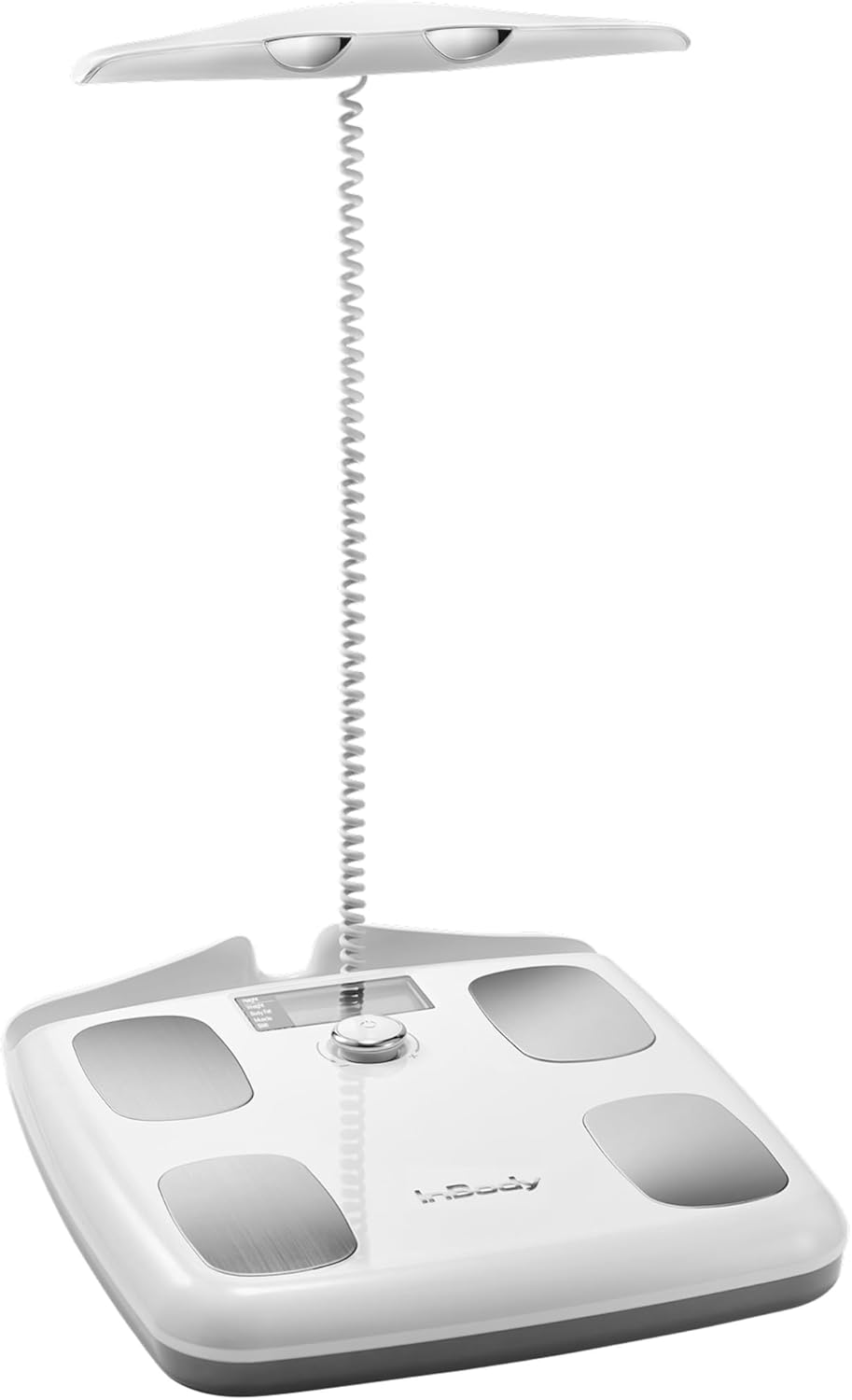
Design-wise, the InBody Dial H20 looks pretty clean. The Soft White version I used blends in with a bathroom or bedroom pretty easily. The base is a 12 x 12 inch platform, so it’s a standard footprint, and the handle with the electrodes folds into the top. Visually, it does look like something more advanced than a basic bathroom scale, mainly because of the hand grips and the metal contact areas for the feet.
Where it falls short is the actual feel of the materials. For the price, I was expecting something that feels closer to a solid medical device. Instead, the plastic casing feels light and a bit flimsy, especially around the handle. One Amazon reviewer said the plastic feels “very cheap and thin”, and I get that. It doesn’t feel like it’s going to break right away, but it doesn’t give you that confidence of a heavy, solid unit either. Considering it’s around the price of a decent smartwatch, the build quality could be better.
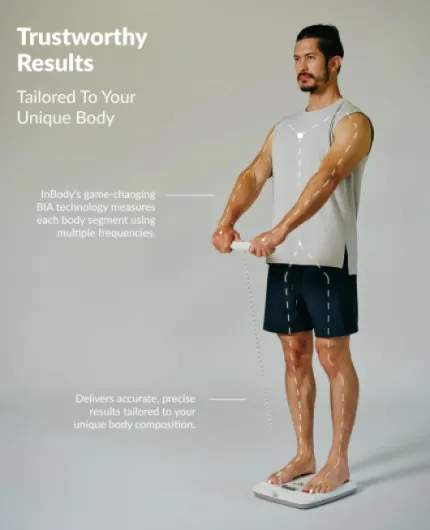
The handle design itself is pretty smart though. It has patented thumb electrodes and an ergonomic shape that helps you hold it the same way every time. That’s actually important for consistency: if your grip changes, your readings can change. I found that once you get used to the motion (step on, pull up the handle, arms straight), it’s easy to repeat the same posture each time. That’s a plus compared to the pure step-on scales that only measure through your feet.
The display is basic but readable. The LED/LCD shows your weight clearly, and then the rest of the info lives in the app. There’s no fancy color screen or extra fluff. Functionally, the design works, but it doesn’t scream “high-end”. If you want something that looks and feels premium on your bathroom floor, this might disappoint you slightly. If you care more about function than feel, the layout is fine and the handle system is actually a strong point.
Battery and day-to-day use: fine on power, annoying on connectivity
The scale runs on 4 AA batteries (included), which is both good and bad. Good because AA batteries are easy to find and swap, and you don’t have to deal with a proprietary charger or cable. Bad because, at this price, I would have preferred a built-in rechargeable battery with USB-C. That said, in normal use (one or two measurements per day), AA batteries tend to last a long time in this kind of device, and I didn’t burn through them quickly. The auto shut-off feature helps, so it doesn’t sit there draining power.
Where the daily experience really breaks down is not power, it’s Bluetooth and app sync. A lot of people, including me, ran into the same pattern: you step on the scale, it connects… or not. Sometimes it syncs quickly, sometimes you stand there for a few minutes trying to get the app to recognize the device. One reviewer mentioned 5–10 minutes to sync on a good day and eventually losing connection completely after about three months. When you rely on the app to see historical data, this is a serious downside.
Another annoying detail: you essentially have to open the app every time you want a proper logged reading. If you just step on the scale without the app open, you see your weight on the screen, but all the body comp details and tracking are in the app. That means if you’re someone who likes to quickly weigh in and go, this workflow feels clunky. It’s not like a dumb scale where you just step on and forget it; you’re tied to your phone more than you might want.
So on the technical side: battery life is fine, no complaints, but the user experience is dragged down by unstable Bluetooth and app dependency. If the app was rock solid and the connection instant, I’d be a lot more positive here. As it stands, it’s usable, but you need some patience, and that’s not what you expect from a scale at this price point.
Durability: feels light, and some units don’t survive long-term
In terms of pure physical durability, the scale is rated for normal adult use, and the platform itself feels stable enough when you stand on it. It’s not wobbly, and the weight distribution is okay. But the overall construction doesn’t scream long-term tank. The plastic housing is pretty thin, especially around the edges and the handle area. It’s the kind of device where you instinctively avoid dropping it or banging it against something because it doesn’t feel like it would handle abuse very well.
More worrying than the plastic, though, are the reports about functional failure. One verified buyer said the scale completely stopped connecting to the app after less than three months. At that point, the hardware might still power on, but if the Bluetooth or software side dies, the whole “smart” part is gone, and you’re basically left with a very expensive regular scale. For a product in this price range, three months to failure is not acceptable.
Personally, I didn’t have it long enough to kill it, but the feeling is that this is not a “10 years and still going” type of device. The moving handle, the contacts, the electronics, and the reliance on the app all add points of failure. Compared to a heavy mechanical scale or even a simple digital one, there’s more that can go wrong here. If you live in a humid bathroom, or you’re rough with your gear, I wouldn’t bet on this being the most durable item in your house.
So, durability verdict: physically okay if you treat it gently, but the combination of light materials and some real-world reports of early failure make me cautious. If you buy it, I’d keep the box and make sure you’re inside the return or warranty window in case the connectivity or electronics start acting up after a couple of months.
Performance and accuracy: solid for trends, shaky if you chase exact numbers
Let’s be blunt: if you’re buying this hoping for lab-level accuracy, you’re going to be annoyed. If you’re buying it to track progress over time, it does a pretty solid job. Compared to a professional InBody scan, one user got 12.5% body fat on the pro machine and around 13.1% on this scale over two weeks, with readings staying within about 1% when used in a consistent way. That’s actually quite good for home use, as long as you accept there will always be some noise.
Where things get messy is when people step on it multiple times in a row or at random times during the day. There are reviews saying it swings a lot for body fat and muscle mass, even within minutes. I saw the same pattern: weight is rock solid, matches a medical beam scale, but body fat and muscle can jump around if your hydration is different, if you just ate, or if you’re not holding the handle exactly the same way. One user even reported up to 4 kg of fat difference day to day, which is obviously not physically possible.
In practice, to get something usable out of it, you have to treat it like this:
- Measure at the same time every day (ideally morning, after bathroom, before food).
- Hold the handle the same way every time, arms straight, no movement.
- Ignore single readings and look at weekly averages or multi-day trends.
So for performance, I’d say: weight accuracy = very good, body fat/muscle = decent trend tool but not stable enough for back-to-back measurements. If you’re the type who jumps on the scale five times in a row to check consistency, you’ll probably get frustrated. If you step on once a day and focus on the graph over weeks, it does its job.
What the InBody Dial H20 actually does (beyond just weight)
On the box and on Amazon, the InBody Dial H20 is sold as a body composition scale that measures way more than just body weight. You step on it, grab the handle with your hands, and it runs a bioelectrical impedance analysis through different segments of your body. In simple terms, a tiny electrical current goes through you and the scale estimates how much of you is fat, muscle, water, etc. The brand insists that, unlike basic scales that mostly guess from height/weight/age, this one measures each segment (arms, legs, trunk) using multiple frequencies.
In the app, you get body weight, body fat percentage, muscle mass, and some extra stuff like basal metabolic rate. The basics are easy to understand: you can see if your fat percentage is trending down, whether muscle mass is going up when you’re lifting more, and how your weight moves day to day. The more advanced metrics are there, but honestly, most normal people will look at three numbers: weight, body fat %, and maybe skeletal muscle.
One thing I like is that the trend aspect is clear when the app behaves: you see your past measurements over time, and it gives you some ranking or comparison data, which can be motivating if you’re a bit competitive. But the way the app spaces the data points is weird: it shows them equally spaced, even if you measured two days in a row or with big gaps between sessions. So visually, trends are sometimes harder to read than they should be, and if you’re into precise tracking, you’ll probably end up exporting or manually logging the numbers anyway.
Overall, in terms of features, it does what it promises: full body comp readings at home, Bluetooth sync, and Apple Health integration. The idea is solid, but you have to remember this is still an at-home BIA scale. It’s useful for direction and progress, not for arguing whether you’re at 13.1% or 13.7% body fat. If you go in with that mindset, the feature set is decent; if you expect clinical precision, you’ll be let down.
Pros
- Very accurate and stable weight measurements, comparable to medical beam scales
- Segmental BIA with hand grips gives more realistic body fat trends than basic step-on scales
- Good for tracking long-term changes in fat and muscle rather than just daily weight
Cons
- App and Bluetooth connection are often buggy, slow to sync, and sometimes fail completely
- Build quality feels cheap for the price, with thin plastic and a light overall feel
- Body fat and muscle readings can vary a lot day to day if conditions are not consistent
Conclusion
Editor's rating
The InBody Dial H20 is one of those products that does some things very well and drops the ball on others. As a weight scale, it’s excellent: stable, consistent, and in line with medical beam scales. As a body composition tool, it’s decent as long as you treat it as a trend tracker, not a lab device. If you measure under the same conditions every day, the body fat and muscle readings are close enough to a professional InBody scan to be useful, and the trends over weeks are clear and motivating.
Where it falls short is the overall experience. The build feels more mid-range than premium, the app and Bluetooth connection are often frustrating, and there are a few worrying reports of early failure. For the price, that’s hard to ignore. You’re paying for the InBody name and the segmental tech, but you’re not getting the polished, rock-solid product you’d expect at this cost.
Who is it for? People who are already into fitness, care about body composition beyond just weight, and are willing to put up with some software quirks to get a more serious at-home tool. Who should skip it? Anyone who just wants an easy, reliable, low-maintenance scale, or who gets irritated quickly by buggy apps and inconsistent readings. For those users, a cheaper smart scale will probably feel like better value, even if it’s a bit less advanced on paper.