Summary
Editor's rating
Value: where it sits vs cheaper bands and pricier watches
Design: light, basic-looking, but the screen saves it
Battery: solid, but only if you don’t abuse all the features
Comfort: you forget it’s there… most of the time
Durability: tough body, but protect the screen
Performance: GPS, metrics, and training tools in actual use
What the Forerunner 165 actually offers in real life
Pros
- Lightweight and comfortable enough for 24/7 wear, including sleep
- Accurate GPS and solid training tools (daily workouts, training effect, recovery)
- Good battery life for a bright AMOLED watch, plus fast charging
Cons
- Screen is prone to scratches without a protector
- Recovery time and some health suggestions can feel exaggerated or off at times
- Design is pretty basic and more sporty than stylish

Specifications
View full product page →| Brand | Garmin |
| Product Dimensions | 1.69 x 0.46 x 1.69 inches |
| Item Weight | 1.38 ounces |
| ASIN | B0CT3SGHXL |
| Item model number | 010-02863-20 |
| Batteries | 1 Lithium Polymer batteries required. (included) |
| Customer Reviews | 4.7 4.7 out of 5 stars (4,158) 4.7 out of 5 stars |
| Best Sellers Rank | #385 in Electronics (See Top 100 in Electronics) #7 in Smartwatches |
A runner’s watch without all the bloated nonsense
I’ve been using the Garmin Forerunner 165 for a few weeks now as my main running watch, after bouncing between cheaper fitness bands and an older smartwatch. I bought it mainly for running and daily health tracking, not for answering emails from my wrist or controlling my smart home. In that context, it does the job very well, with a few quirks you should know about before buying.
The first thing that stood out is how straightforward it is. You take it out of the box, pair it with Garmin Connect, and you’re basically ready to go. No 40-minute setup, no endless app permissions. The watch asks a few basic questions (weight, height, fitness level) and starts giving you daily suggested workouts and recovery estimates pretty fast. If you’ve used Garmin before, your old data shows up again, which is nice.
In daily life, it sits in that sweet spot between fitness tracker and full smartwatch. It shows notifications, tracks sleep, heart rate and activities, but it doesn’t try to replace your phone. That’s actually what I liked about it: fewer distractions, more focus on training. The AMOLED screen makes it feel more modern than older Forerunners, without killing the battery in one day like some other brands.
It’s not perfect. The recovery suggestions can be a bit over the top, the glass is not the toughest out there, and if you go crazy with GPS and notifications, you’ll be charging more often than the “up to 11 days” marketing line suggests. But for someone who runs a few times a week and wants better training data than a basic band, it’s a pretty solid option that stays out of the way most of the time.
Value: where it sits vs cheaper bands and pricier watches
In terms of value, the Forerunner 165 sits in a kind of middle zone: more expensive than basic fitness bands and budget smartwatches, but cheaper than high-end Garmins and premium brand watches. For the price, you’re mainly paying for decent GPS tracking, proper training metrics, and Garmin’s ecosystem, not for fancy materials or heavy smartwatch features.
Compared to cheaper generic smartwatches I’ve tried, the difference is clear in accuracy and reliability. Steps, heart rate trends, GPS routes, and sleep data feel more consistent and less random. Also, the Garmin Connect app is miles ahead of the basic apps you get with low-cost trackers. You get graphs, historical data, challenges, and easy sync with Strava and MyFitnessPal. If you care about tracking progress over months, that matters.
Compared to more expensive watches (like higher-end Forerunners or Apple Watches), you obviously lose some stuff: offline music, more advanced performance metrics, fancier materials, and deeper smartwatch integration. But if you mainly want a light running watch with solid training help and you don’t care about installing a ton of apps or replying to messages from your wrist, the 165 hits a good balance. It feels like paying for what you actually use, not extras you’ll ignore.
So, is it good value for money? For runners and active people who want real training features without spending top-tier cash, yes. If you only want basic step counting and notifications, it’s probably overkill and you could save money with a simpler band. If you want a full-blown smartwatch with all the bells and whistles, you might feel it’s a bit limited. It really shines as a focused training tool at a reasonable price point.
Design: light, basic-looking, but the screen saves it
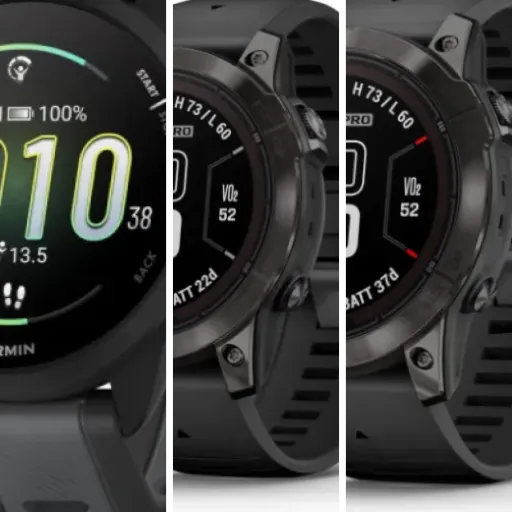
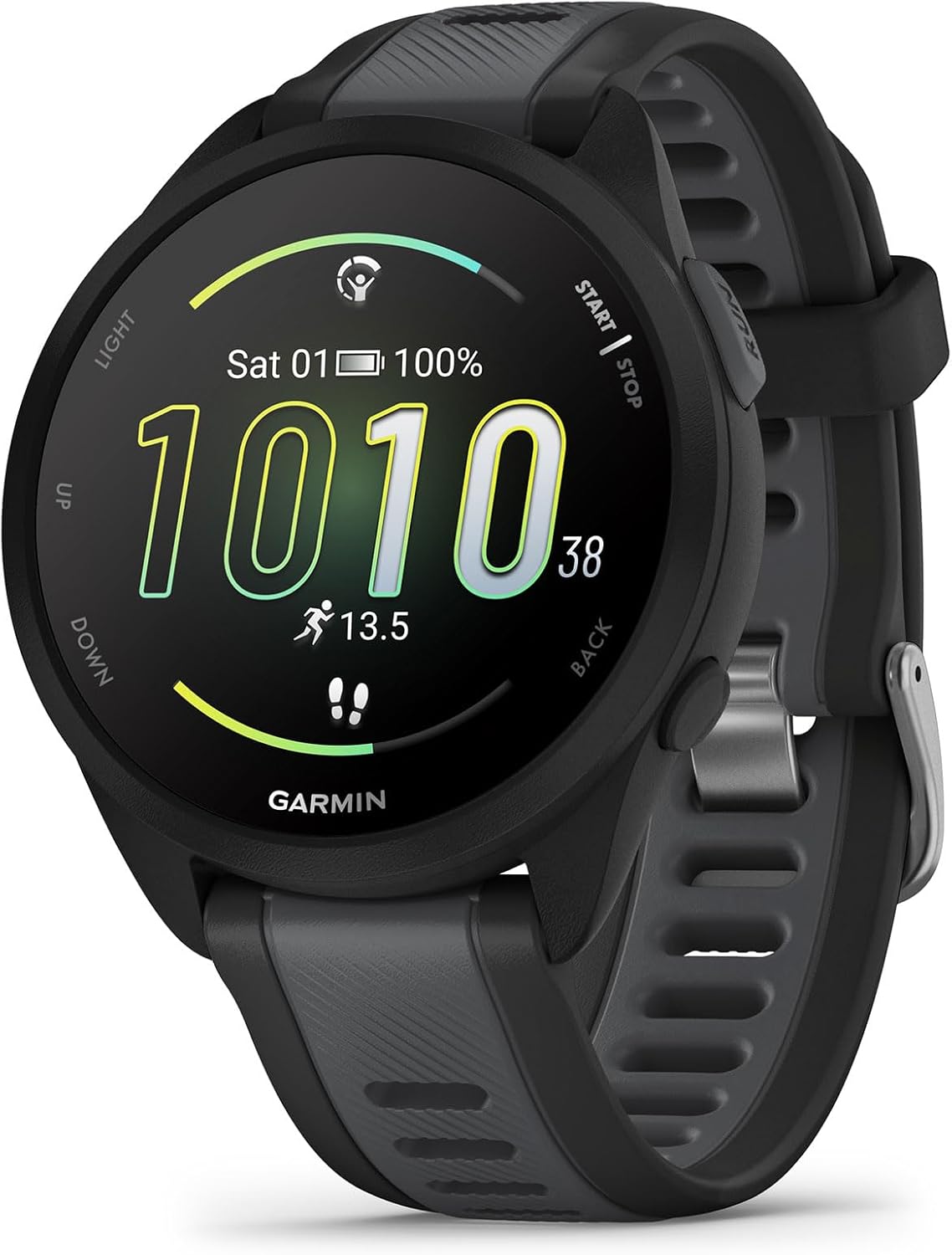
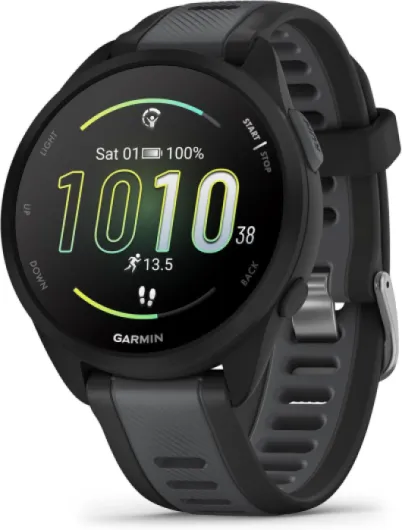
Design-wise, the Forerunner 165 is not the kind of watch people are going to compliment you on. It looks like a typical Garmin sports watch: round, plastic case, silicone band, and a pretty neutral style. I had the black version, which is fine for everyday wear, but it’s not going to pass as a fancy watch with a dress shirt. If you want something that looks more like jewelry, this isn’t it.
The watch is 43 mm, which on my medium wrist sits nicely — not huge, not tiny. The big plus is how light it is. After a few minutes, you sort of forget it’s there, which is exactly what I want when I’m running or sleeping. Compared to heavy metal smartwatches, this feels like a toy in weight, but not in a bad way. During workouts, it doesn’t bounce around or dig into the skin.
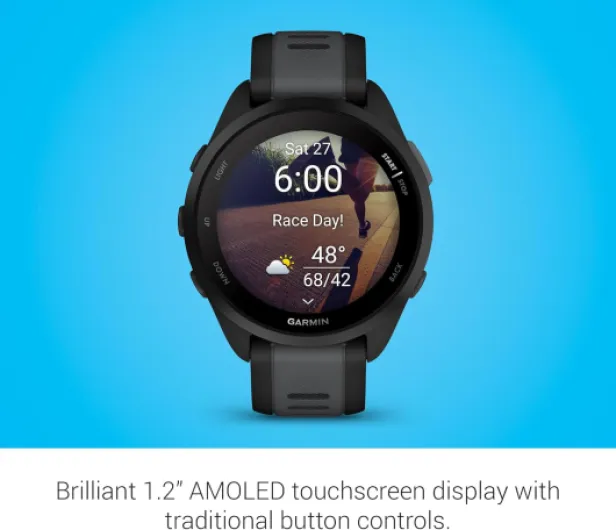
The AMOLED display is where it feels more modern. It’s bright, sharp, and easy to read in sunlight. I ran a few times at midday and could still read pace and distance without squinting. Indoors, with low brightness, it looks good and doesn’t blind you at night. There are a lot of watch faces on Connect IQ, including free ones, so you can make it look a bit more interesting. I ended up using a simple one with big numbers and heart rate, nothing fancy.
Buttons plus touchscreen is a good combo. I used the touchscreen for scrolling through widgets and swiping, and the buttons for starting/stopping activities, which is safer when you’re sweaty or running in the rain. Overall, the design is more about practicality than style: light, comfortable, and readable. If you want a visually impressive gadget on your wrist, this is more “sports tool” than fashion piece.
Battery: solid, but only if you don’t abuse all the features
Garmin advertises up to 11 days in smartwatch mode and up to 19 hours in GPS mode. In real life, what I got depended a lot on how I used it. With notifications on, always-on display off, a couple of GPS runs per week (around 45–60 minutes each), and sleep tracking active, I was getting roughly 6–8 days per charge. That’s still very good compared to many touchscreen smartwatches, but it’s not the full 11 days unless you keep things pretty minimal.
When I cranked up the use – more GPS activities, more screen-on time, checking stats all day, using weather widgets, etc. – the battery dropped faster. On one week where I ran 5 times and played with the watch a lot, I needed to charge every 3–4 days. So yes, activities and notifications do drain it more than you’d think, especially if you like seeing the screen bright and often.
On the positive side, it charges quickly. Plugging it in for about 30–40 minutes on a regular USB-C charger usually got me from low battery back to around 70–80%, which was enough for several more days of normal use or a couple of long runs. The proprietary cable is a bit annoying, but that’s standard for Garmin. At least the connector is secure and doesn’t fall out easily.
If you’re expecting to charge it once every two weeks, you’ll be disappointed. If you’re fine throwing it on the charger once a week or every few days when training hard, it’s more than acceptable. Compared to a typical full-featured smartwatch that needs daily charging, this feels much more relaxed and practical for tracking sleep and workouts consistently.
Comfort: you forget it’s there… most of the time
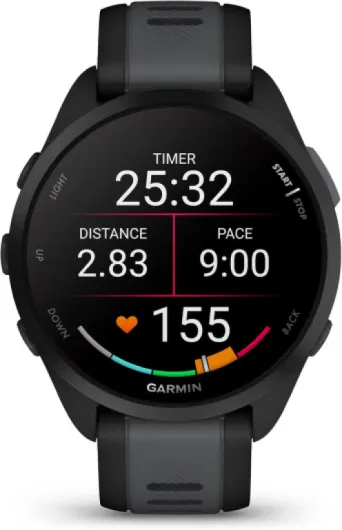
Comfort is honestly one of the main reasons I kept wearing the Forerunner 165 all day and night. The weight is very low, and the silicone band is soft enough that it doesn’t rub or dig into the wrist. I wore it for runs, desk work, showers, and sleep without taking it off for several days in a row, and I didn’t get any skin irritation or red marks, which I sometimes get with heavier metal or stiffer straps.
For running, the watch stays put without needing to tighten it to a painful level. That’s important for heart rate accuracy too. If you wear it too loose, the readings jump around. With a medium snug fit, I got stable readings and no discomfort. One thing to note: if you have a very large wrist, the standard band might be just on the edge of too short. You can swap the band easily, though, and there are tons of cheap third-party options.
Sleeping with it is fine. It’s light enough that it doesn’t feel like a brick on your arm, which made sleep tracking way more realistic for me. With some other smartwatches, I end up taking them off at night because they’re annoying. With this one, I only noticed it when I rolled over and the watch pressed between my wrist and the mattress, but that was rare.
One small annoyance: the touchscreen can sometimes react to bedsheets or clothes, which can change screens or start random things if you don’t use the screen lock. Once I turned on the lock option, that problem basically went away. So overall, comfort is a strong point: it’s a watch you can wear 24/7 without feeling like you’ve strapped a phone to your arm.
Durability: tough body, but protect the screen
Build-wise, the Forerunner 165 feels like a typical Garmin sports device: plastic body, but not flimsy. I bumped it into door frames, gym equipment, and countertops a few times, and the case itself didn’t show anything more than tiny marks you have to look closely to see. It’s clearly designed to handle sweat, rain, and regular daily abuse without falling apart.
The weak point, like many watches, is the glass. After some use, micro-scratches can show up if you’re not careful. It’s not super fragile, but it’s also not bulletproof. I’ve seen a couple of people mention that it scratches easier than they’d like, and I can believe that based on how similar Garmin screens behave. If you’re clumsy like me, I’d strongly recommend putting a cheap screen protector on from day one. It doesn’t ruin the look and saves you the headache later.
The band and buckle held up well during sweat-heavy workouts and showers. The silicone doesn’t feel like it’s going to tear anytime soon, and the quick-release pins make it easy to swap bands if something happens. The watch is water-resistant enough for running in heavy rain and showering; I didn’t baby it and had zero issues with moisture or fogging under the screen.
Long term, I don’t see this watch falling apart quickly unless you really abuse it. The plastic housing is more forgiving than metal when you hit it on something, and the electronics seem stable — no weird reboots or freezes. Just don’t expect the screen to stay flawless if you wear it daily without protection. It’s durable enough for regular training, but not indestructible.
Performance: GPS, metrics, and training tools in actual use
On the performance side, the Forerunner 165 does what it promises: it tracks runs and workouts reliably and gives you useful feedback. GPS lock is pretty quick in my experience, usually within a few seconds in open areas and slightly longer in dense city streets, but nothing crazy. Distances matched what I got from Strava on my phone and from friends’ watches within a tiny margin, so no obvious nonsense there.
Heart rate tracking on the wrist is decent. During steady runs and walks, it lines up well with how I feel and what I’ve seen on chest straps before. During intervals or very sudden changes, it lags a bit, which is normal for wrist sensors. For most recreational runners, it’s good enough. If you’re very picky, you can pair a chest strap anyway. The watch supports that via Bluetooth.
The training tools are where it’s clearly ahead of basic trackers. Training effect tells you if a workout was more aerobic or anaerobic, and you get a recovery time estimate afterward. Sometimes, the recovery suggestions are a bit exaggerated. I had a light run and then did some gardening, and it decided I needed way more recovery than felt logical. So treat those numbers as guidelines, not strict rules. Still, they’re helpful for not overdoing it day after day.
Daily suggested workouts and race plans via Garmin Coach are handy if you don’t like planning your own sessions. The watch adapts based on how you handle previous workouts. It’s not magical, but it’s better than just going out and randomly running the same loop every time. In short, performance is solid: accurate enough tracking, useful training insights, and no big bugs or freezes so far.
What the Forerunner 165 actually offers in real life
On paper, the Forerunner 165 is an “entry-level” running watch with GPS, heart rate, AMOLED screen, training metrics, and recovery insights. In practice, what that means is: you get proper GPS tracking for runs and rides, continuous heart rate, sleep tracking, and a bunch of training tools that go beyond “you walked 8,000 steps, congrats.” The watch gives you daily suggested workouts, training effect (how hard that workout hit you), and recovery time estimates after each session.
The watch has 25+ activity profiles: running (indoor/outdoor), cycling, HIIT, strength, walking, and a bunch of others. I mostly used running, walking, and strength. For running, you get pace, distance, cadence, heart rate zones, and basic intervals. For strength, it counts sets and reps decently, but it’s not as smart as a dedicated gym tracker — you still need to adjust things a bit in the app afterward if you’re picky.
Connected features are pretty standard: notifications from your phone (calls, texts, apps), Garmin Pay if your bank supports it, and syncing with Strava and MyFitnessPal through Garmin Connect. I linked it to Strava and everything pushed across automatically after each run, no drama. The Garmin Connect app is packed with stats: HRV, sleep stages, training readiness style info, and graphs for pretty much everything. It’s helpful if you like numbers, but it can feel like overkill at first.
Overall, the feature set feels very focused on people who actually train. If you want a watch mainly for music control, big app stores, or replying to messages from your wrist, there are better options. If your priority is “track my workouts properly and give me some guidance,” then the Forerunner 165 has more than enough tools without turning into a toy full of gimmicks.
Pros
- Lightweight and comfortable enough for 24/7 wear, including sleep
- Accurate GPS and solid training tools (daily workouts, training effect, recovery)
- Good battery life for a bright AMOLED watch, plus fast charging
Cons
- Screen is prone to scratches without a protector
- Recovery time and some health suggestions can feel exaggerated or off at times
- Design is pretty basic and more sporty than stylish
Conclusion
Editor's rating
The Garmin Forerunner 165 is a solid choice if your main goal is to train smarter without turning your wrist into a mini smartphone. It gives you accurate GPS, decent heart rate tracking, daily suggested workouts, and recovery insights in a light, comfortable watch that you can wear all day and night. The AMOLED screen is easy to read outdoors, the battery life is good enough for most people, and the Garmin Connect ecosystem gives you way more data and history than cheap trackers.
It’s not perfect: the glass can scratch, the recovery estimates can be a bit dramatic, and the battery life drops faster if you hammer GPS and notifications. It also doesn’t try to be a full-featured smartwatch, so if you want advanced apps, heavy media control, or fancy styling, you might feel limited. But for everyday runners, hikers, and people who just want reliable health and activity tracking without paying top-tier prices, it’s a very reasonable package that gets the job done with minimal fuss.